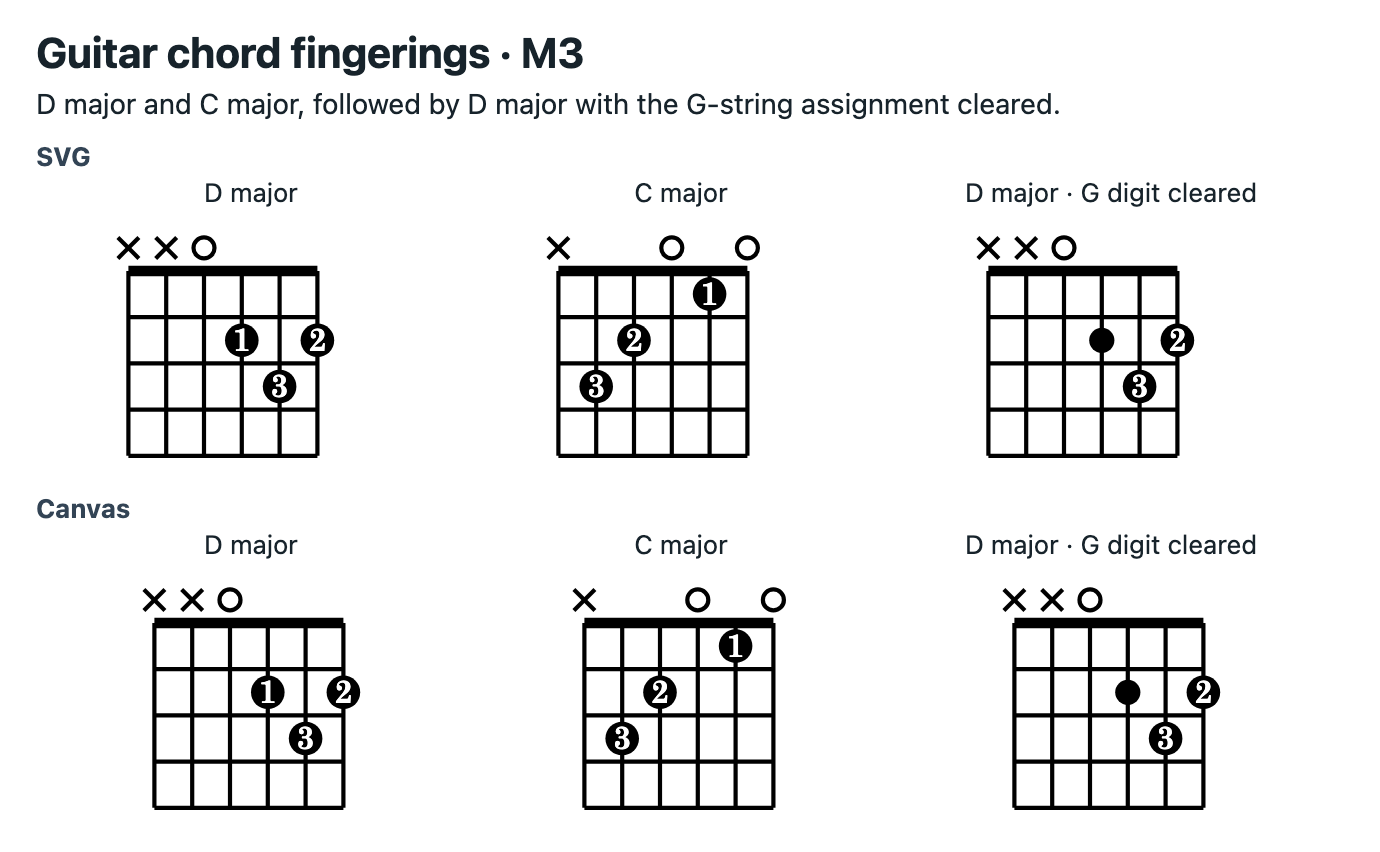
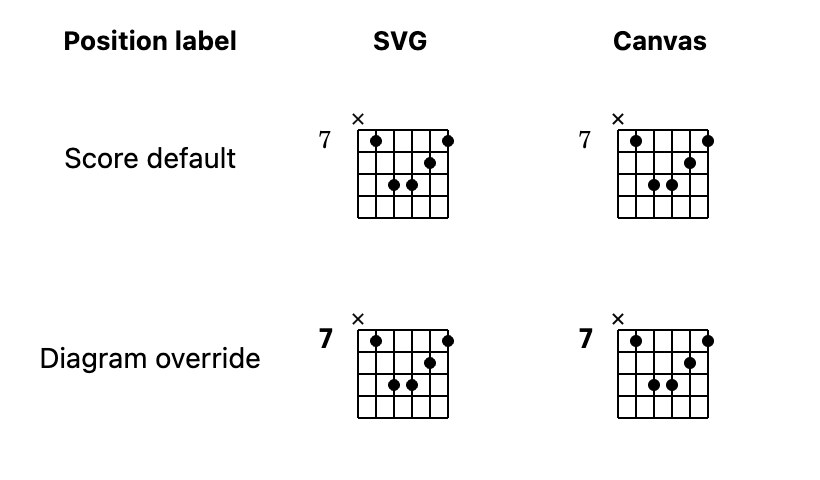
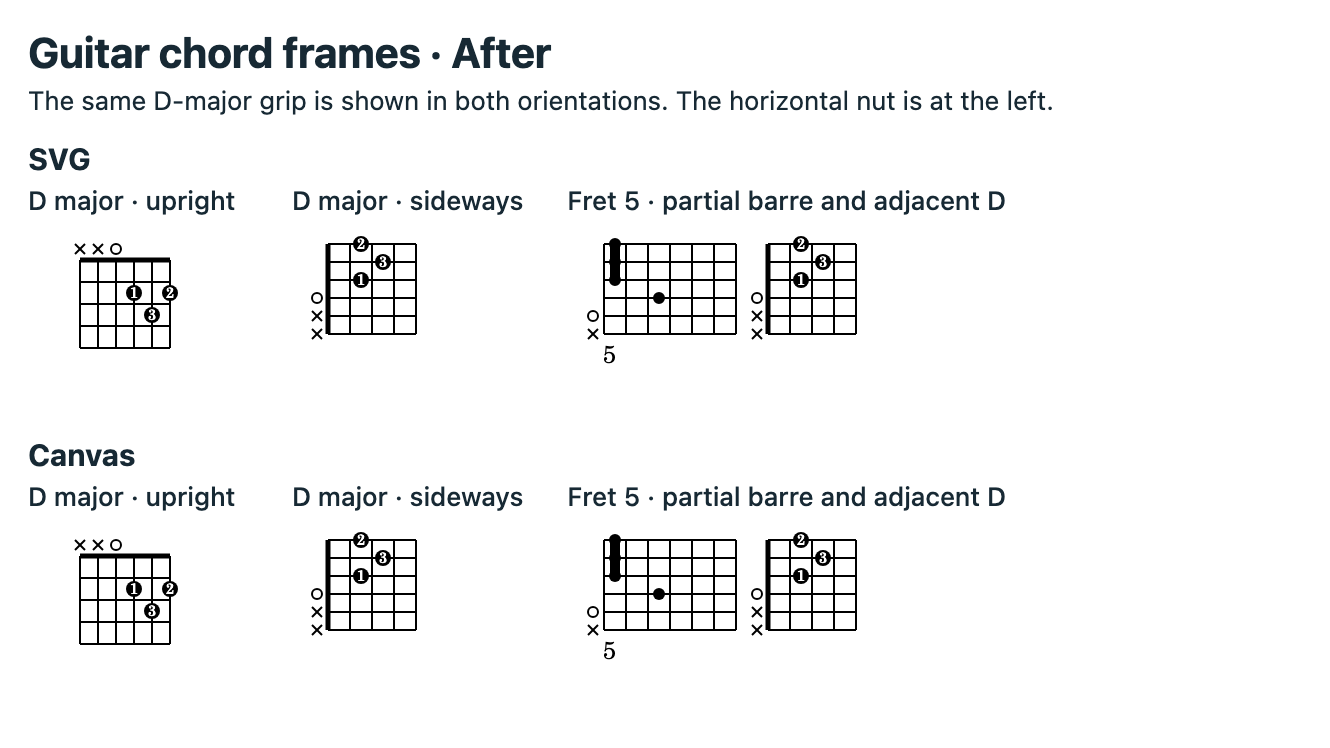
The same D grip turns sideways with high E on top. The open circle and two mutes sit to the left of the nut. The second grip shows the upright fifth-fret label and partial barre.
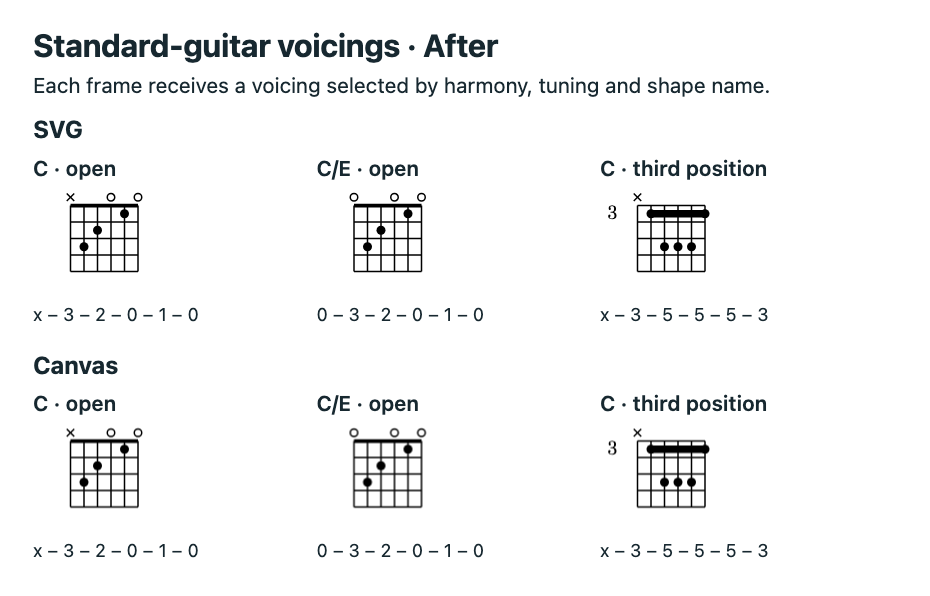
The open C voicing mutes low E. The open C/E voicing sounds it. Their bass notes and every sounded pitch were checked against standard guitar tuning. A second C voicing can be selected by name.
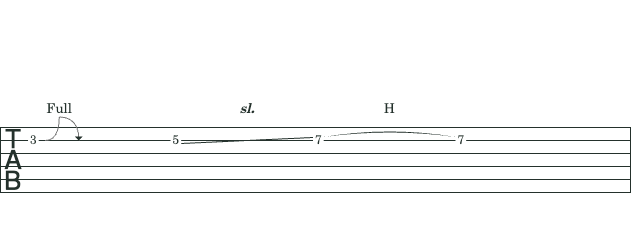
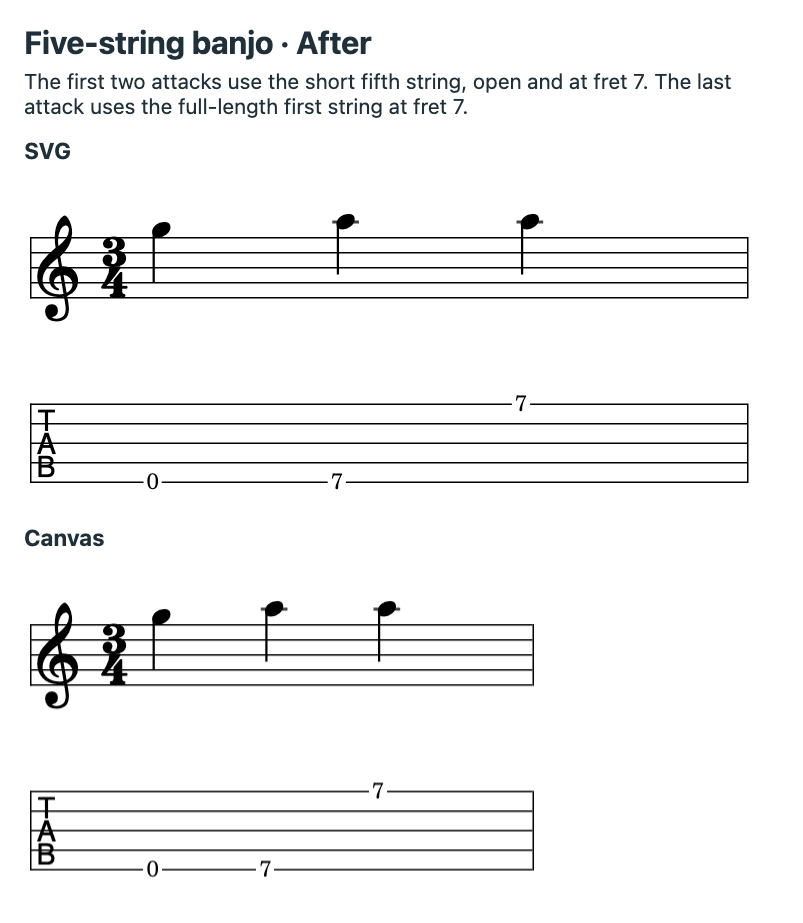
The fifth-string TAB still reads 0 and 7. The paired staff now shows G and A, two semitones apart. Fret 7 on the full-length first string still raises its open D by seven semitones.
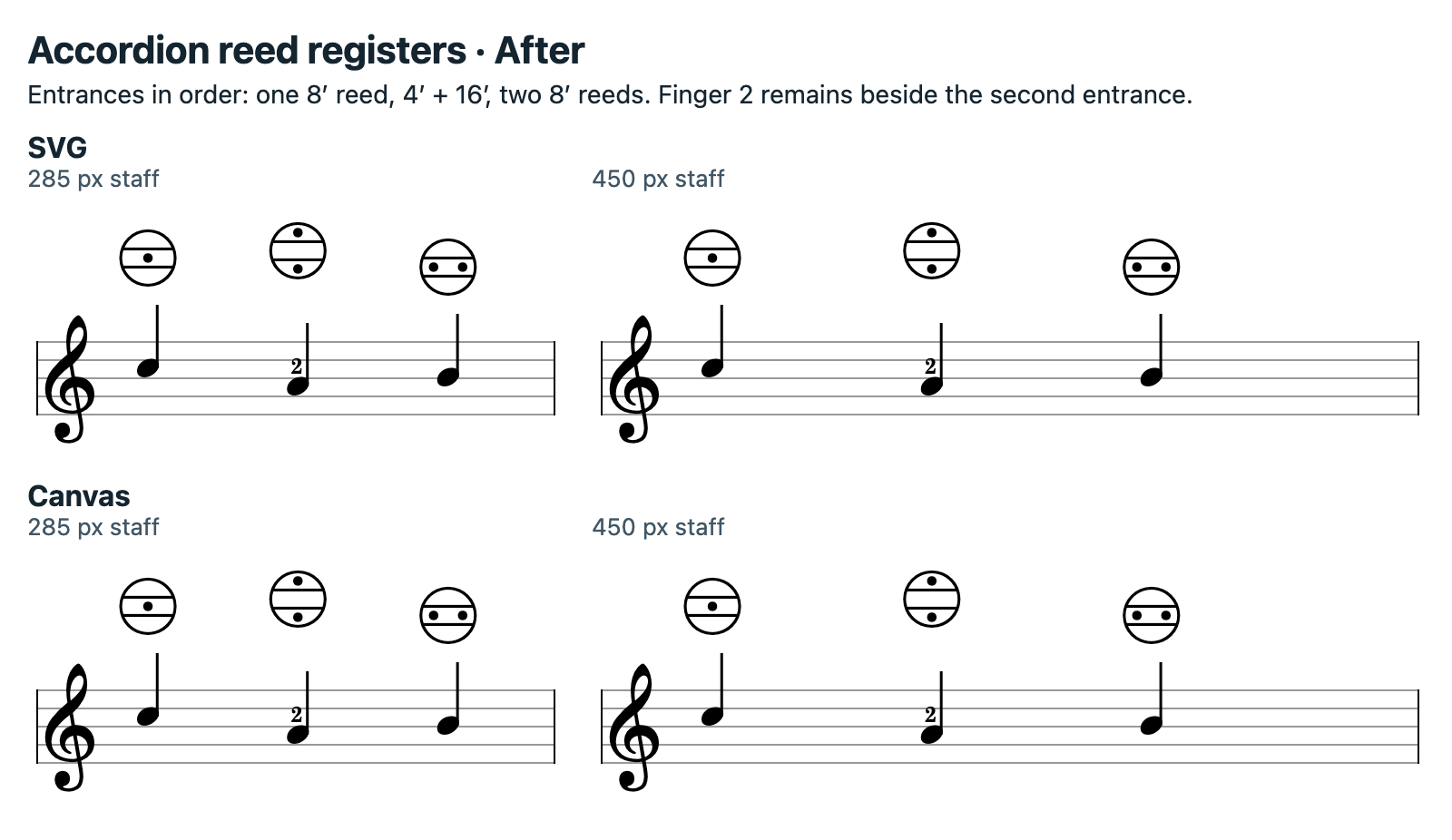
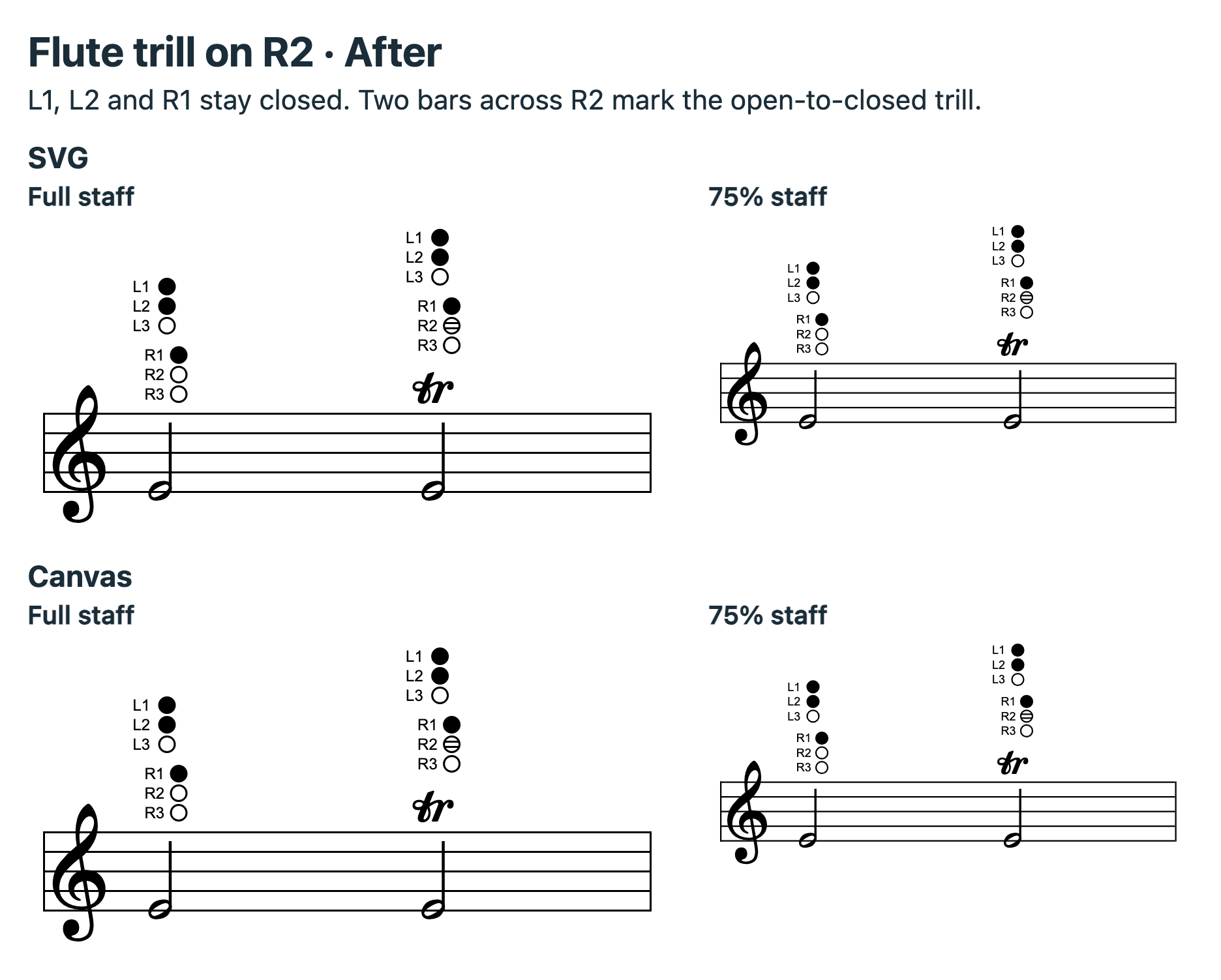
Compare the single middle reed, the high and low reeds together, and the double middle reeds. Each register stays with its entrance when note spacing changes.
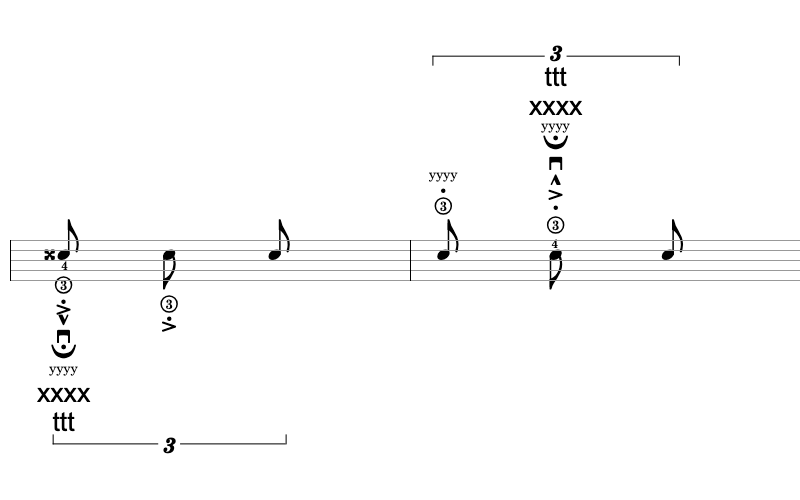
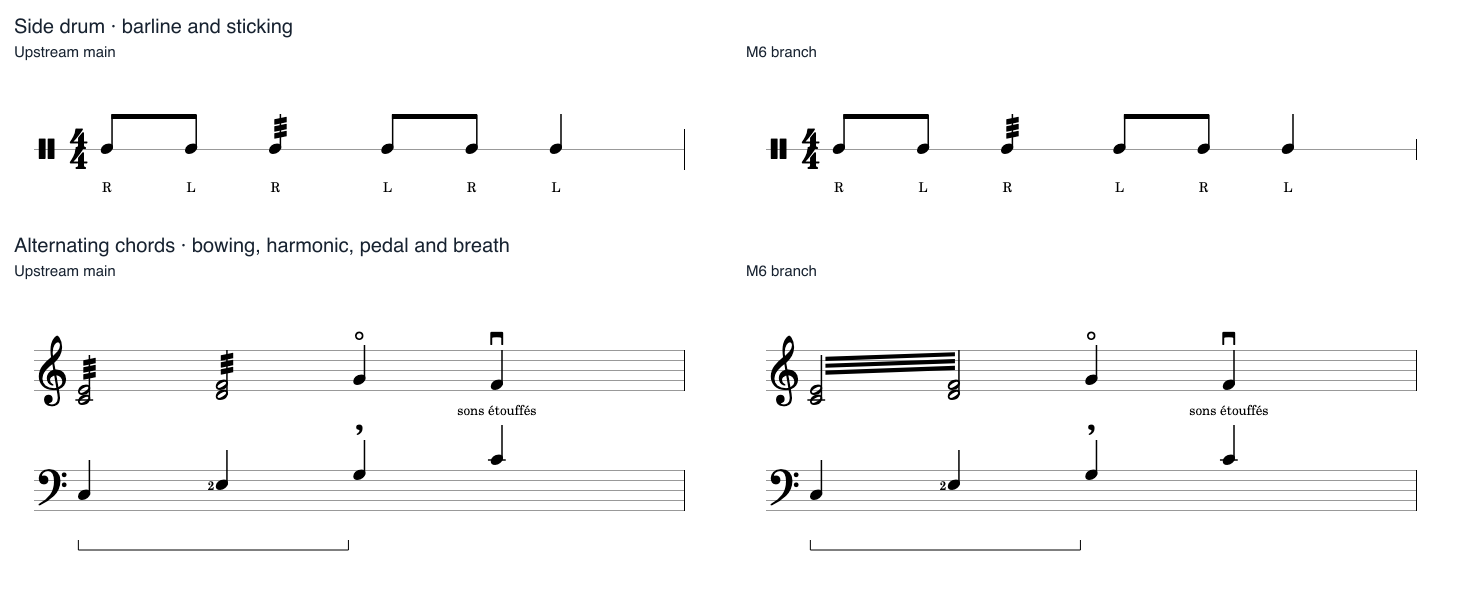
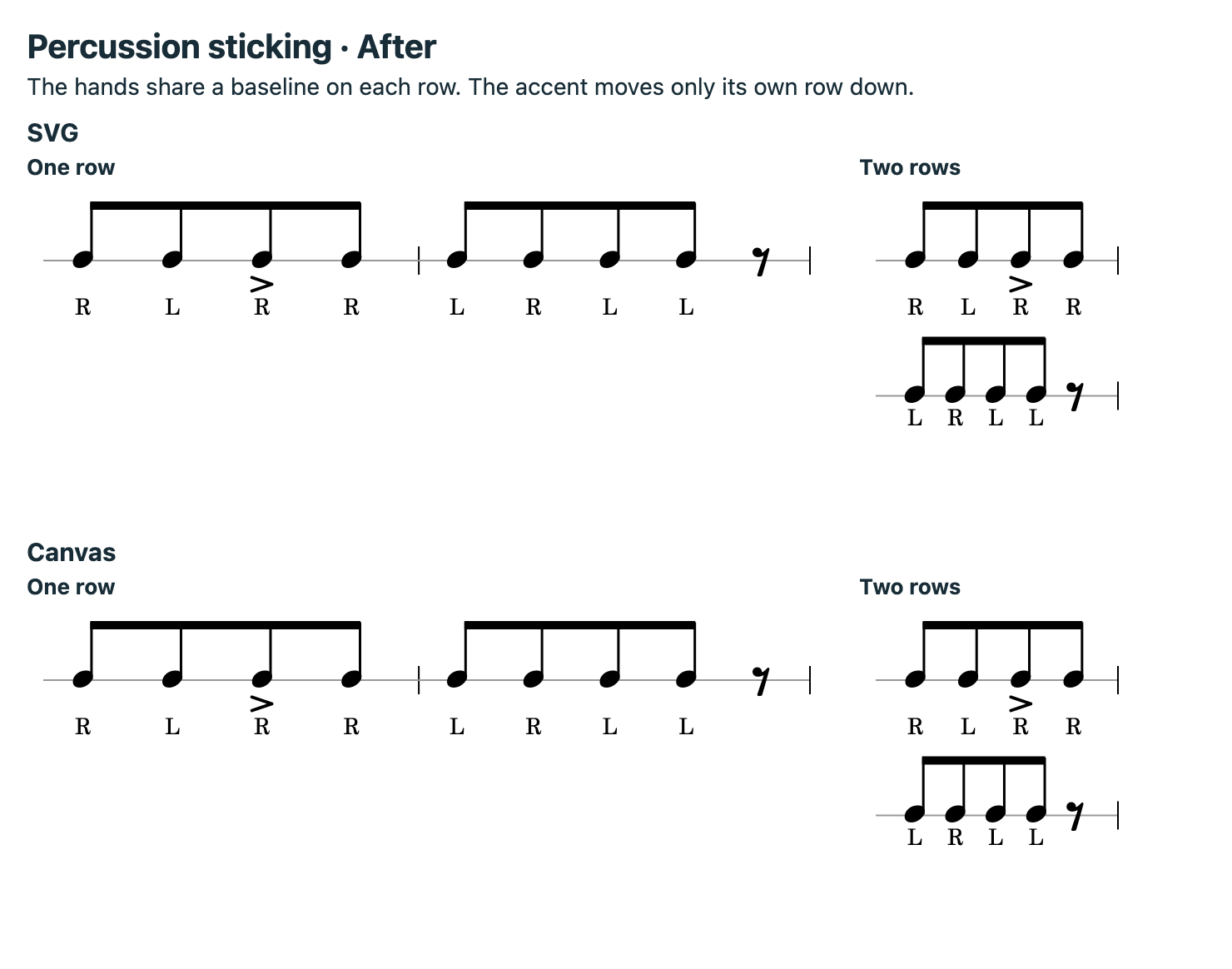
Follow R L R R, then L R L L. The letters share a baseline on each system, clear the below-staff accent, and stay centered on their attacks through a line break.
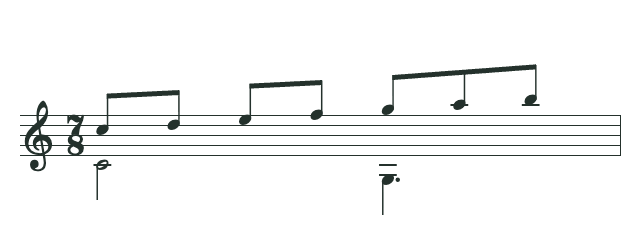
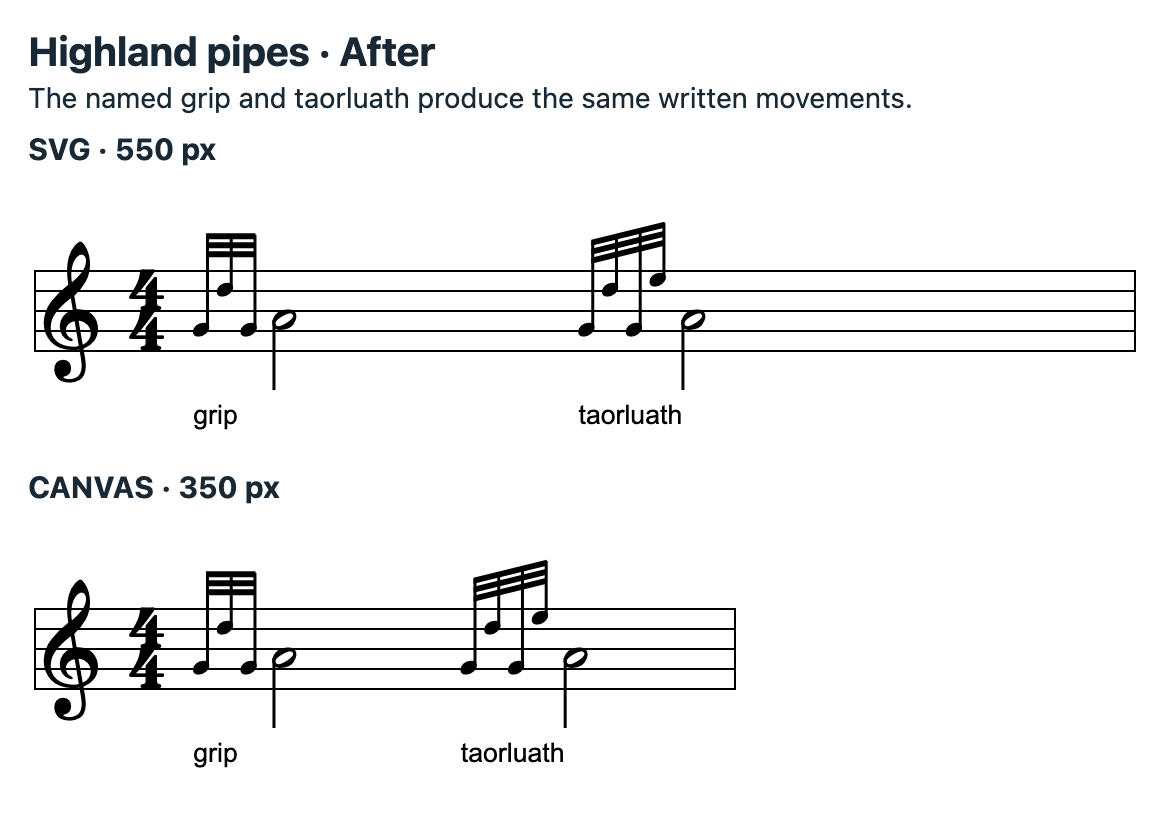
Both examples land on low A. The grip plays low G, D, low G. The taorluath adds E. The earlier example enters each pitch by hand. The named forms produce the same engraving.
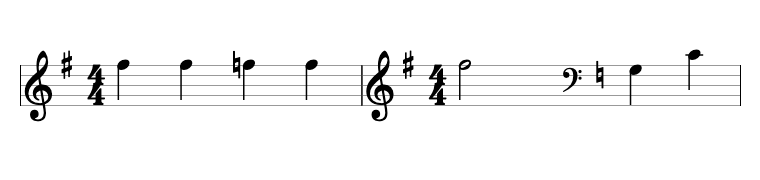
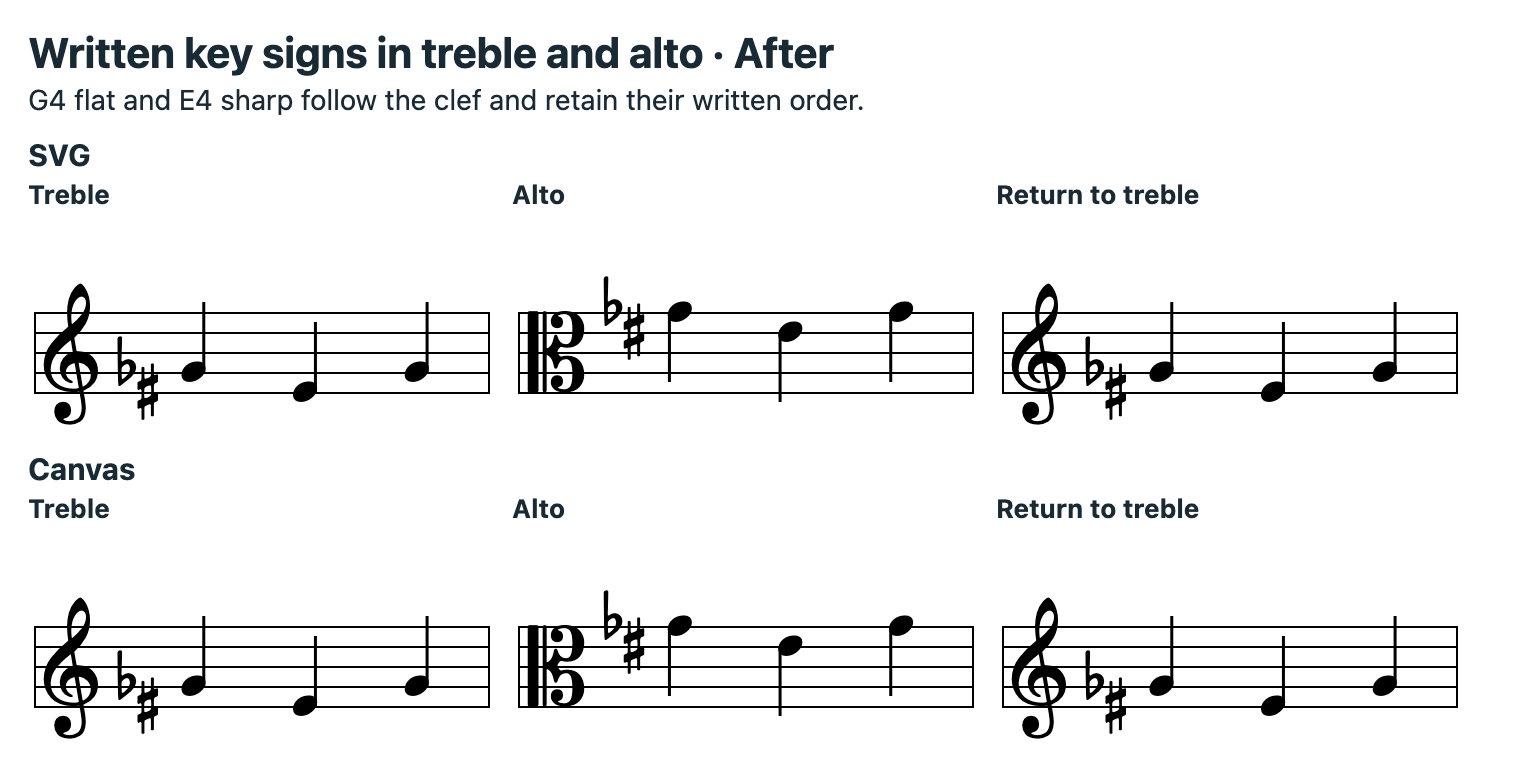
The same G4 flat and E4 sharp are placed in treble and alto. The signs keep their input order when the clef changes and return to their original positions in treble.
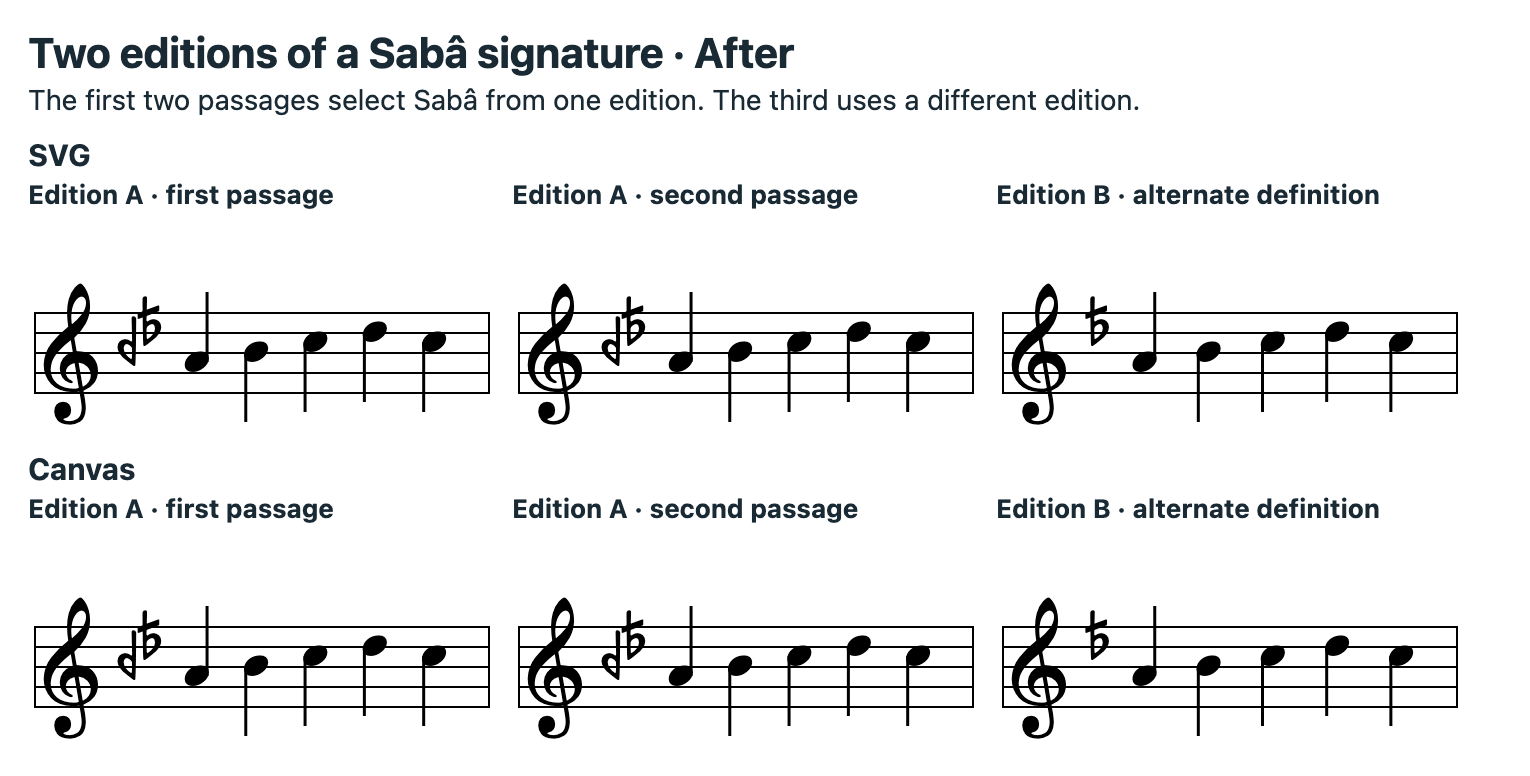
Two passages select Sabâ by name. The edition supplies a koma flat on B and a bakiye flat on D. Selecting another edition uses that edition’s written signs.
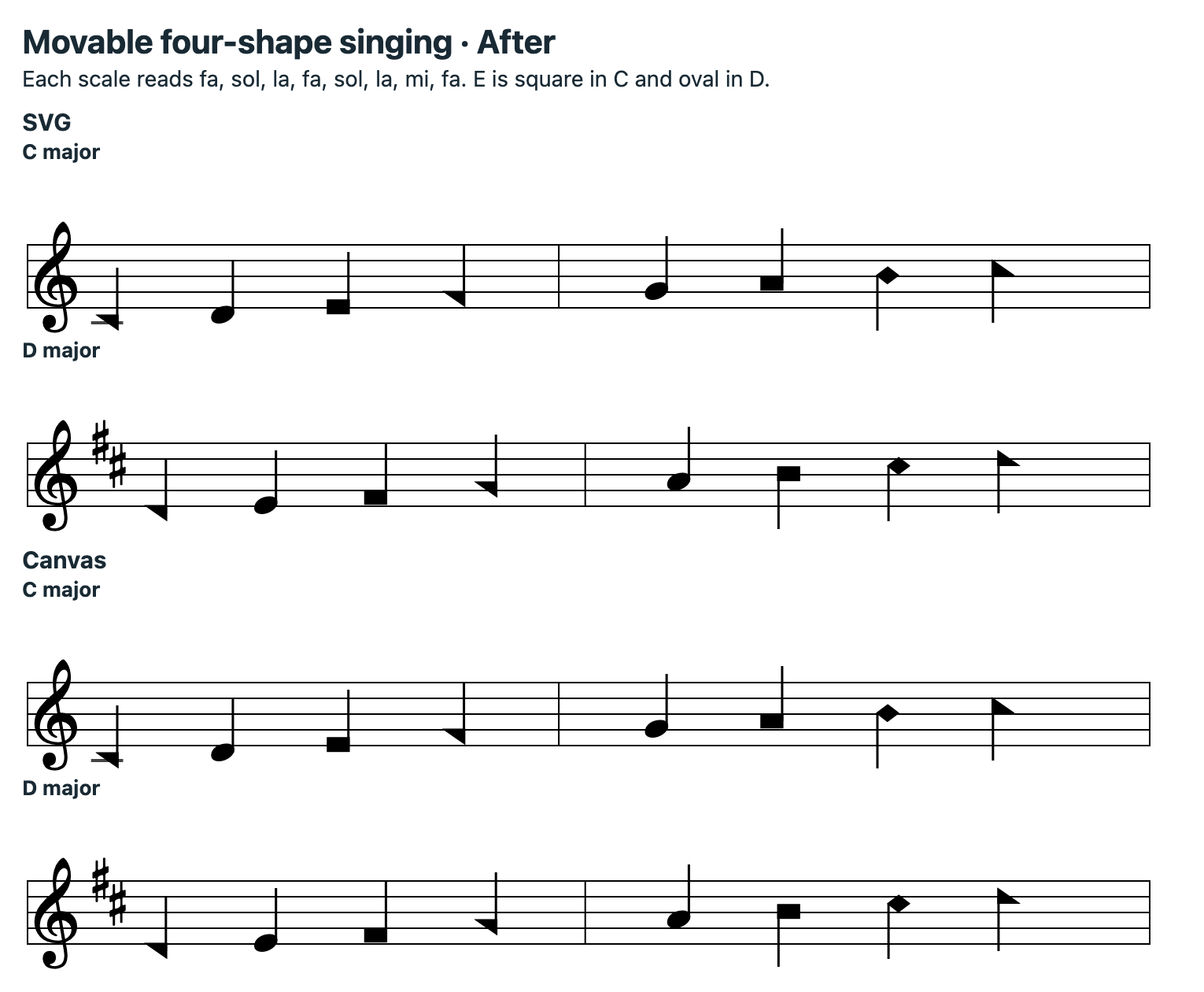
The C-major and D-major scales share the same degree sequence. Written E takes a square in C and an oval in D. The written pitches, quarter-note durations and key signatures are preserved.
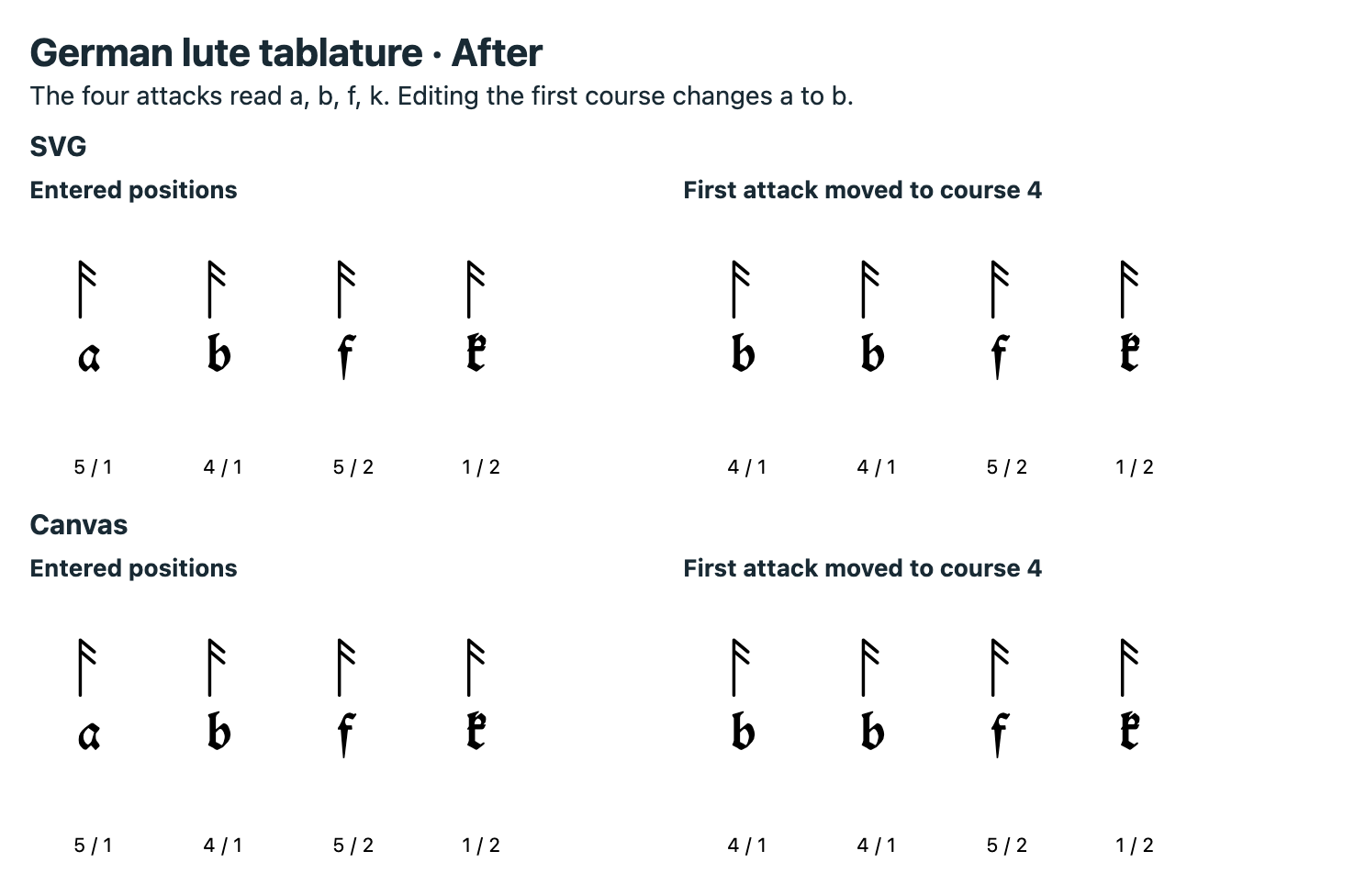
The four attacks read a, b, f, k on a staffless row. Changing the first attack from course 5 to course 4 changes a to b and preserves the rhythm and spacing.
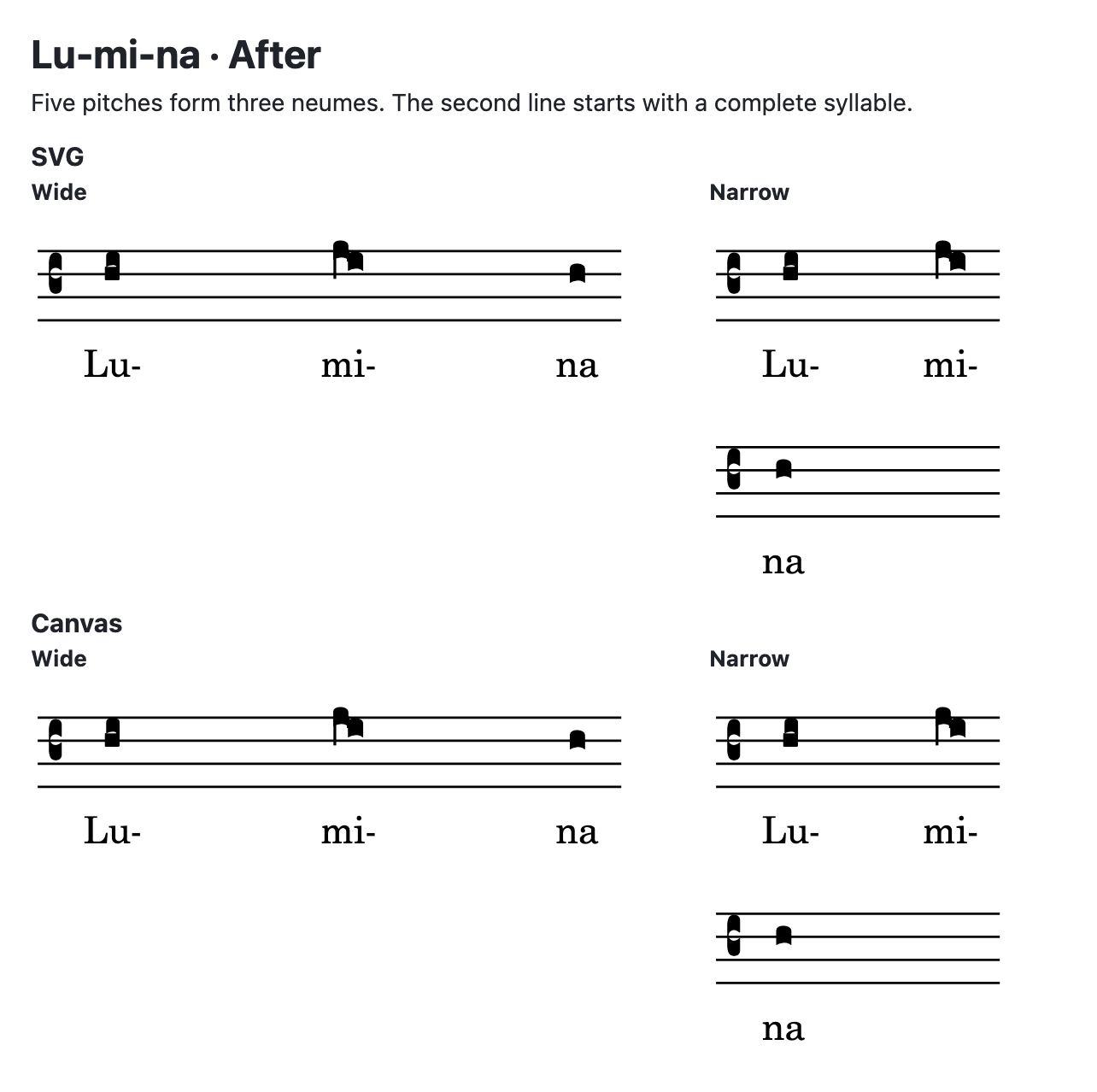
Lu-mi-na sets five pitches under three syllables. C–D rises as a podatus, E–D falls as a clivis and the final C is a punctum. The narrow example breaks before the last syllable.
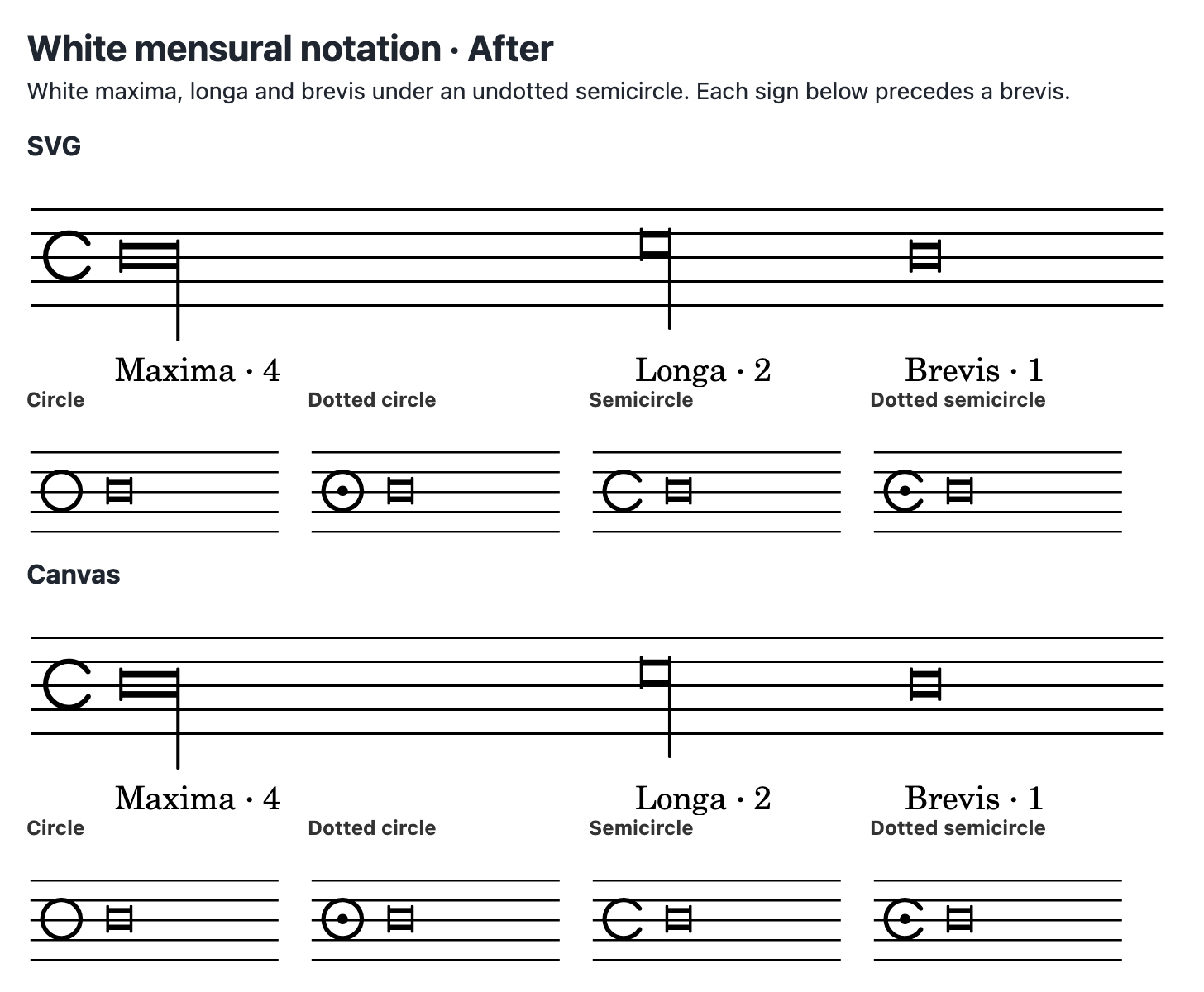
The maxima, longa and brevis retain the exercise’s four, two and one breve units. The sign row shows a circle and semicircle, each with and without a dot.
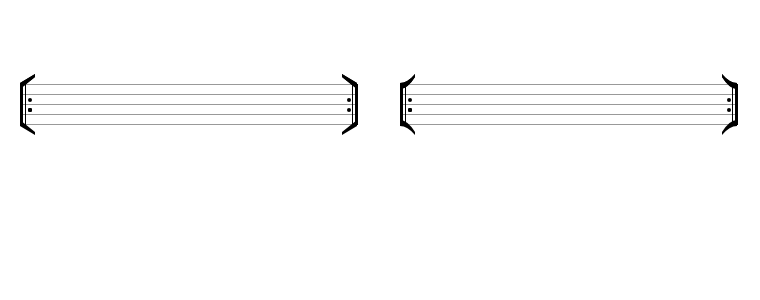
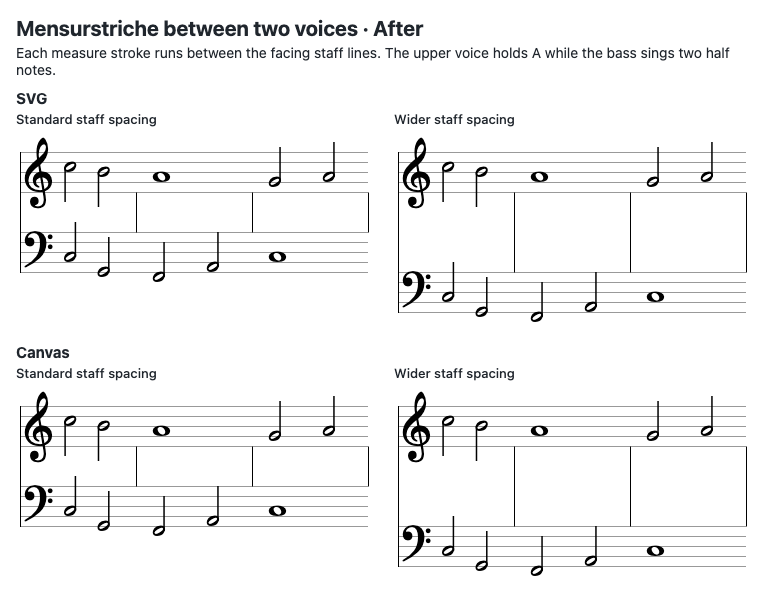
The two internal measure boundaries run between the facing staff lines. Increasing the staff spacing lengthens both strokes. The held upper A and the two bass attacks keep their timing.
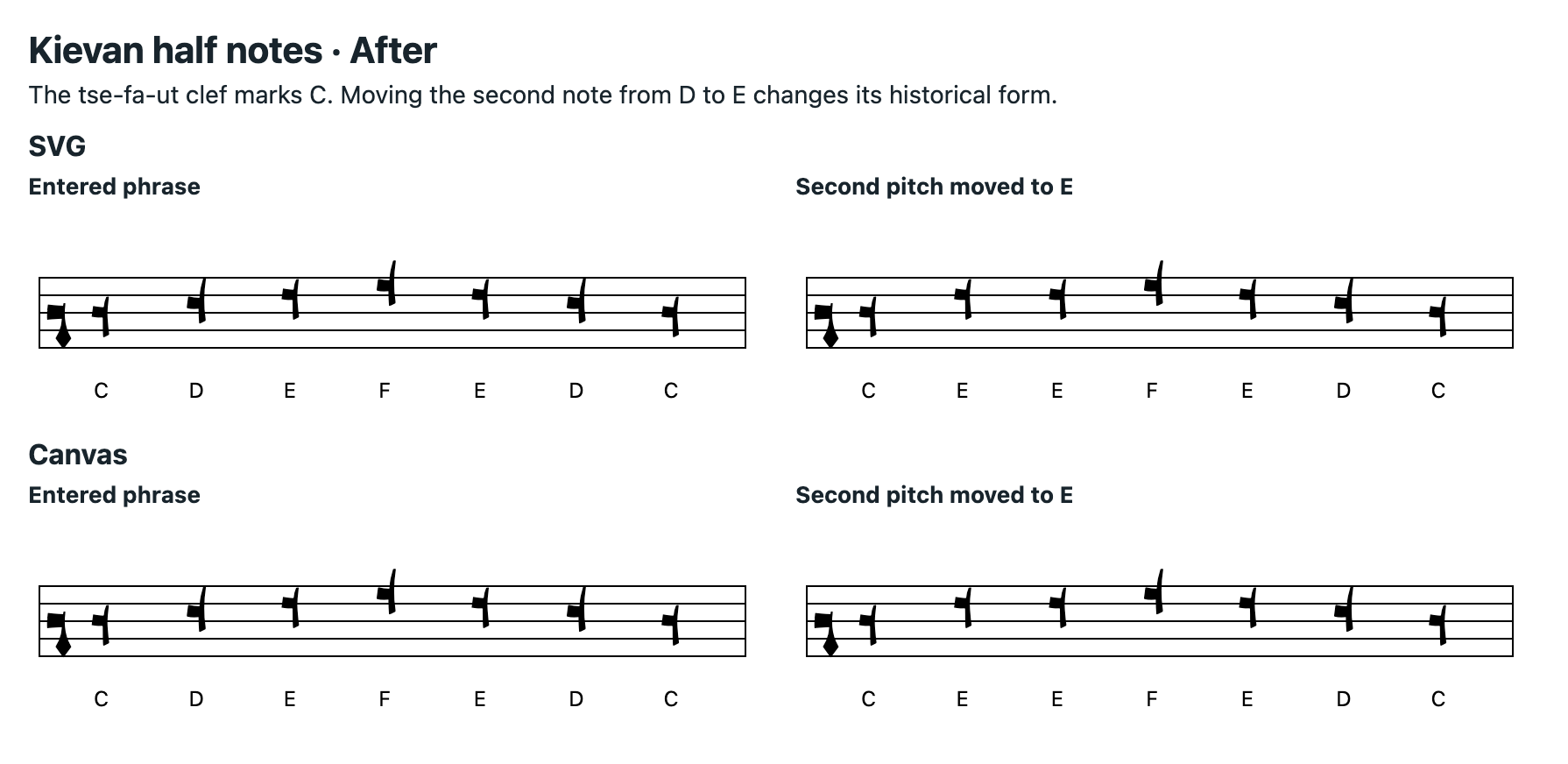
The seven half notes use the Kievan line and space forms. Moving the second pitch from D to E replaces its space form with the line form and preserves the half-note duration.
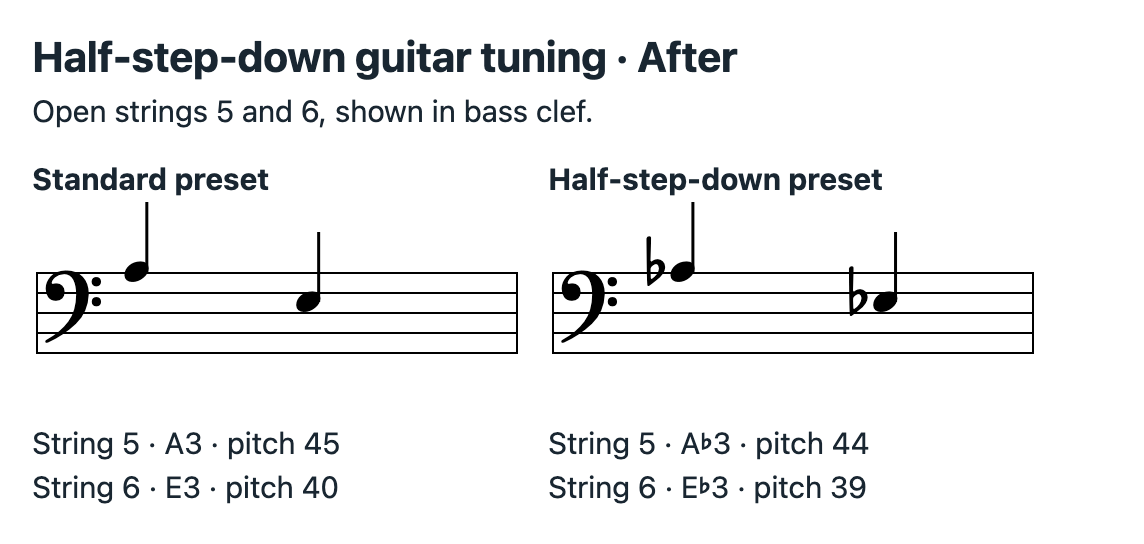
The sixth open string now reads E♭3, one semitone below standard E3. The regression test caught the previous pitch (37) on string 6 and now passes on all six strings, including the corrected pitch (39).
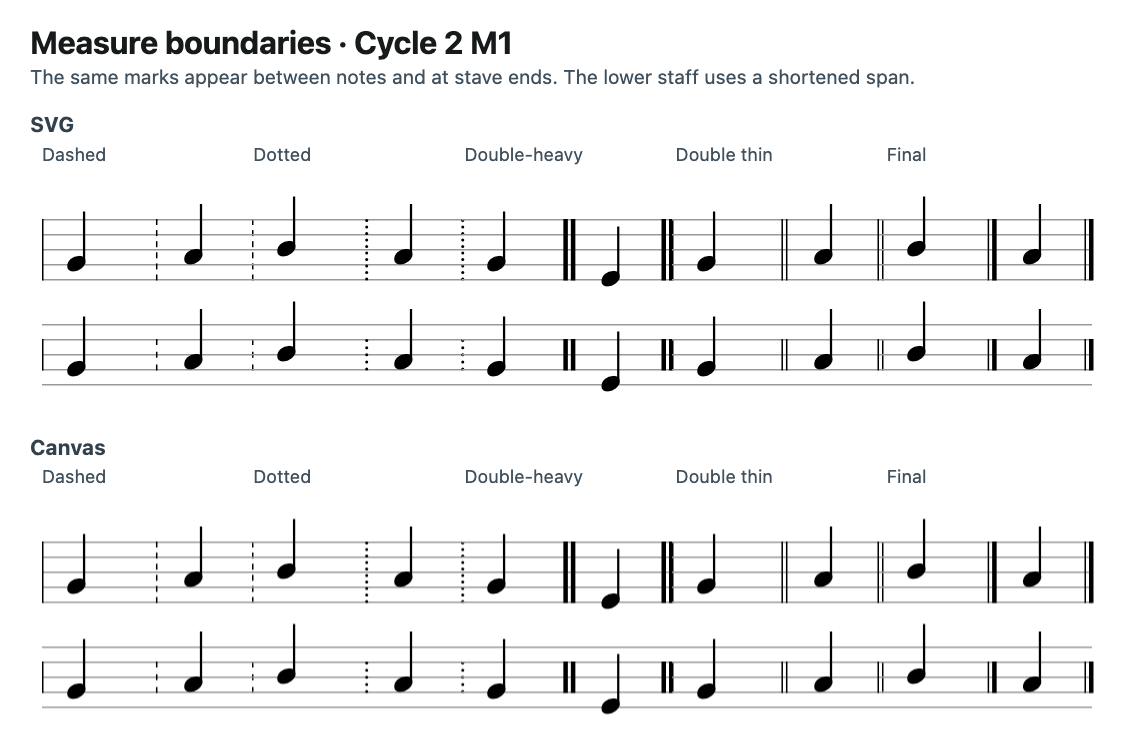
Dashed, dotted and double-heavy bars now work at stave ends and inside a voice. The upper row shows the full span. The lower row shows the shortened span. Compare the last two columns with the unchanged double-thin and final bars. The 5.7.0 panel uses single bars for the three previously unavailable styles.
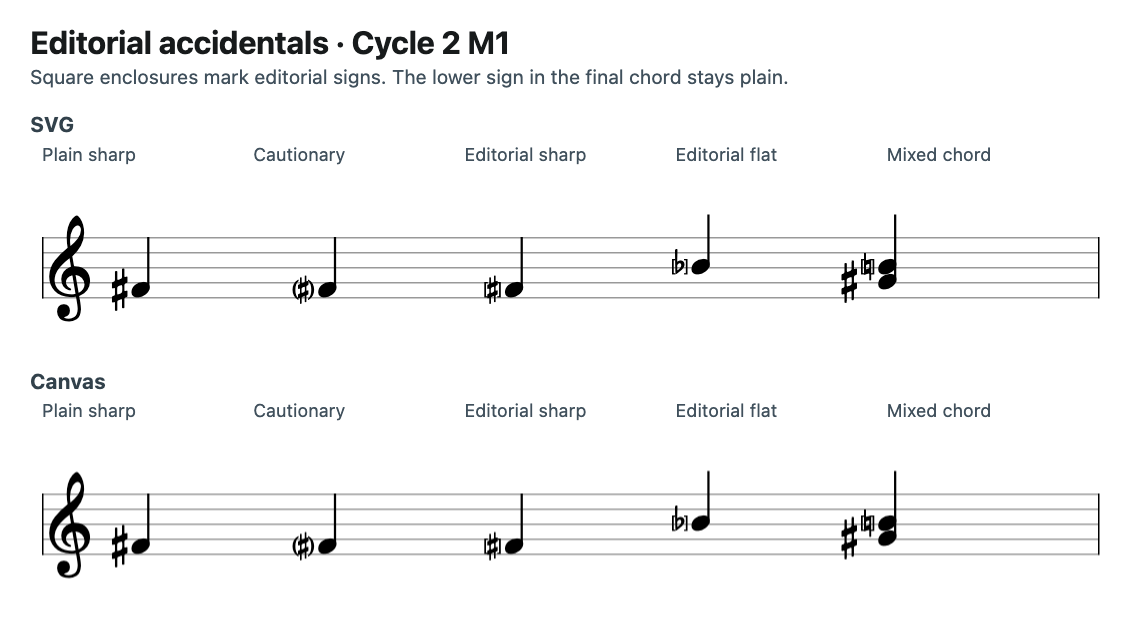
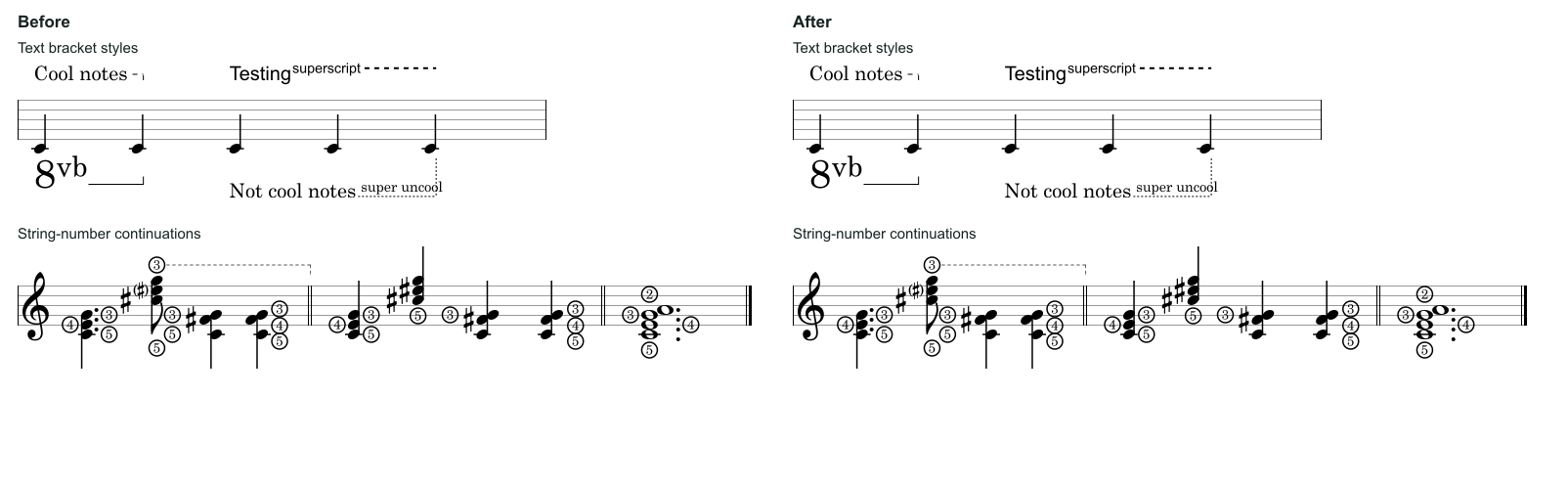
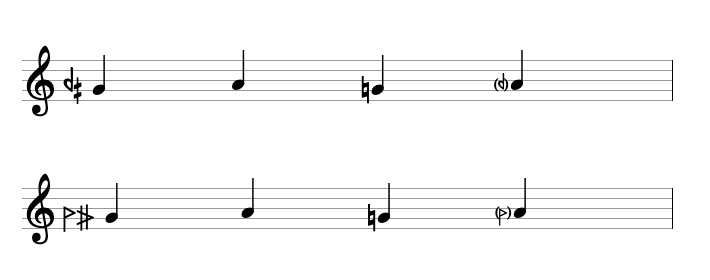
Use setAsCautionary('brackets') for an editorial sign. The no-argument call still uses round parentheses. In the final chord, the plain G♯ and bracketed B♮ clear each other and their noteheads without offsets.
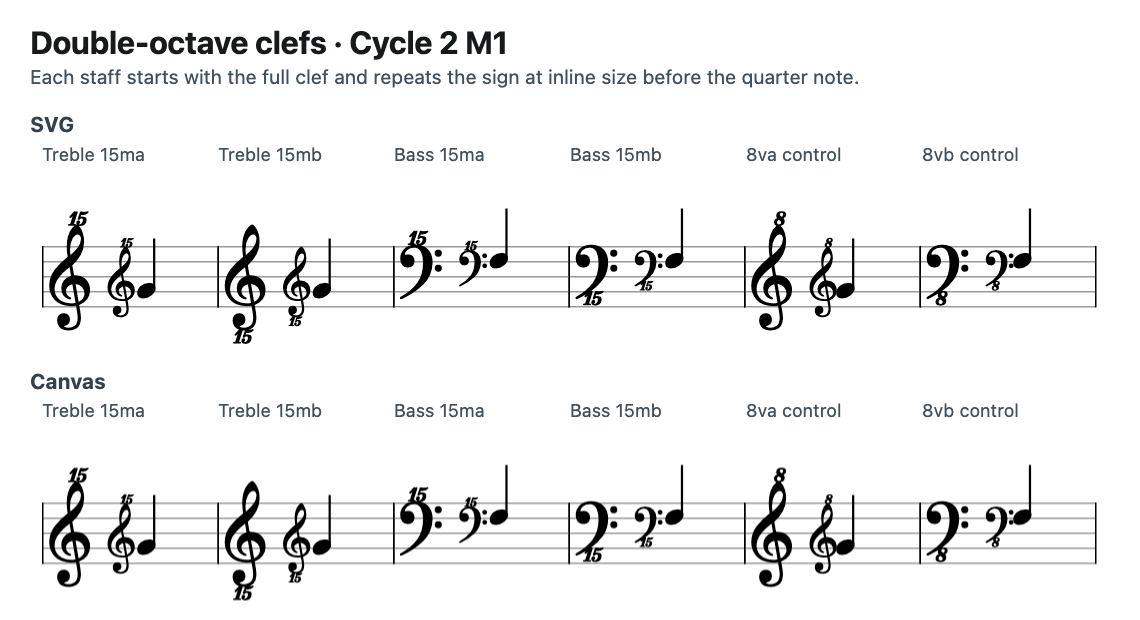
Treble and bass clefs now accept 15ma and 15mb at stave and inline sizes. Follow each small clef to its quarter note. The last two columns show the existing single-octave controls. The measured bounds include the full numeral in all three browsers.
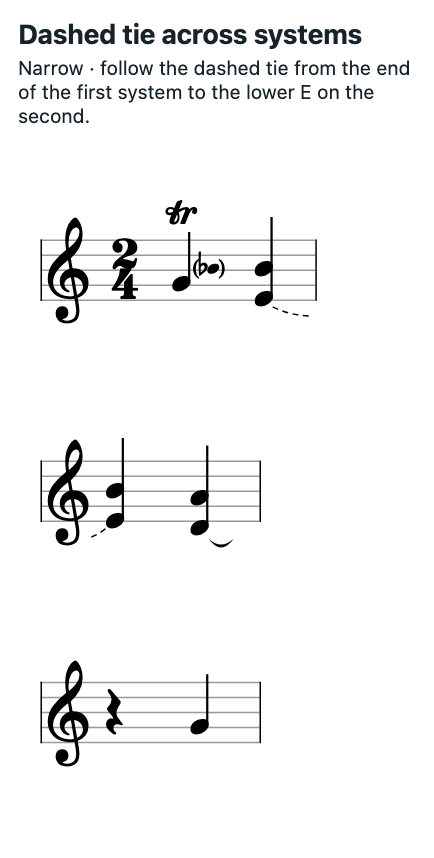
StaveTie.setStyle({ lineDash: '4 3' }) now draws an open dashed arc. The lower E is tied and the upper B is struck twice. The solid G tie is the control. A continuous tie with dashed: true carries the pattern and selected pitches through a system break.
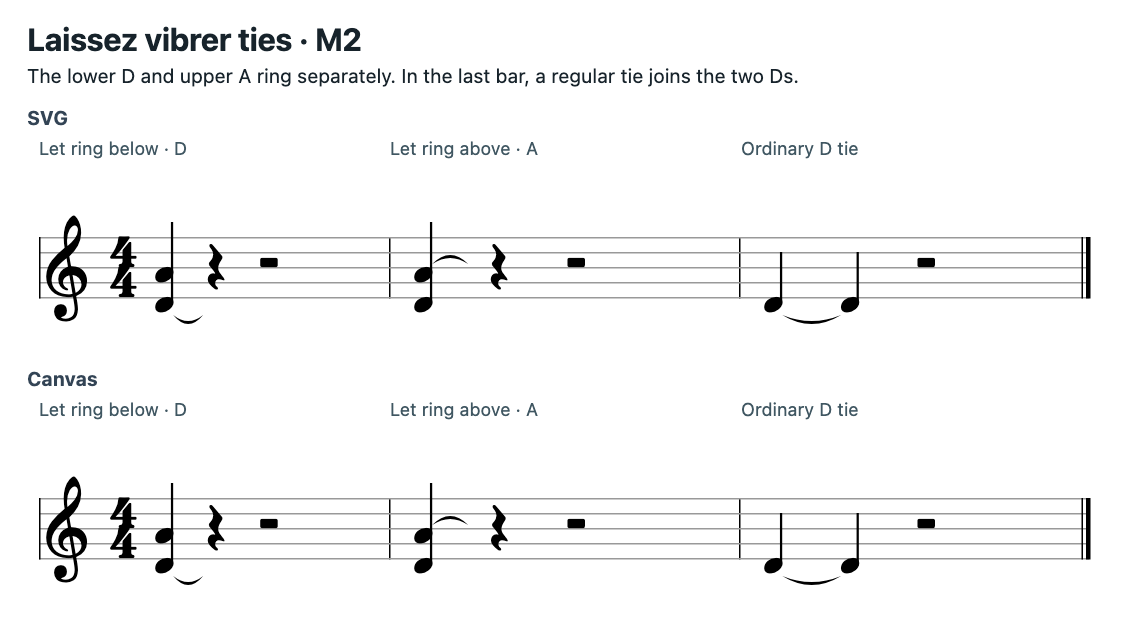
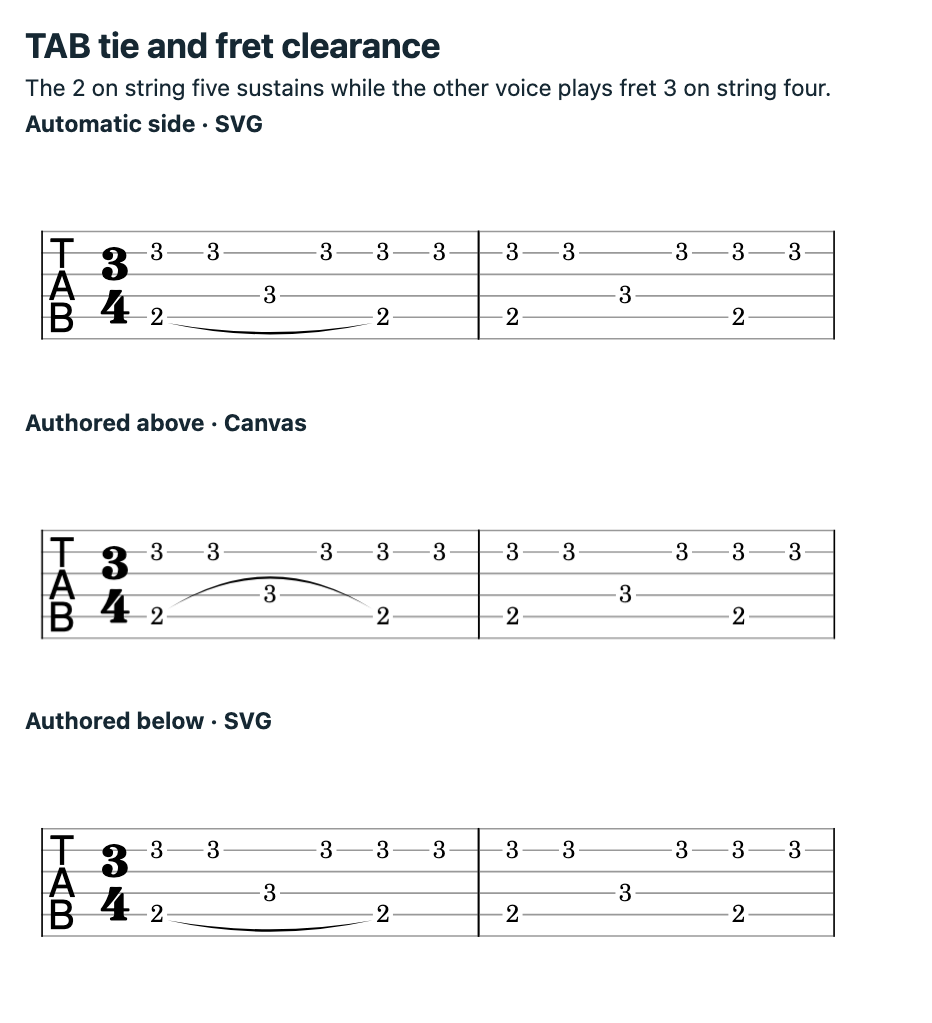
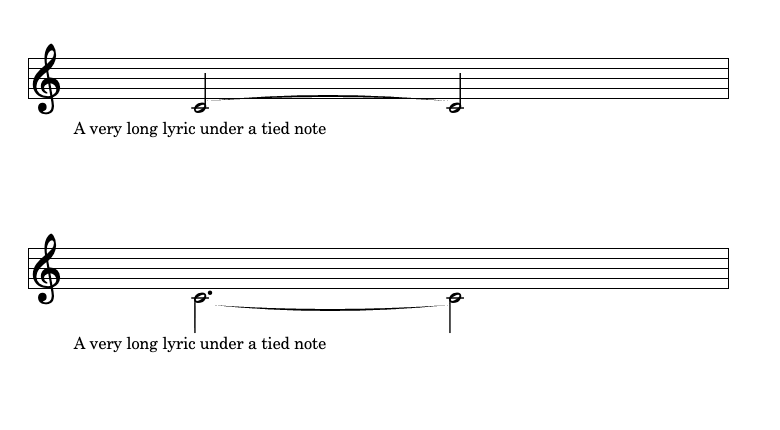
A let-ring tie can now leave one selected head above or below the chord. The reach is measured from that head in pixels. The quarter rest still starts on beat two. The regular D tie in the last bar is the control.
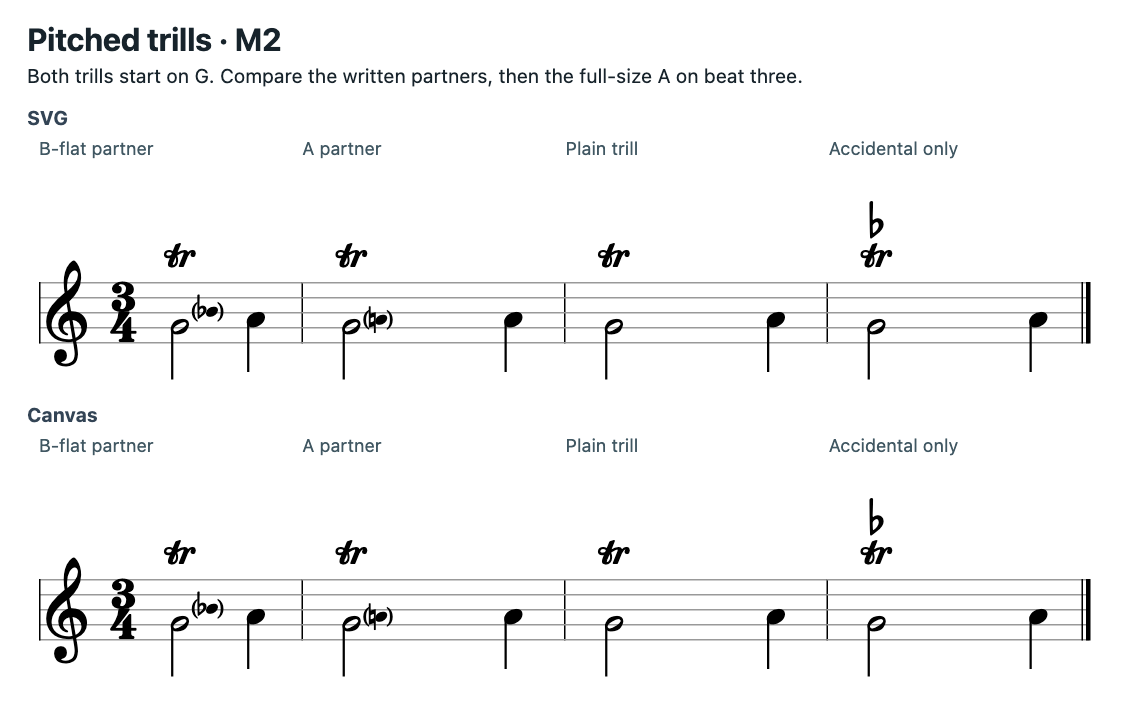
Both principals are half-note Gs. The parenthesized flat and head identify B-flat in the first bar. The second bar shows A with an explicit natural. Both full-size As still start on beat three. The final two bars show the plain and accidental-only controls.
D major reads 1 3 2 and C major reads 3 2 1 from the lowest stopped string to the highest. In the third frame, only the G-string digit has been cleared.
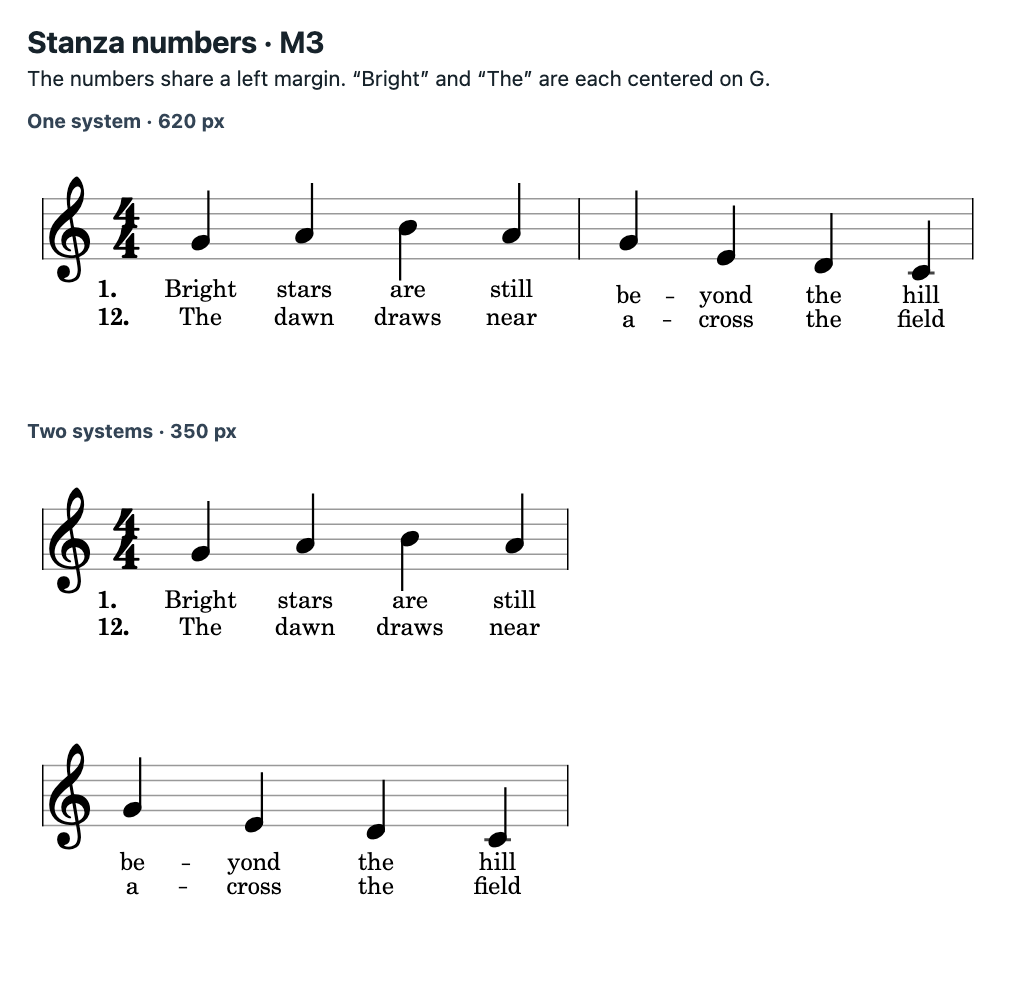
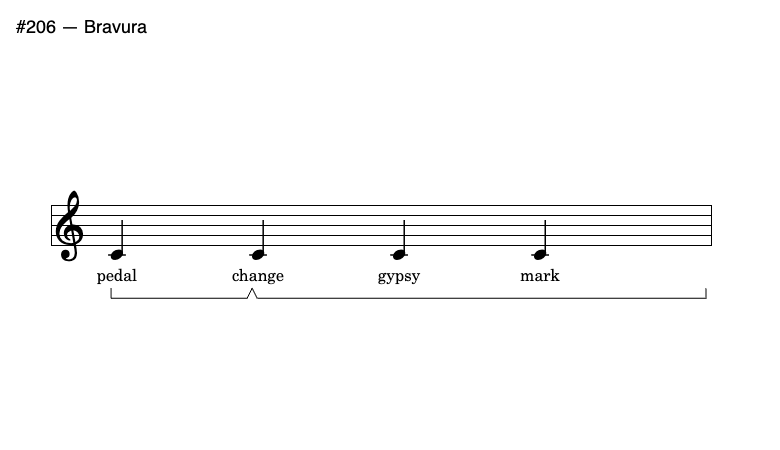
Compare 1. and 12. at the left of the first system. “Bright” and “The” stay centered on the first G. The labels appear once when the hymn wraps onto two systems.
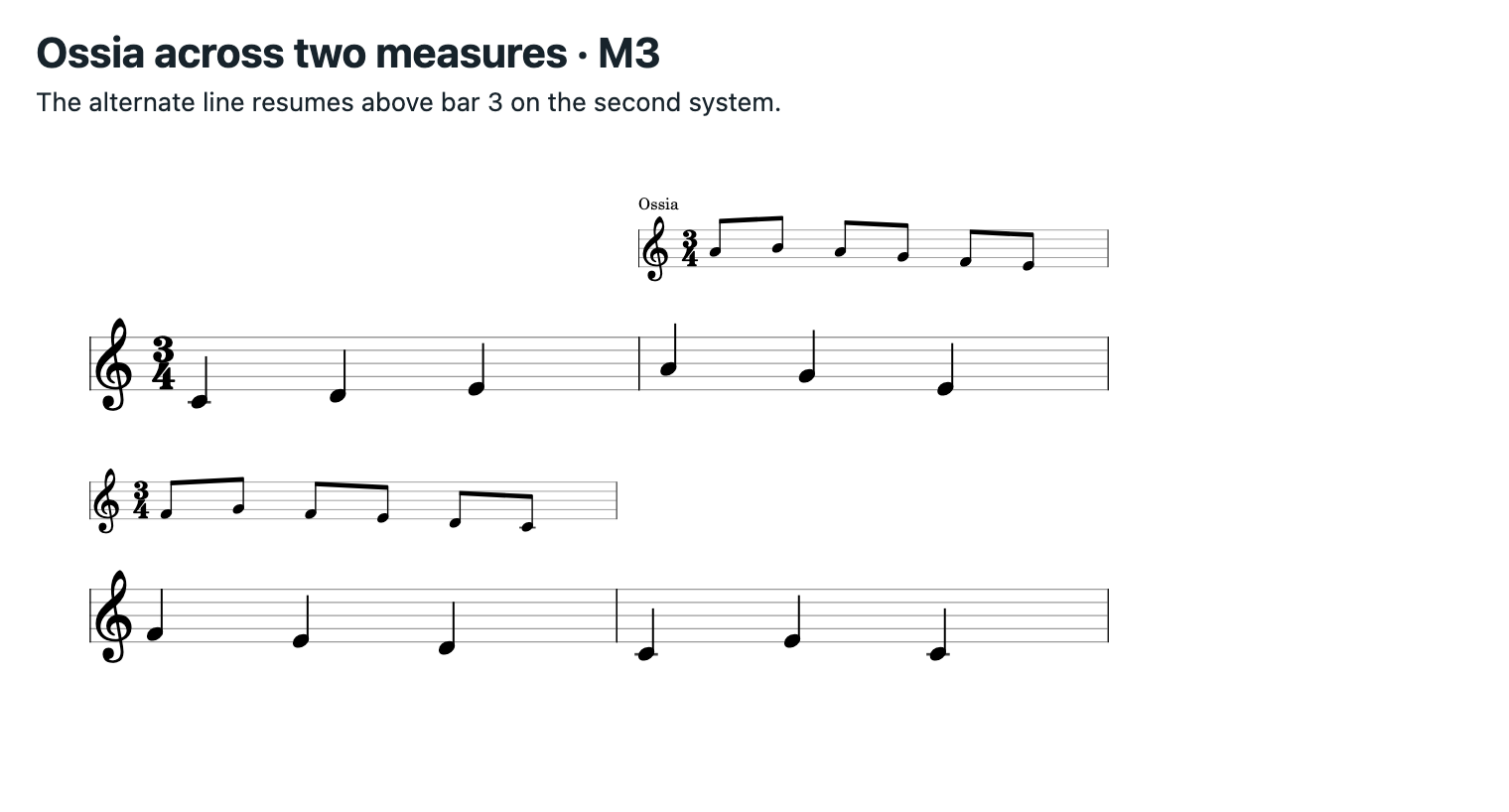
The reduced staff covers bars 2–3. Its middle barline lines up with the main melody. After a break, the remaining six eighth notes resume above bar 3, and the ossia ends before bar 4.
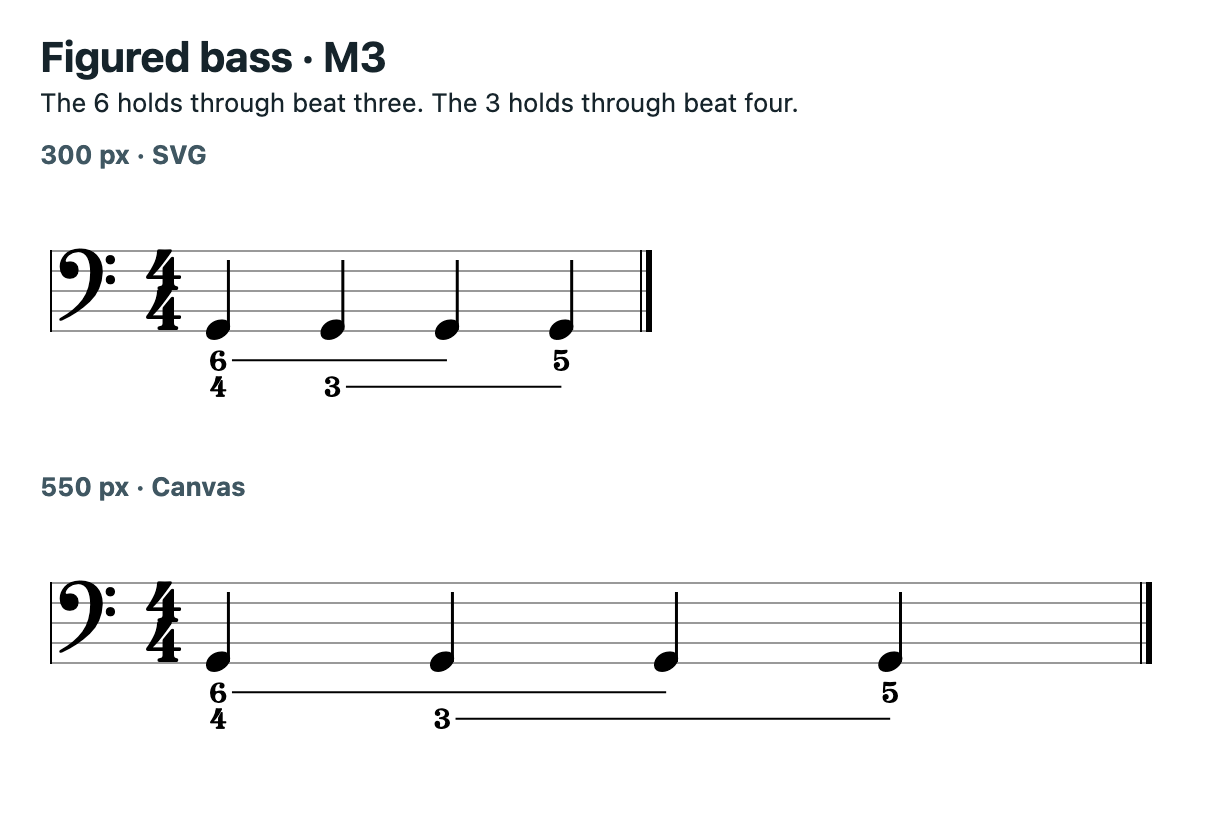
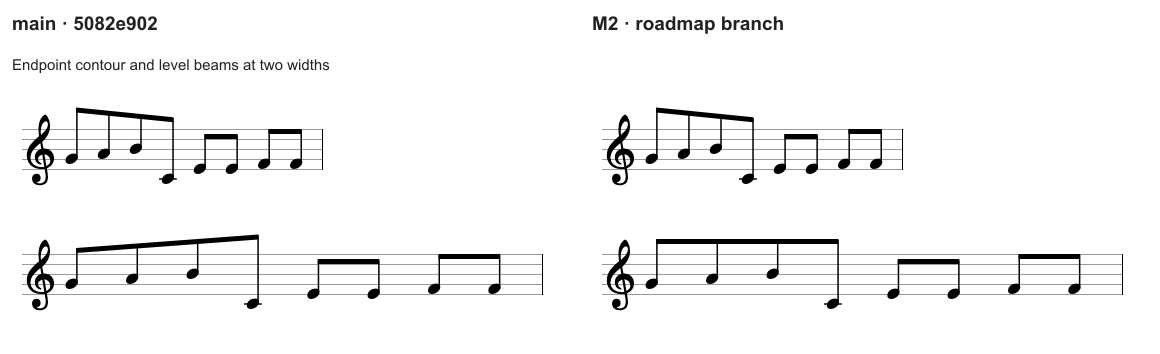
Read 6 above 4 on beat one. The 6 holds through beat three. The lower 4 resolves to 3 on beat two and holds through beat four, where a new 5 appears above it. The lines follow their own endpoints at both widths.
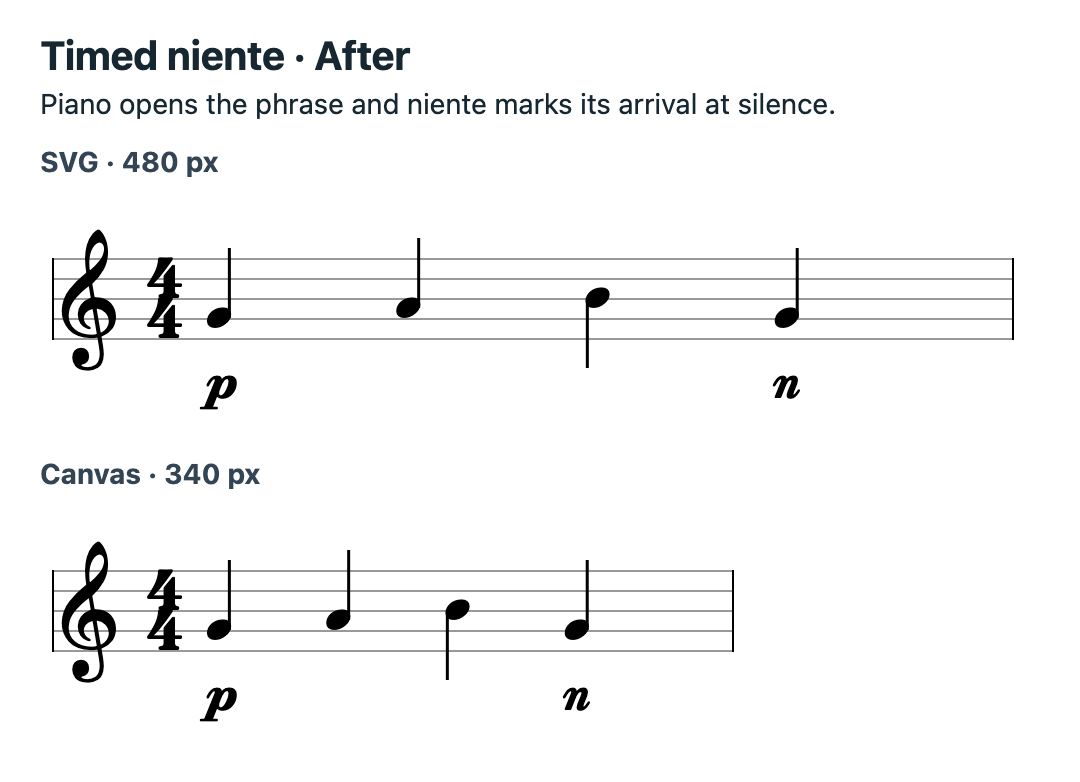
The four-beat phrase begins at piano and arrives at niente on the last G. The earlier version rejected n, so its comparison shows the supported piano with the last beat left empty. The new version prints one niente letter on the same baseline after resizing.
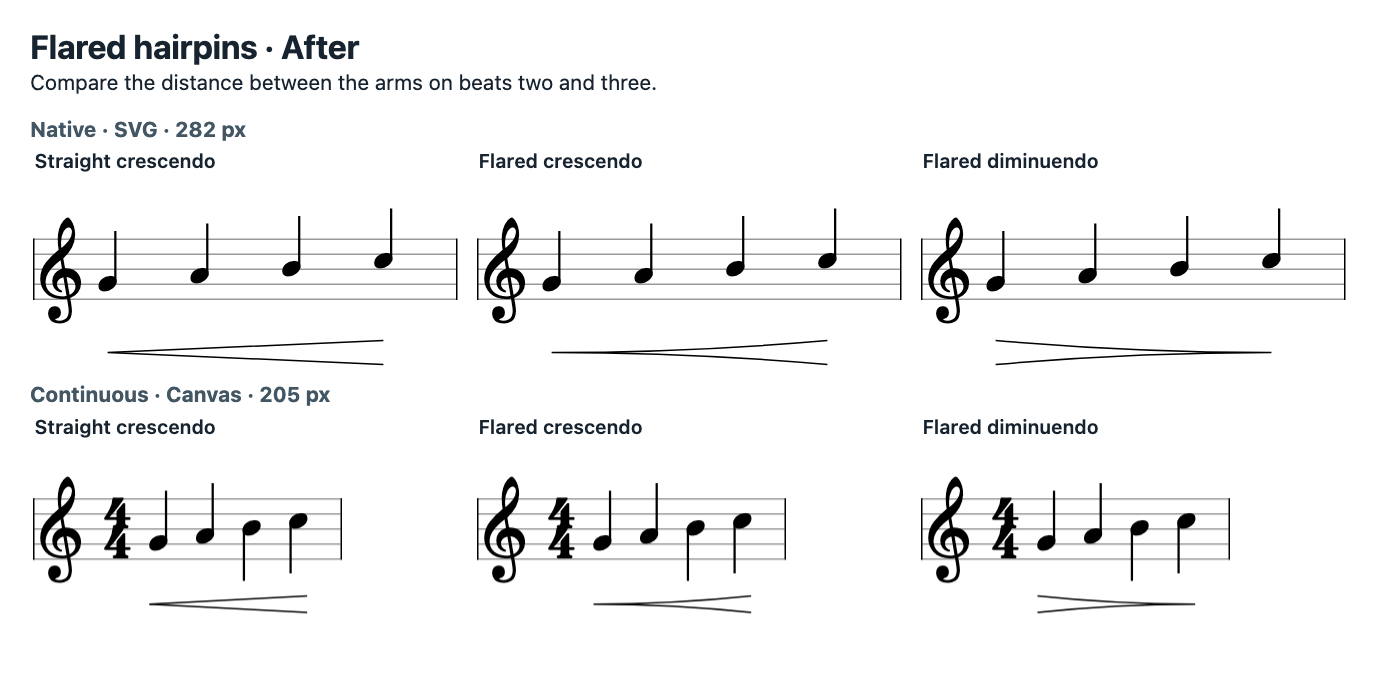
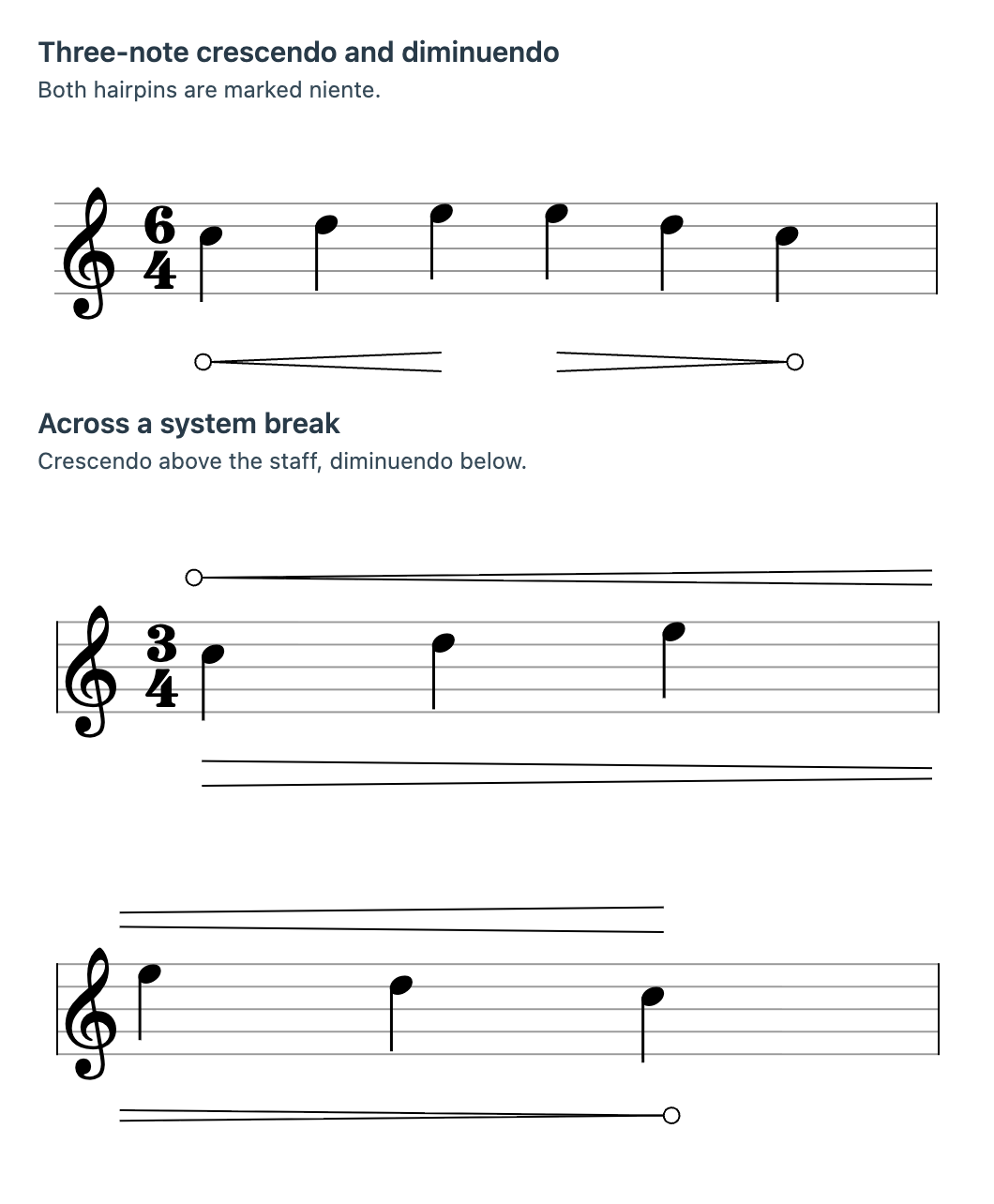
The flared crescendo opens to a quarter of its final aperture halfway through the mark. The diminuendo mirrors it. Compare the straight controls at the same widths. With a system break, each fragment continues the curve from the preceding system.
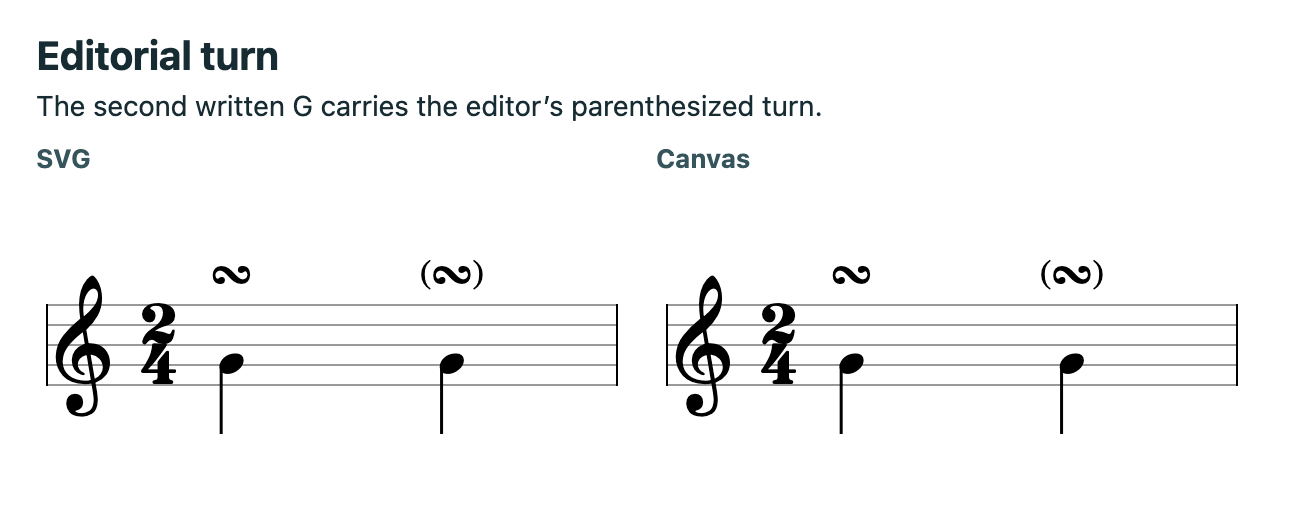
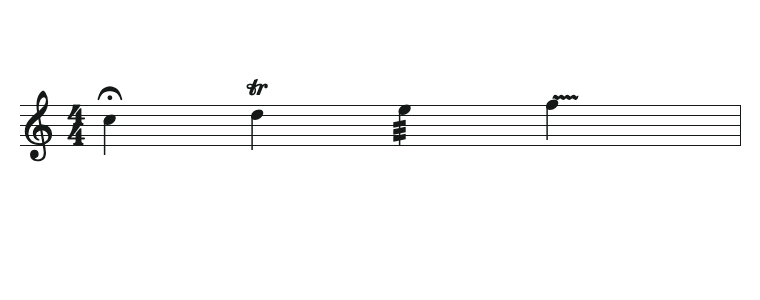
The first G carries a plain turn. The second carries the same named ornament in parentheses. The signs are included in its measured bounds and stay clear of the turn when the passage is redrawn.
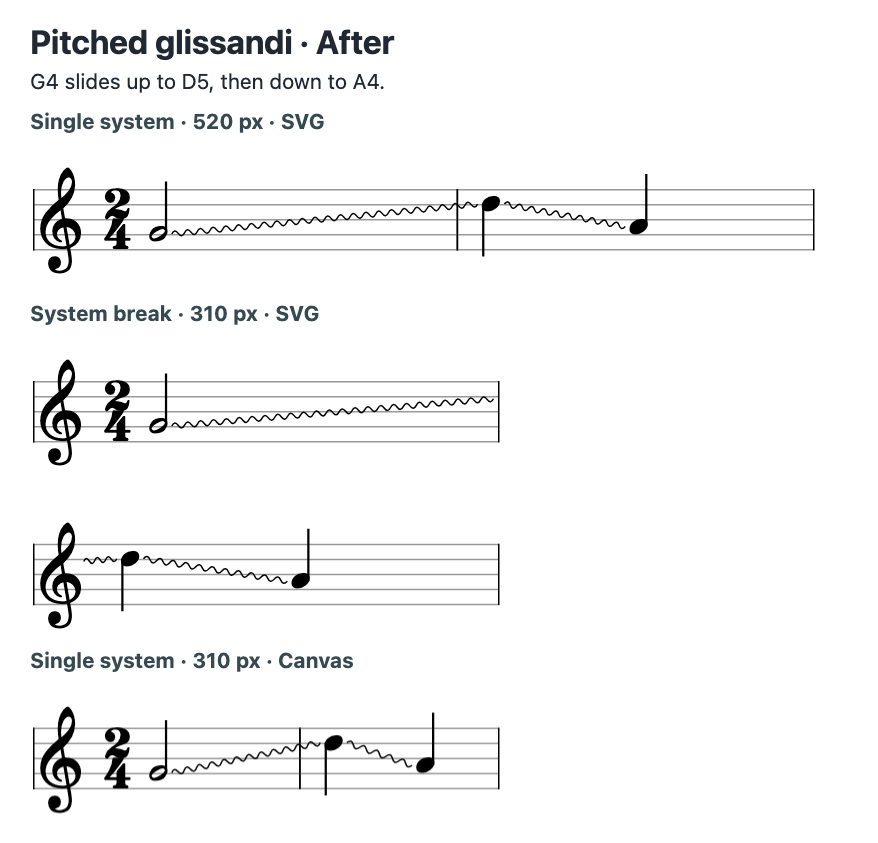
The slide from G4 to D5 rises and the slide to A4 falls. The narrower score fits fewer waves between the heads. After a system break, each fragment keeps the direction of the slide.
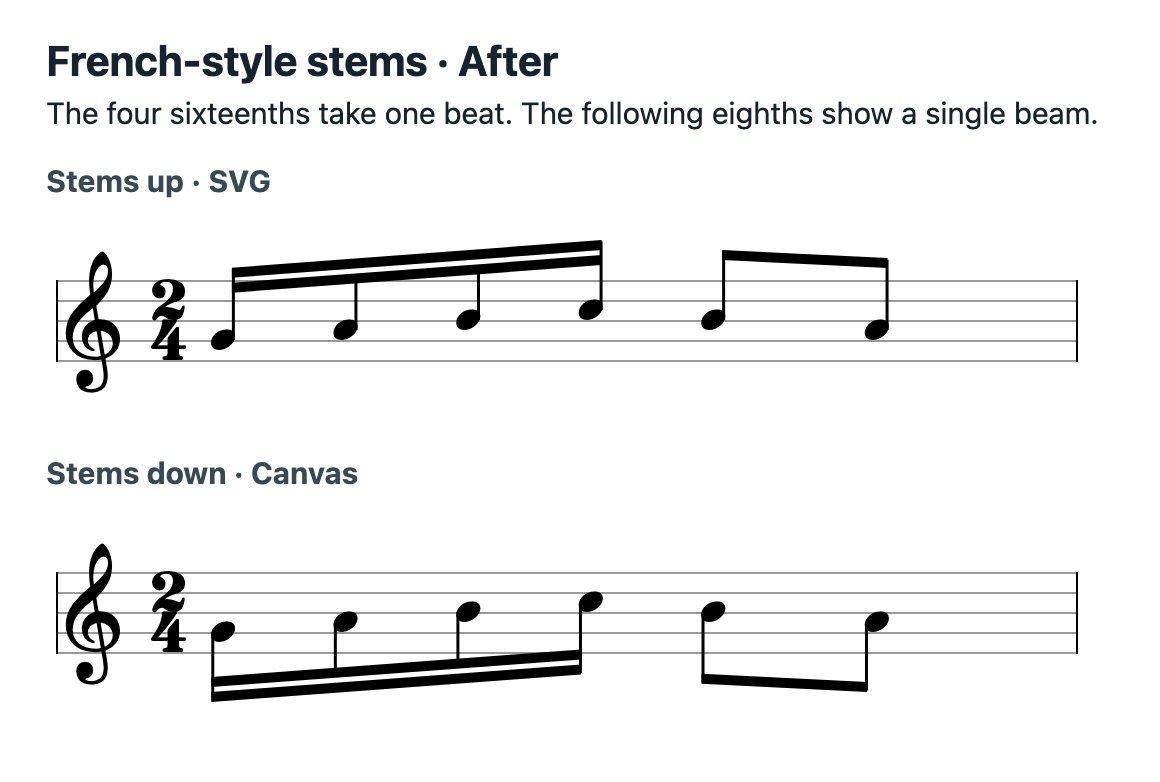
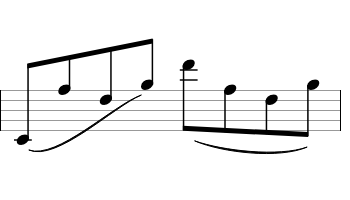
Compare the two middle stems with the outer stems. In the French group the middle stems end at the beam closest to the heads, leaving the gap between strips clear. The four sixteenths still occupy one beat.
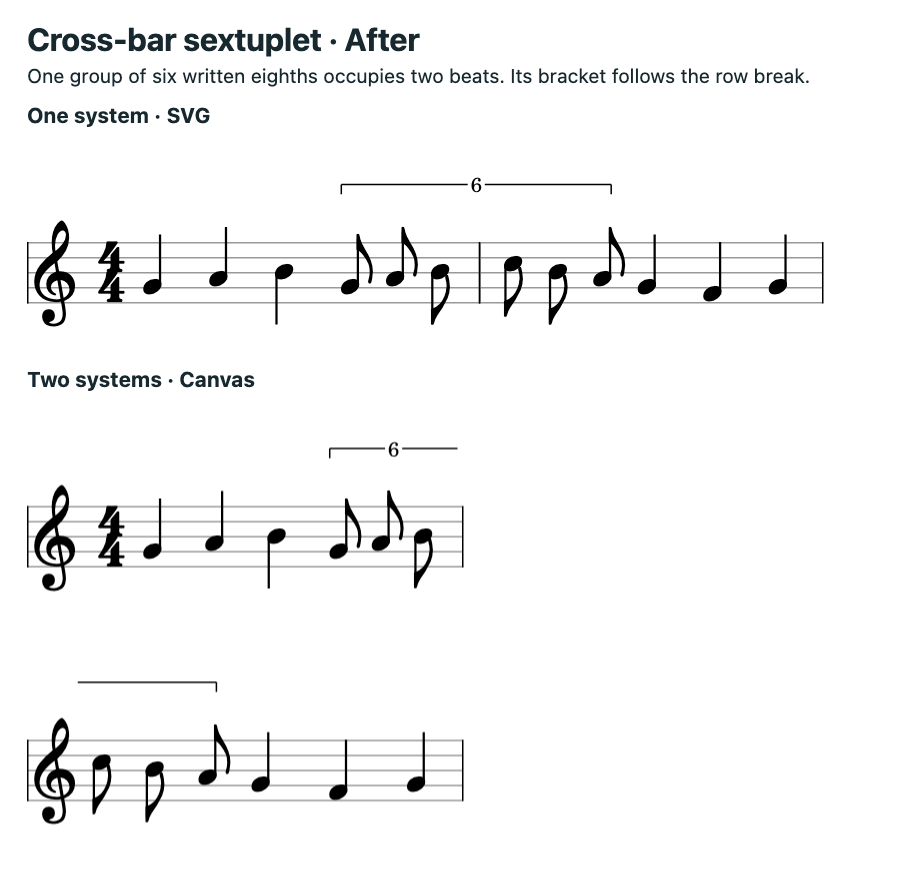
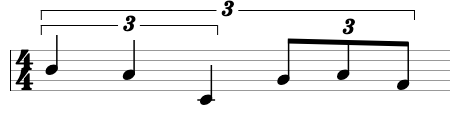
The earlier score uses two local triplets to fit the bar durations. The new score declares six members once. Their bracket shows one 6 and continues across the break. The next quarter still lands on beat two.
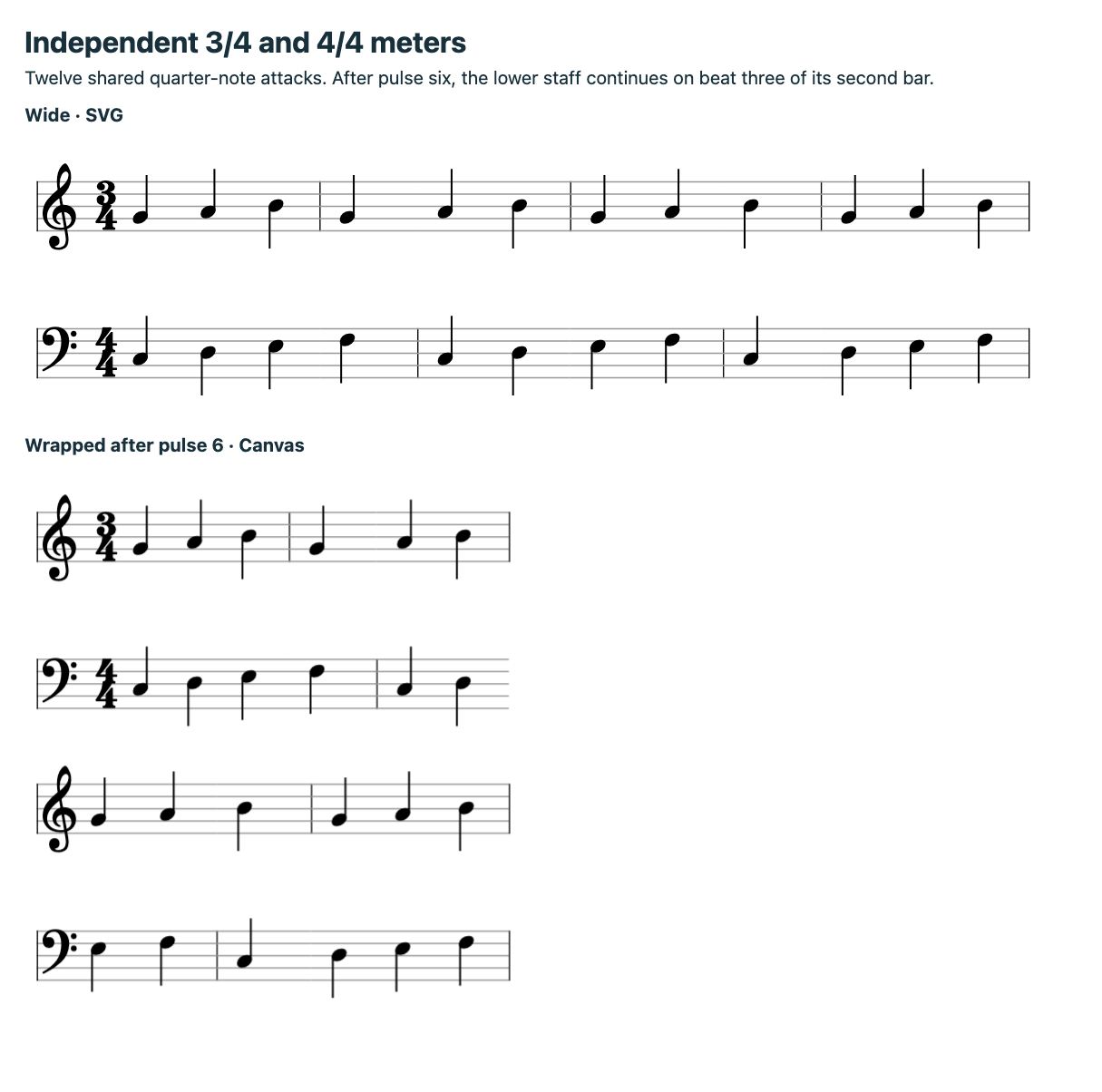
The earlier renderer required separate parts for the two meters. The new score aligns twelve quarter-note attacks on two staves. The upper staff counts in threes and the lower in fours. At the break after pulse six, the lower staff resumes on beat three of its second local bar.
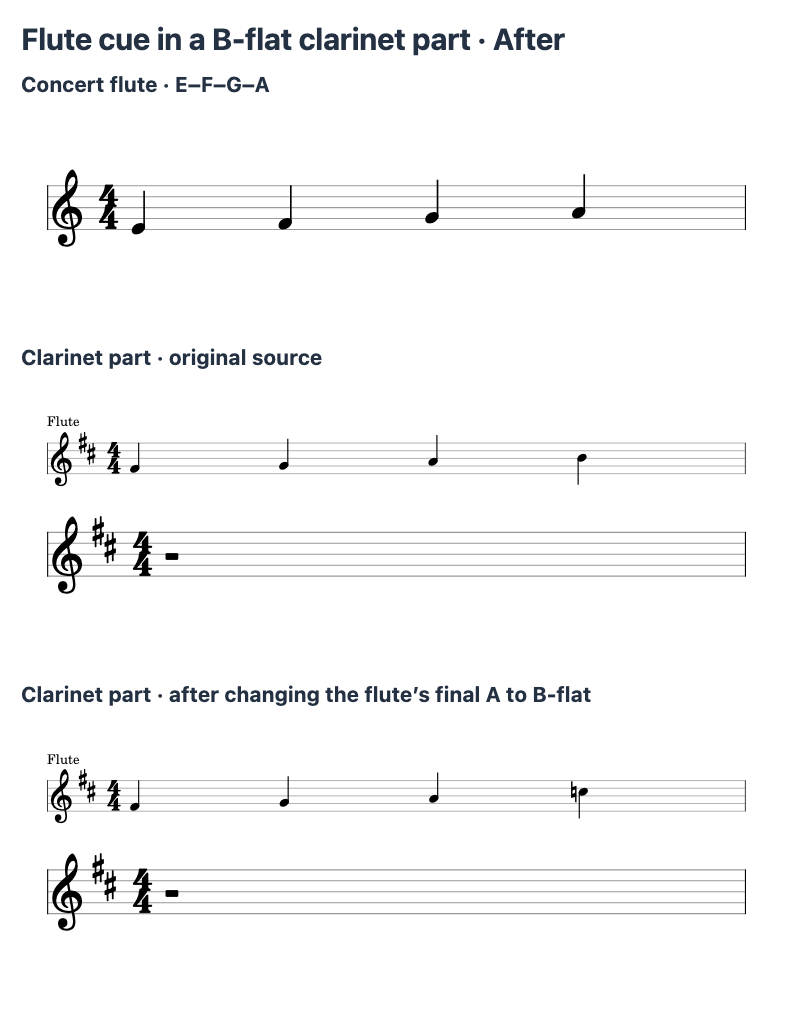
The clarinet part quotes the flute a written major second higher, in D major. Changing the flute’s final A to B-flat produces C natural in the cue. The attribution, cue size and clarinet rest are preserved.
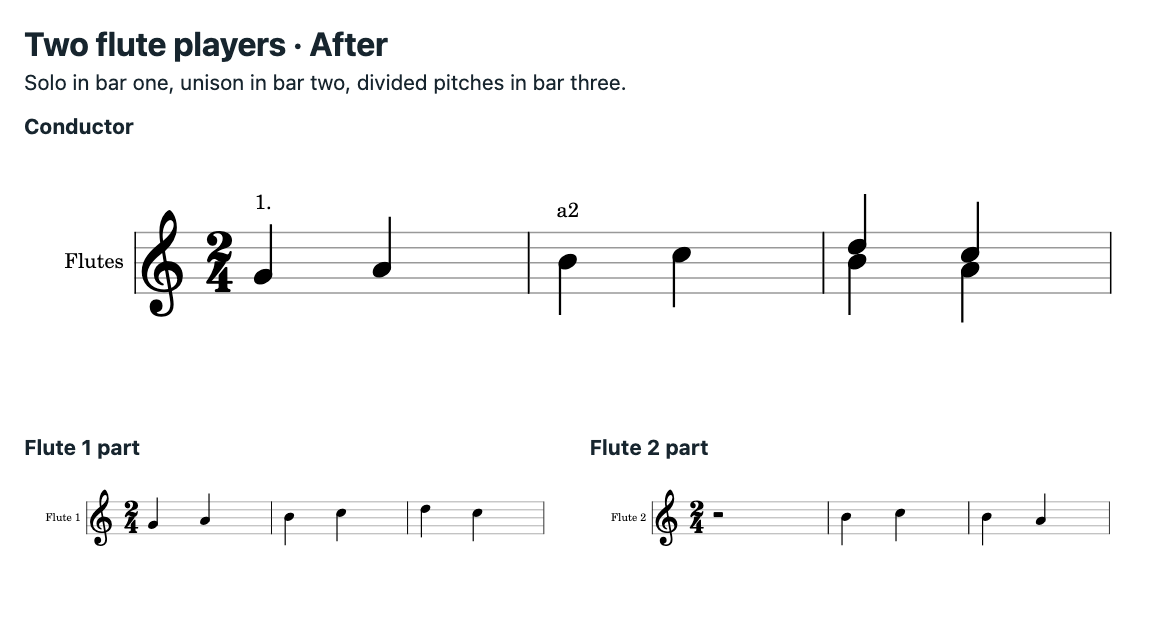
Both flute parts come from the same source. The conductor sees “1.” for the solo, “a2” for the unison and opposing stems when the lines divide. The independent parts keep their original pitches, durations and rests.
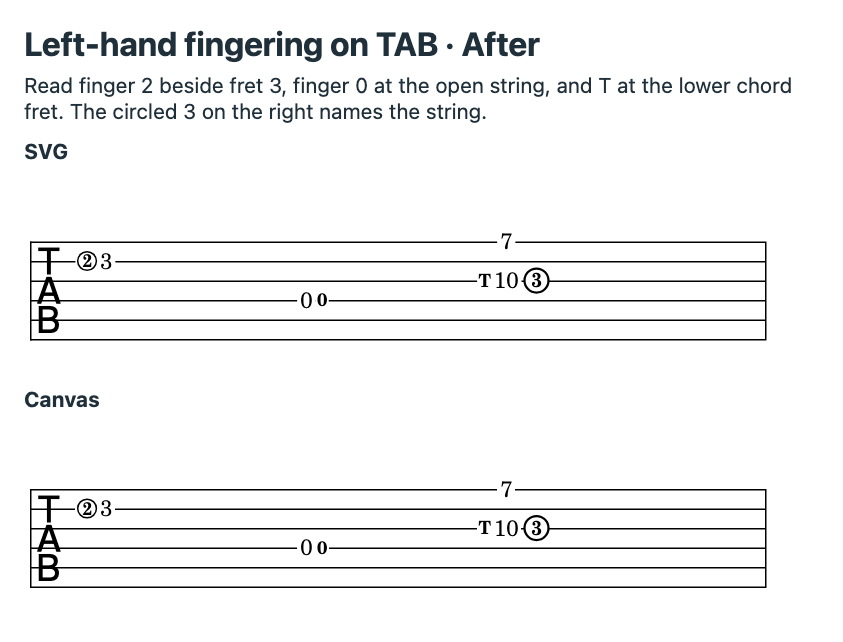
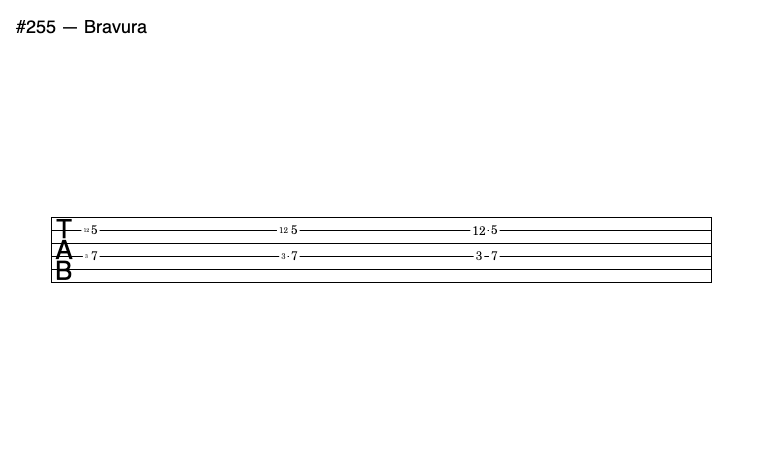
The earlier version threw during formatting, so its panel shows the unmarked frets. The new fingering follows the selected string in a TAB chord. The comparison includes an open string, a nonnumeric label and an enclosed finger digit beside its fret.
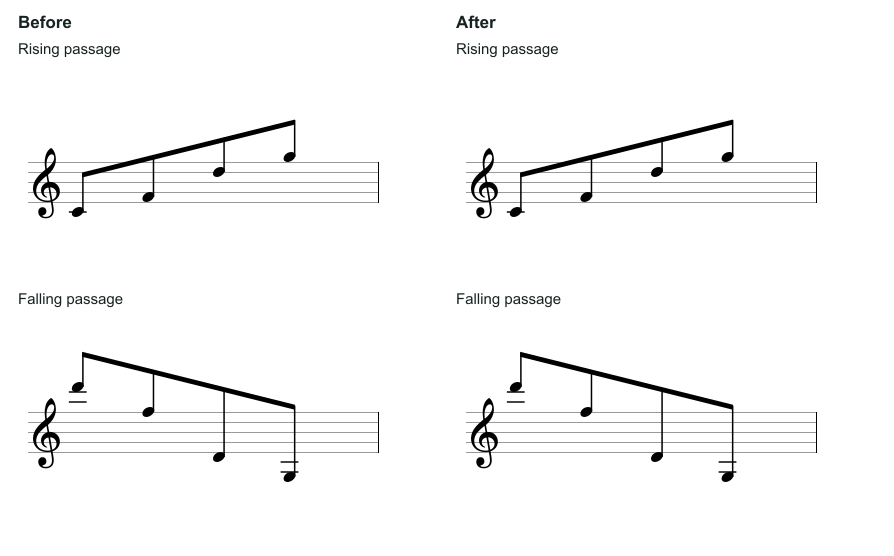
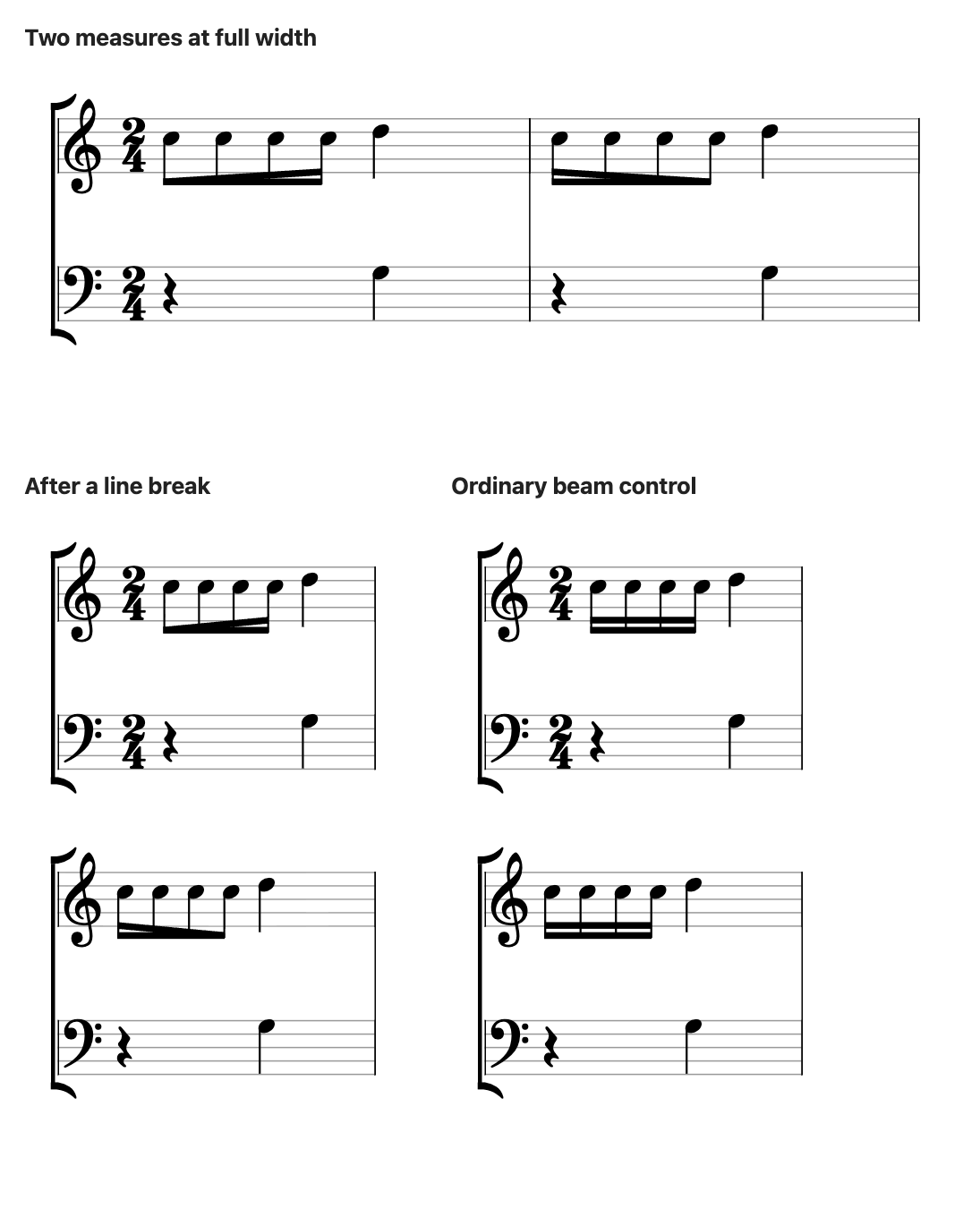
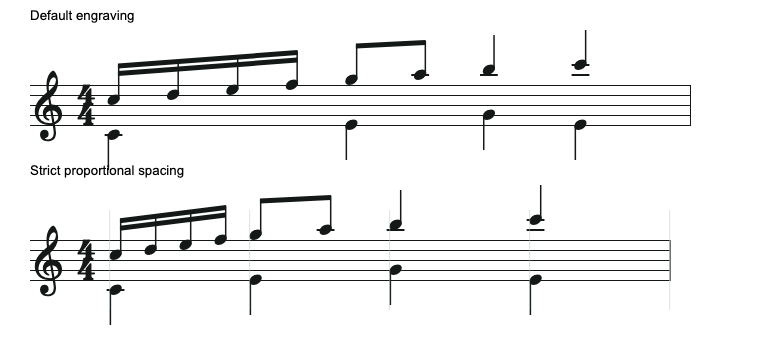
Beam fitting checks both ends of a bounded slope range. Equal limits select a fixed slope. The comparison shows the default engraving on four passages.
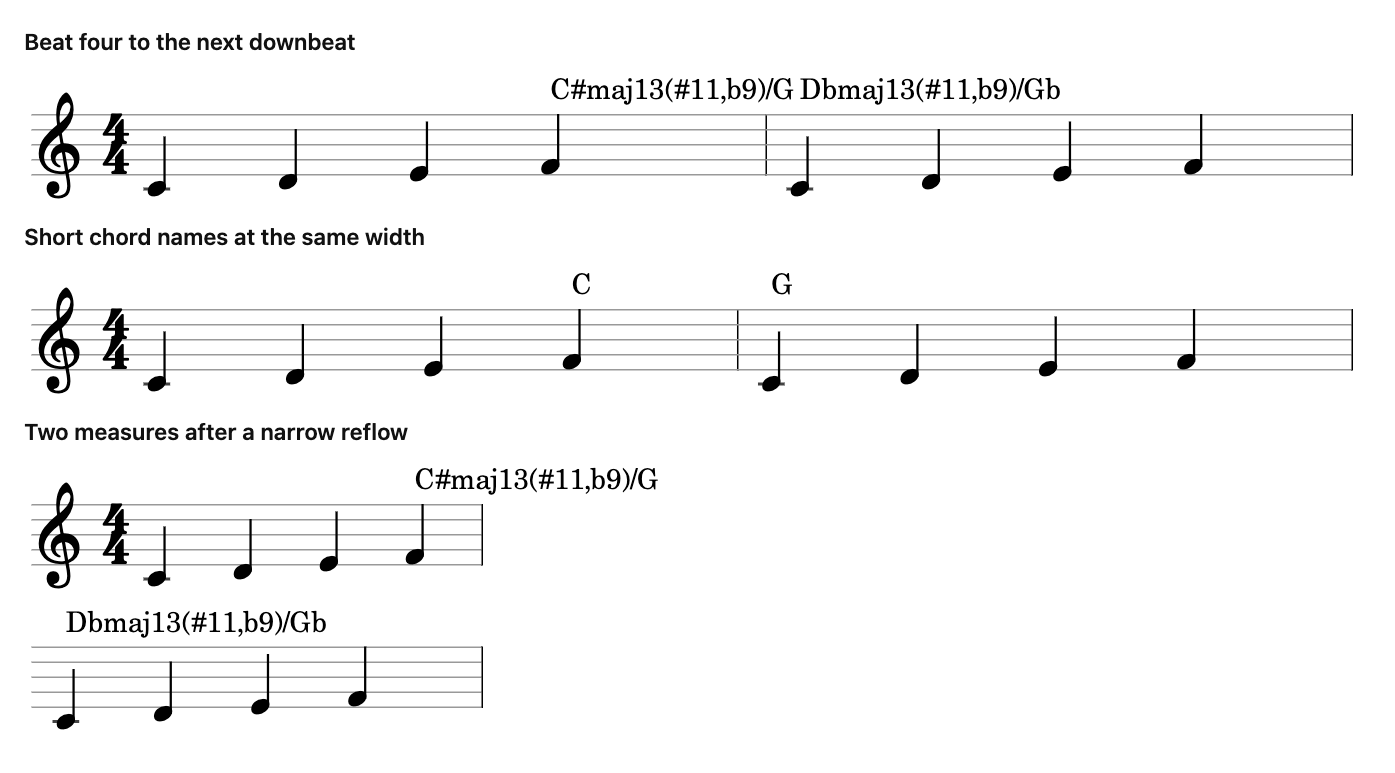
Long harmony labels reserve space on both sides of a barline. At narrow widths the sheet can wrap the measures. Short chord names retain their spacing.
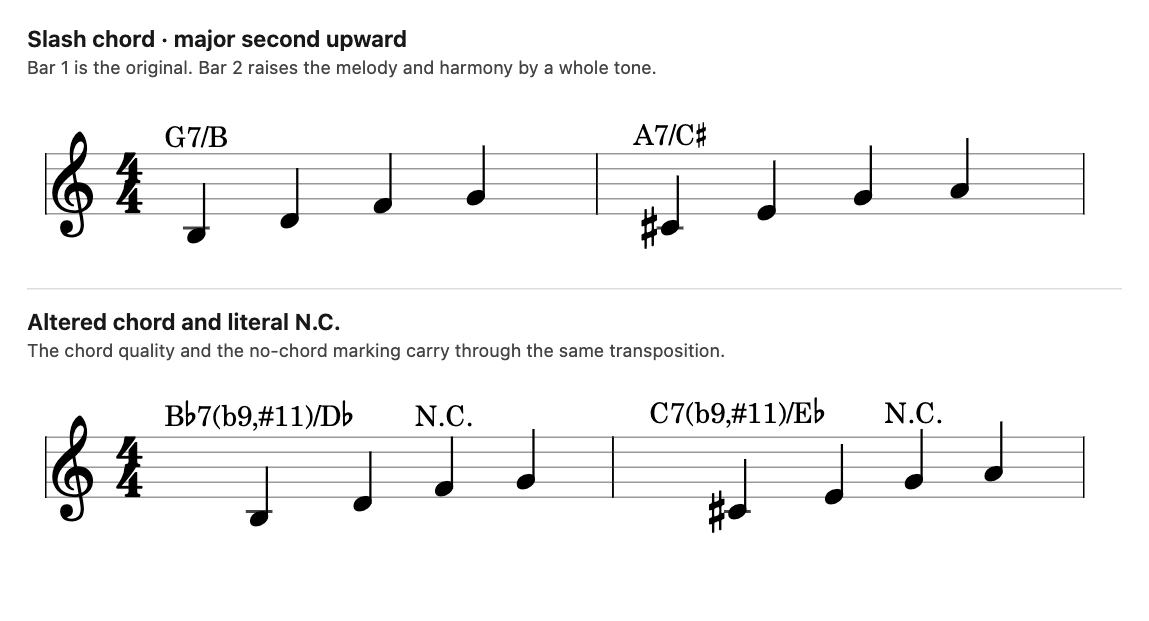
A transposed passage now carries its harmony with it. The root and slash bass move by the written interval while the chord quality and N.C. remain literal.
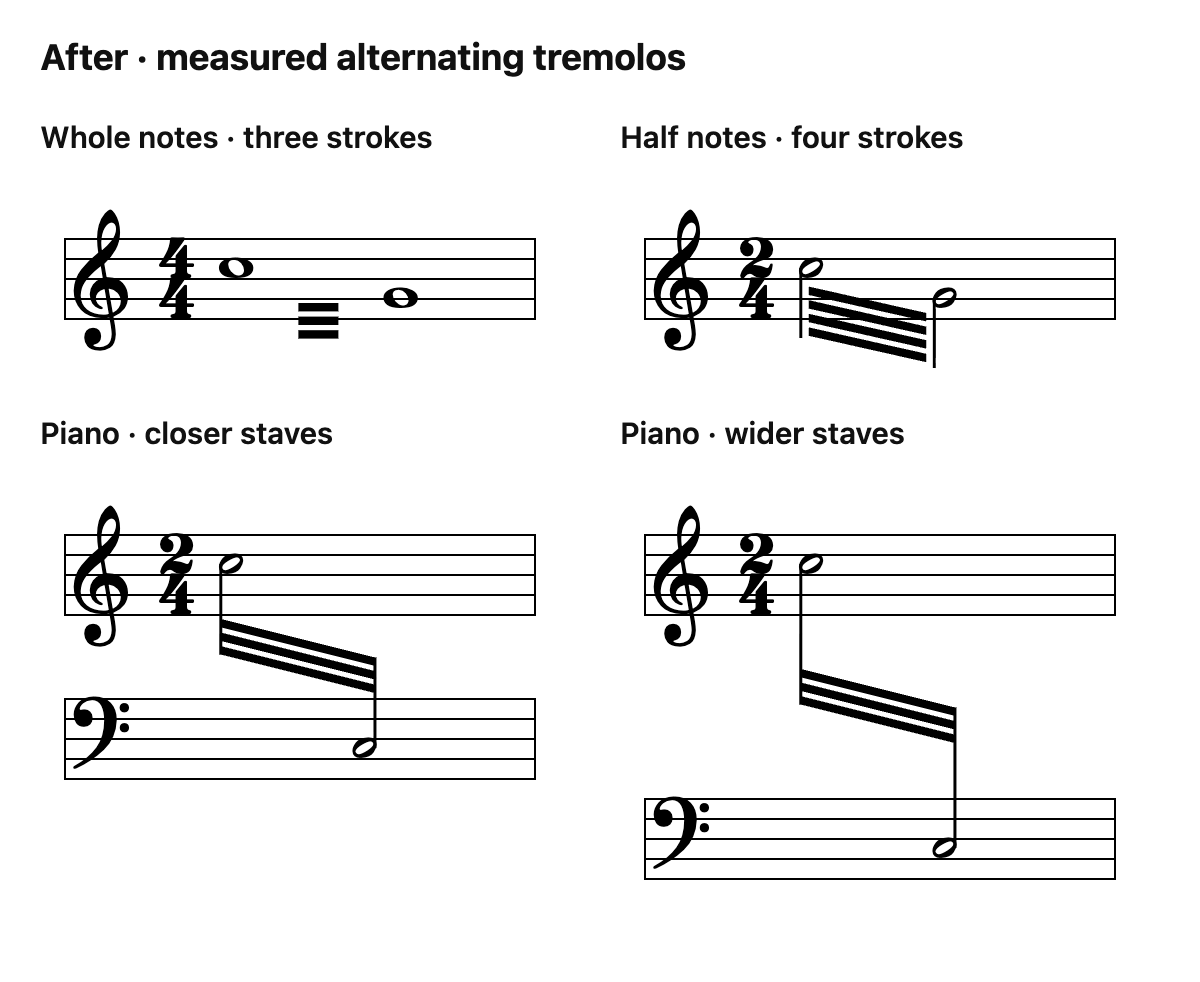
Measured alternating tremolos support up to four strokes. Whole notes can carry floating strokes, and a pair can span two staves at different separations.
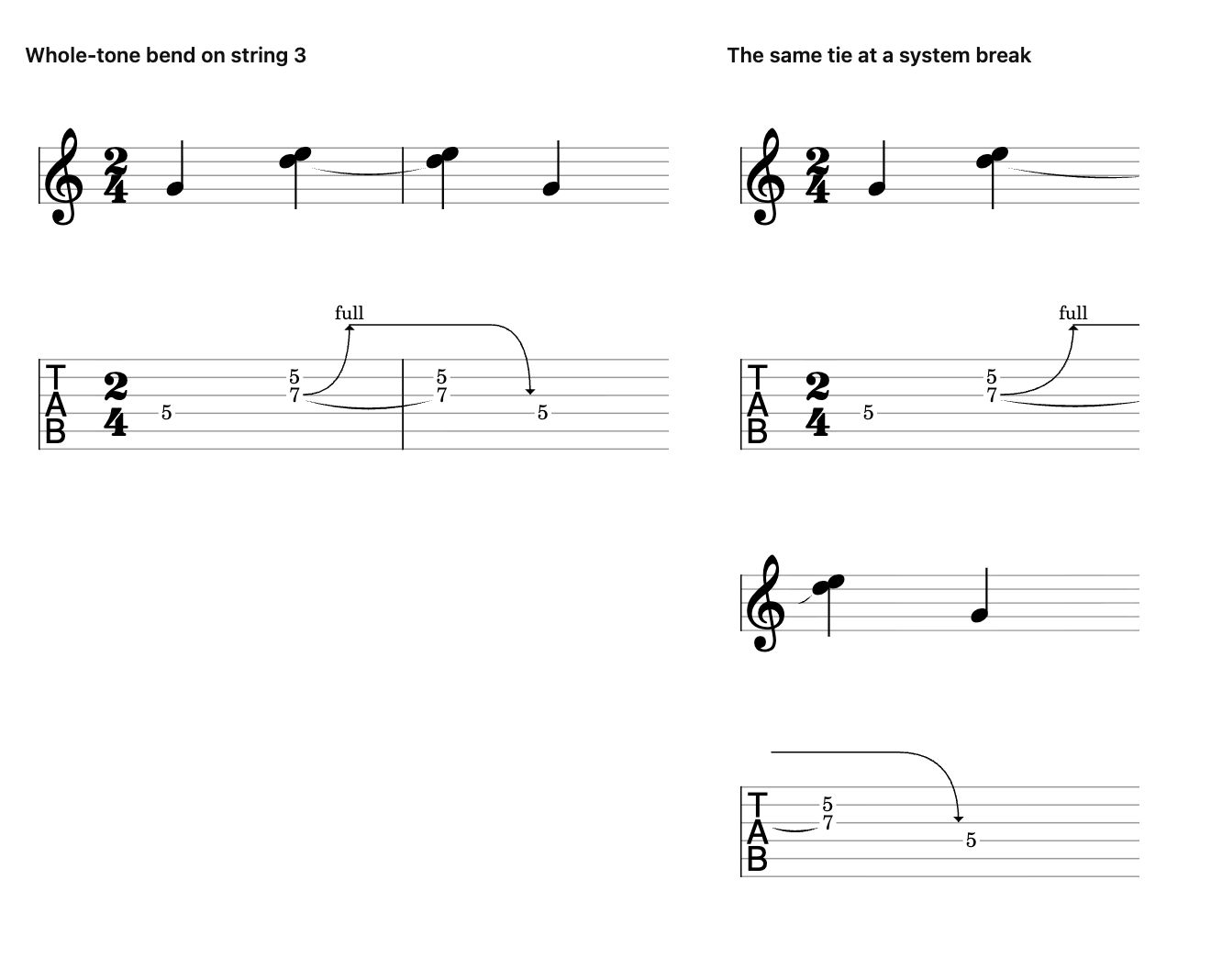
A bend can start on one string, keep its pitch through a tied attack, and release later. An adjacent fretted string retains its pitch through the gesture.
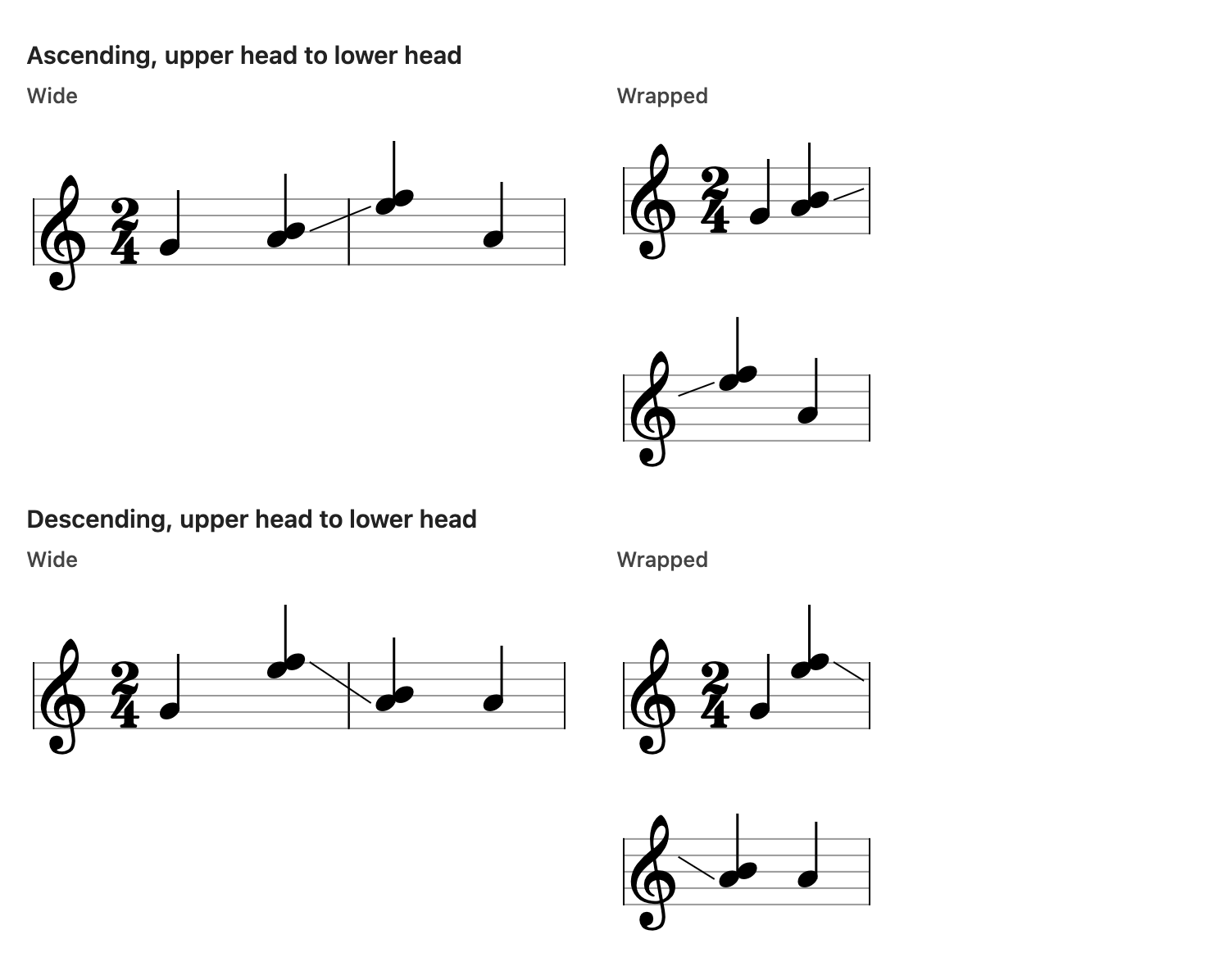
A straight glissando can connect selected chord heads across a break. Both segments preserve the direction of the slide and leave room beside the heads.
An open circle marks the closed musical tip of a crescendo or diminuendo. Wrapping the passage leaves that circle at the endpoint without adding one at the break.
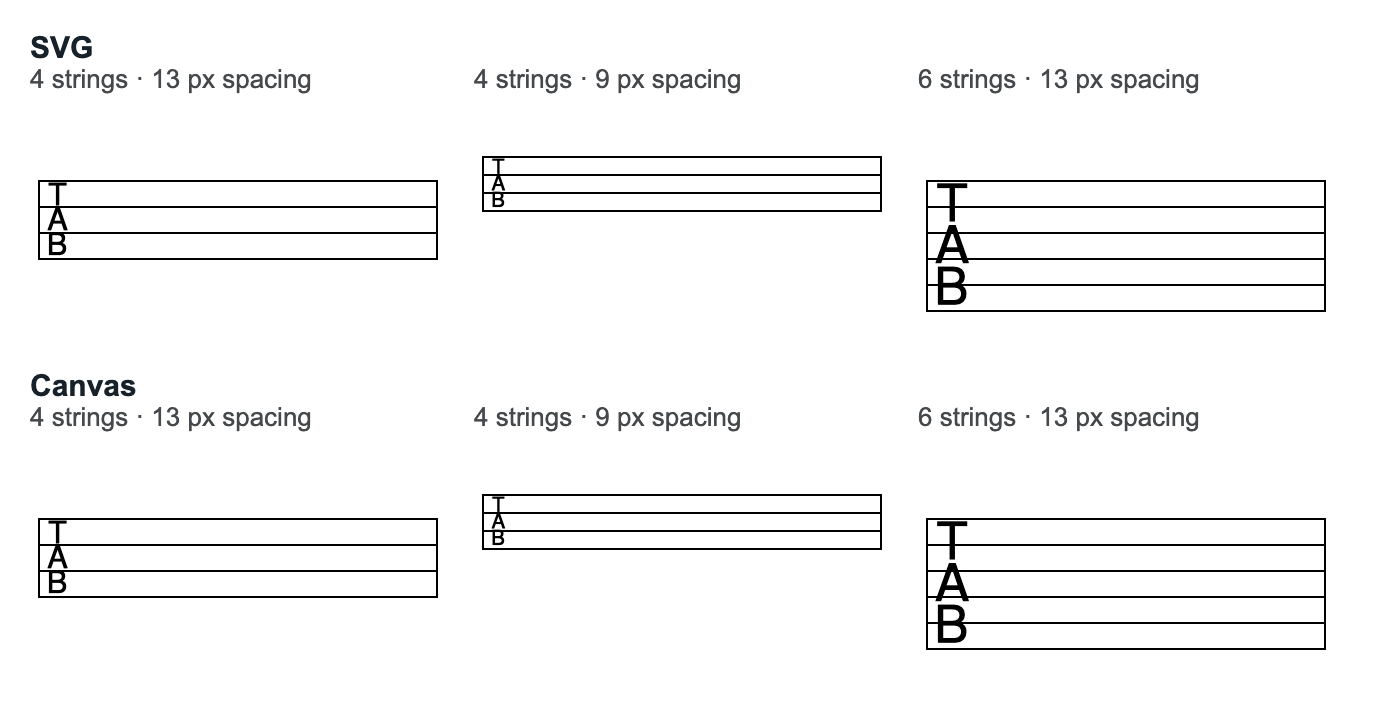
The clef sits halfway between the outer strings with clearance above and below its ink. Four-string instruments use a dedicated glyph. The examples show how the same placement adapts to different string counts.
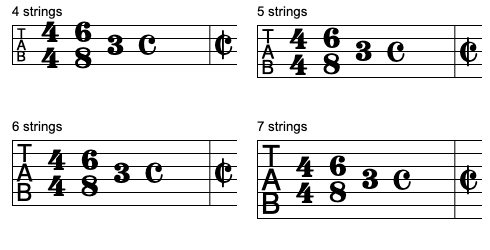
Numeric meters and the common and cut time symbols center on the tablature stave. The examples compare their positions as the number of strings changes.
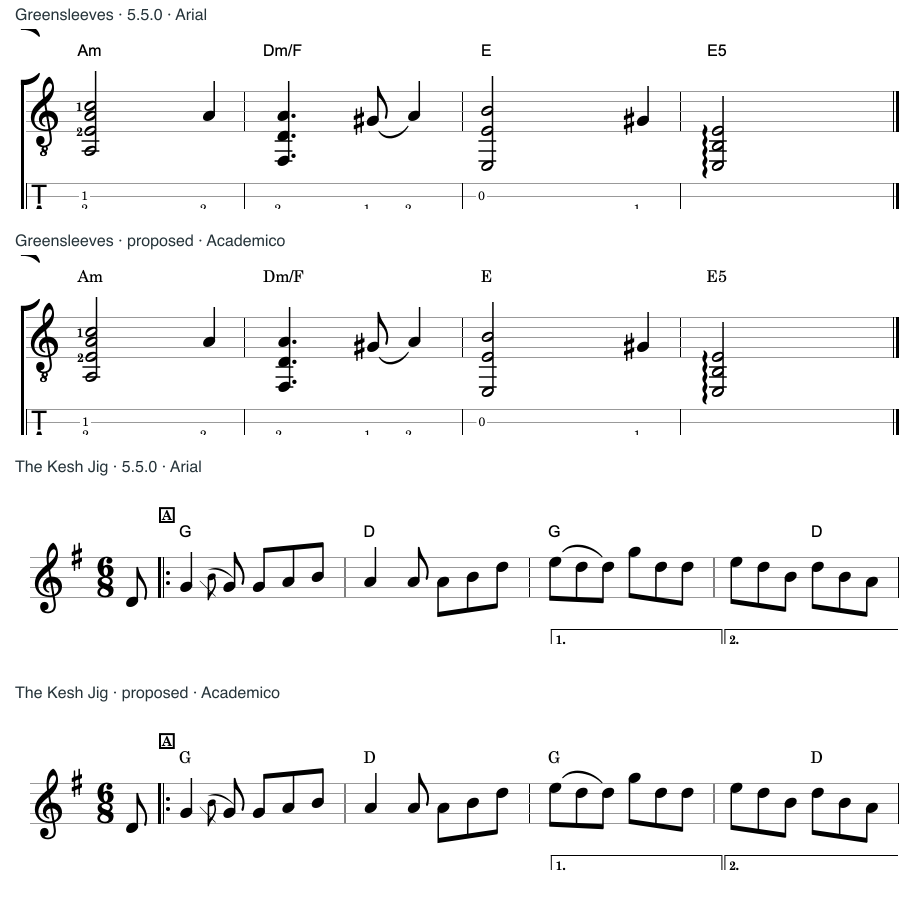
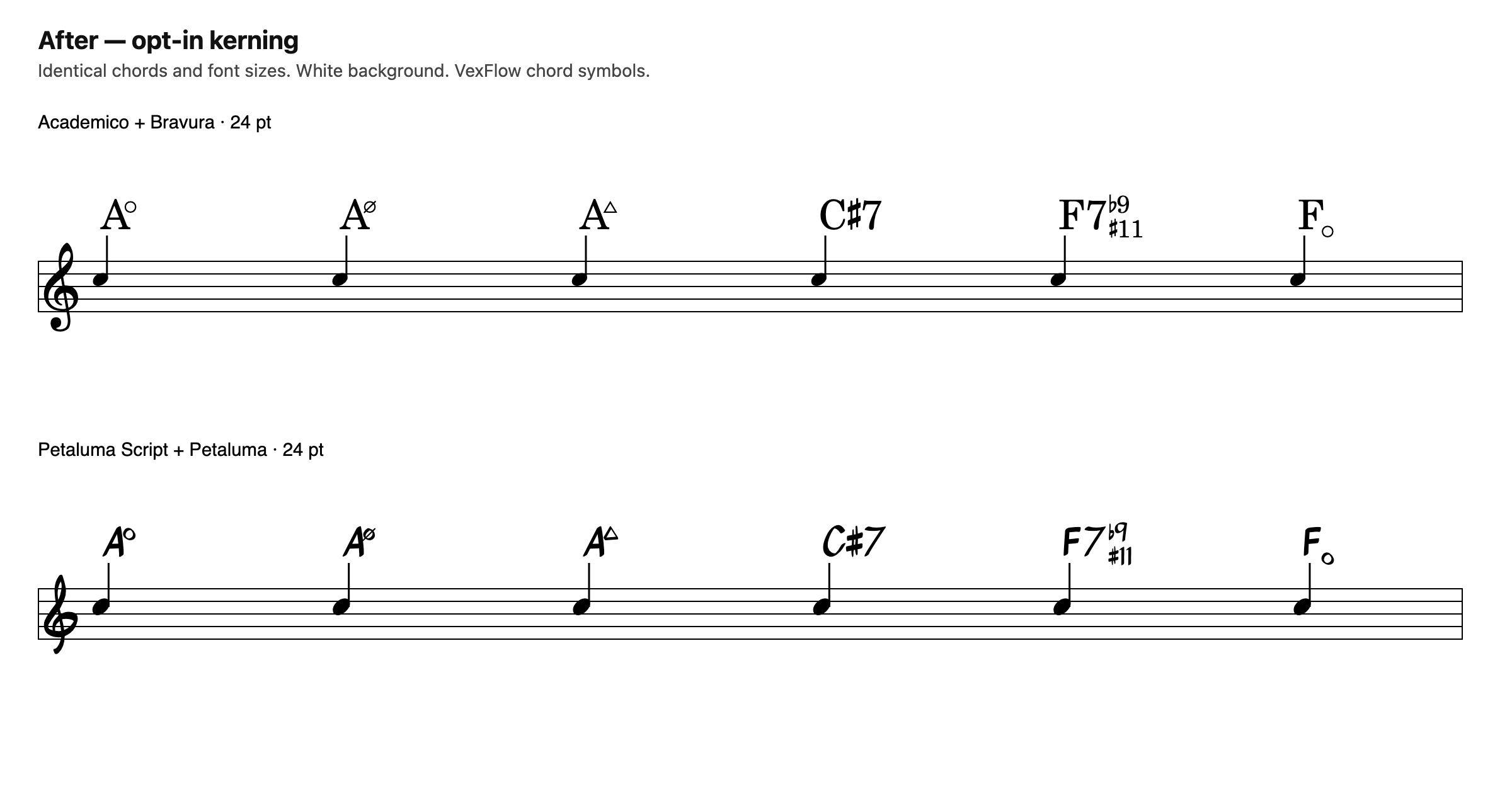
Chord roots use 14 pt Academico and their extensions use 8.4 pt. Verse syllables use 12 pt. A held syllable can anchor its extender so the line clears the word and keeps its height across a system break.
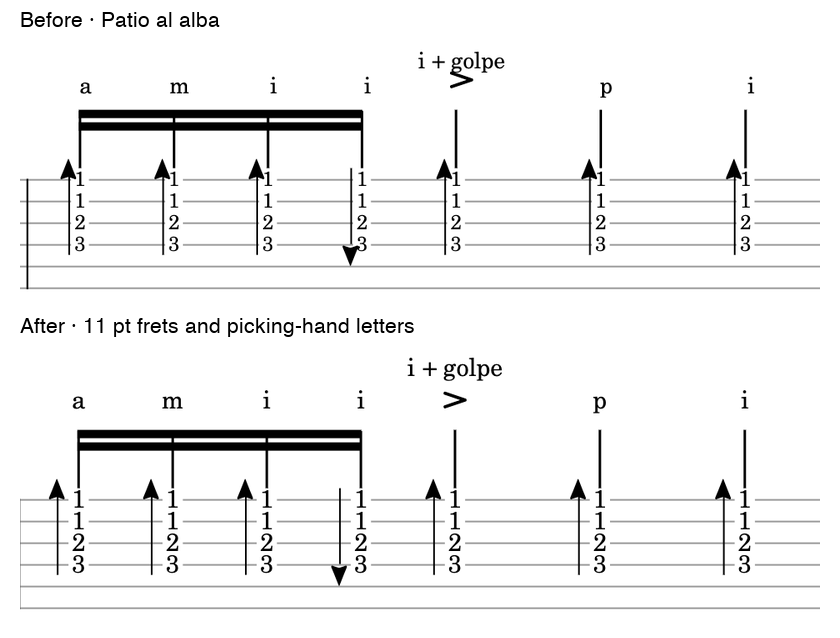
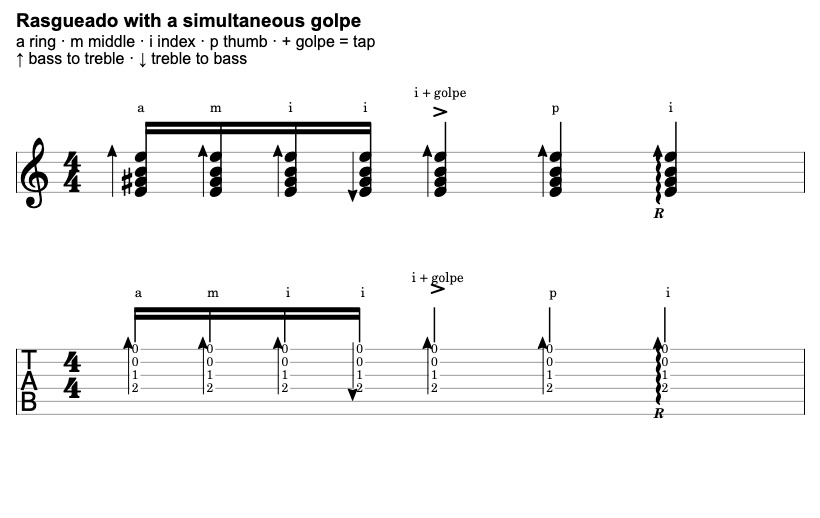
Tab frets use 11 pt and reserve space on both sides of the string position. Stroke arrows clear the widest fret in the chord. In the rasgueado study the accent sits between the stem and the picking-hand label “i + golpe”.
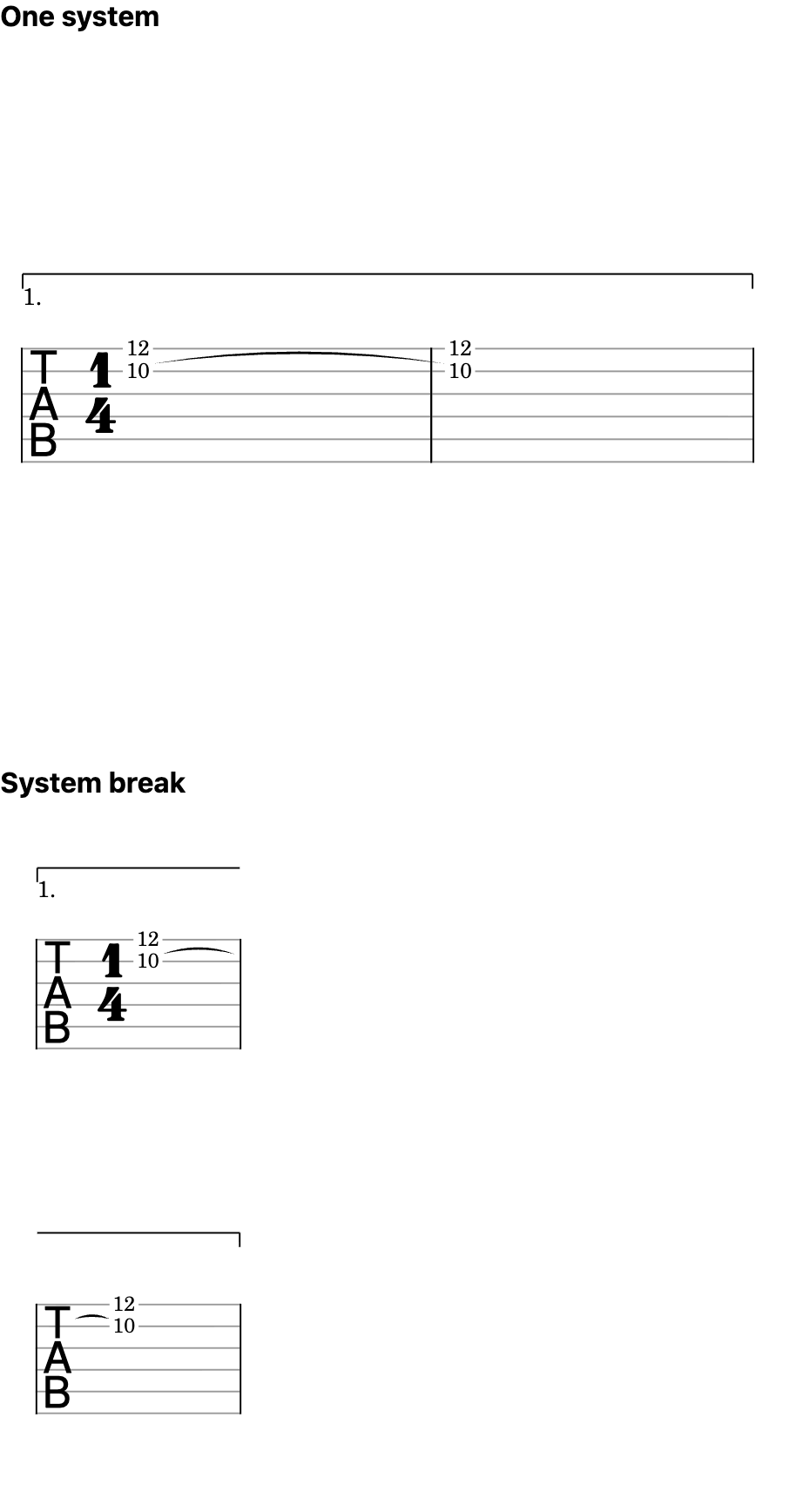
Select a string for a tablature tie even when the two chords list their frets in different orders. Ties and repeat endings split at system breaks and carry into an extracted guitar part.
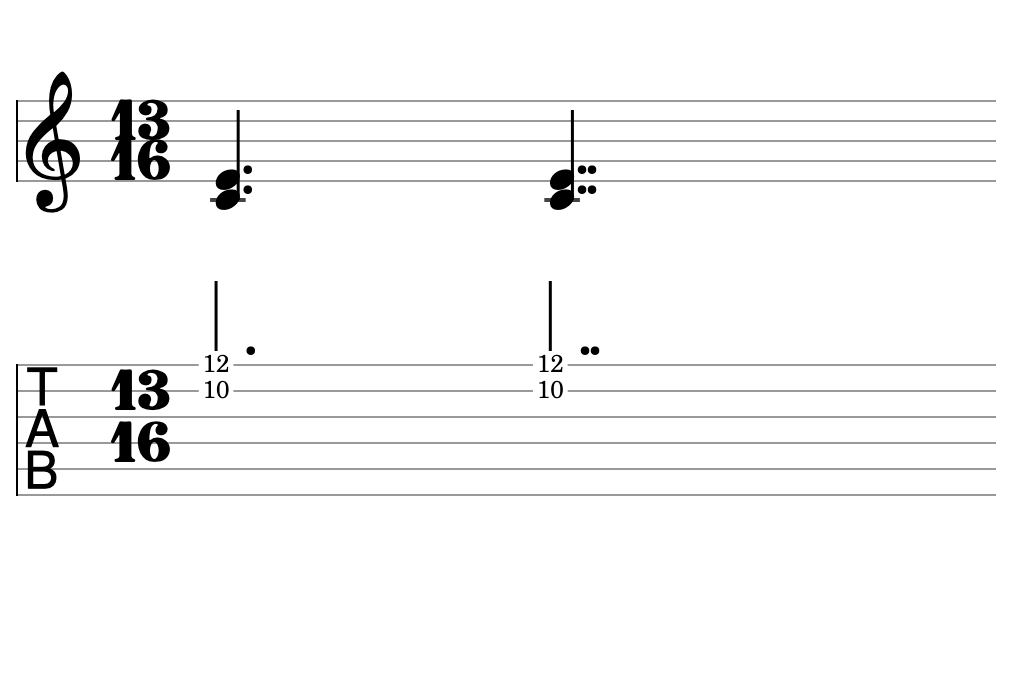
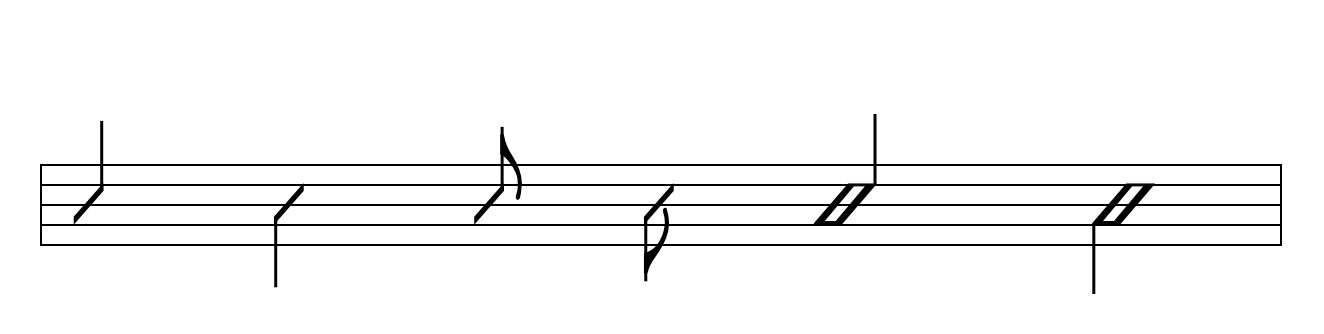
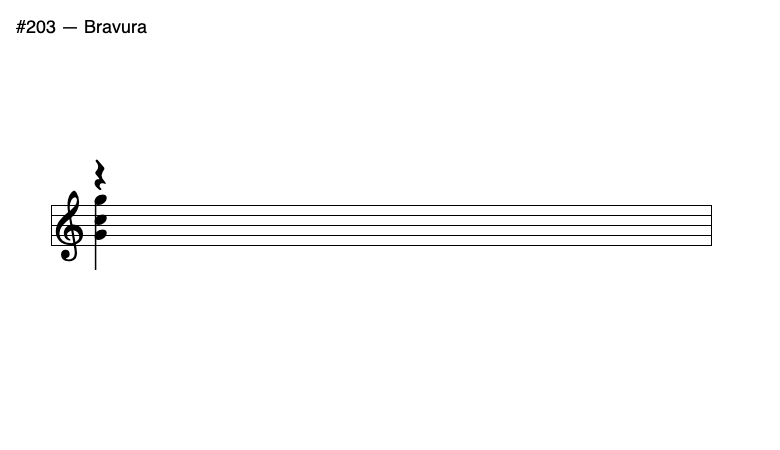
Structured chord notes engrave augmentation dots on each head. Rhythmic tab places the dots at the shared stem. Lead sheets retain their barlines and signature choices in printed parts. Explicit rest positions retain their ledger lines, and Bravura slash heads meet their stems at the font anchors.
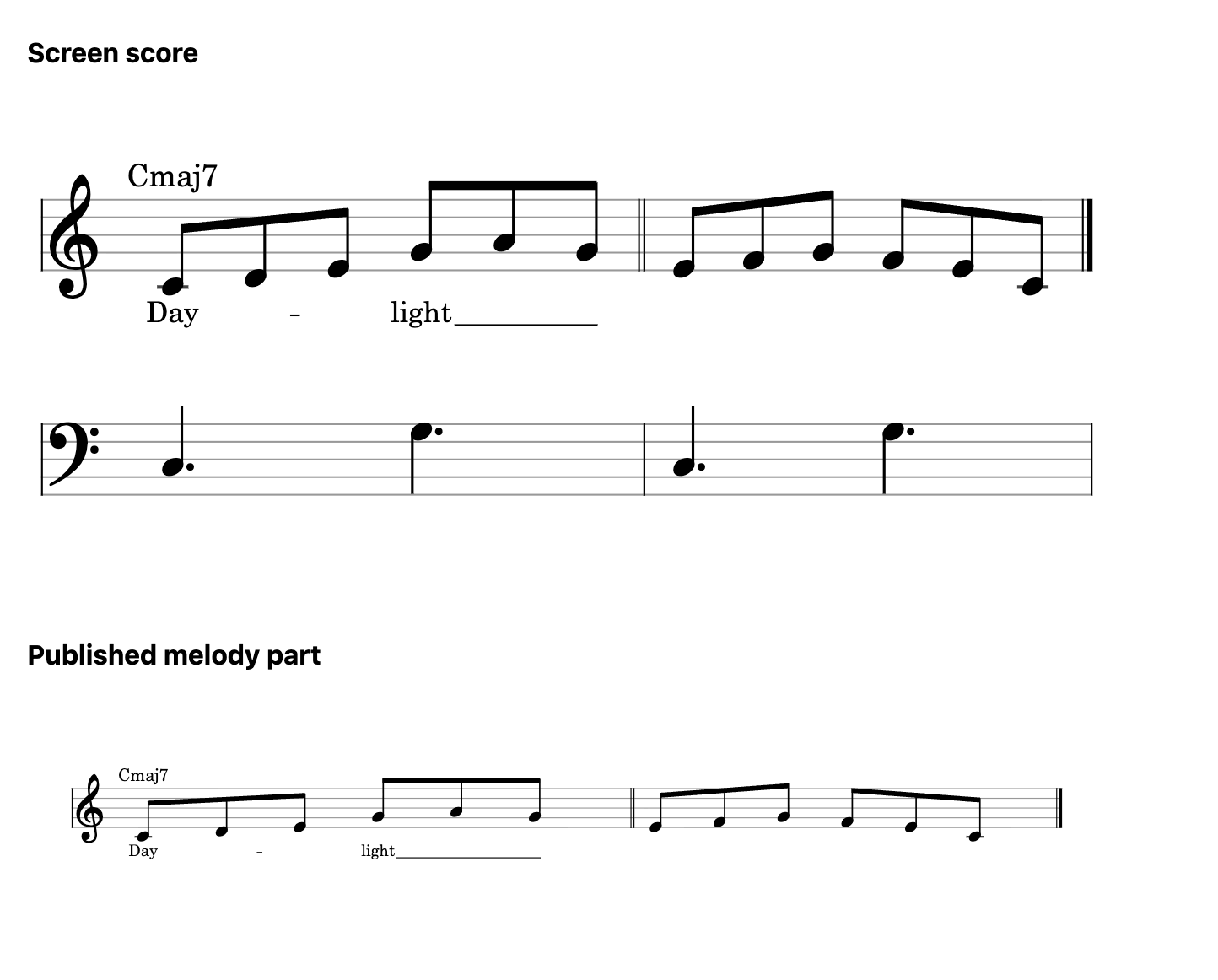
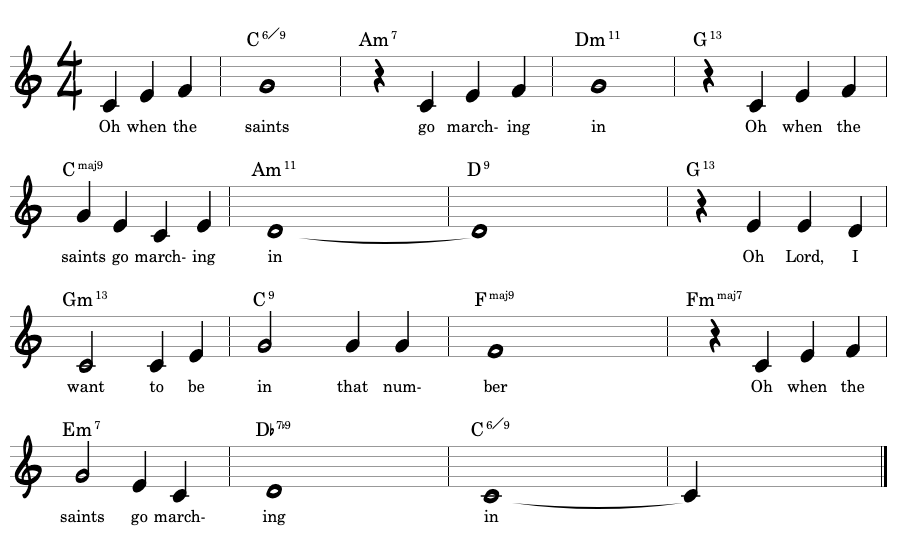
Compare the screen score and the printed melody part. The Cmaj7 label, lyric syllables, double bar and final bar carry through publication, including measures with a hidden time signature.
Quarter, eighth and half slash heads now attach their stems at Bravura’s published anchors. The same correction is visible in the Harbor Song lead sheet.
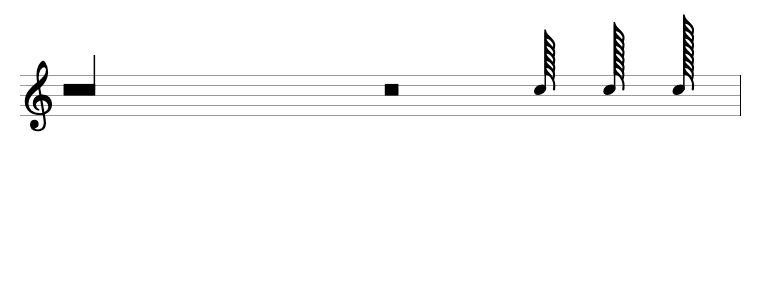
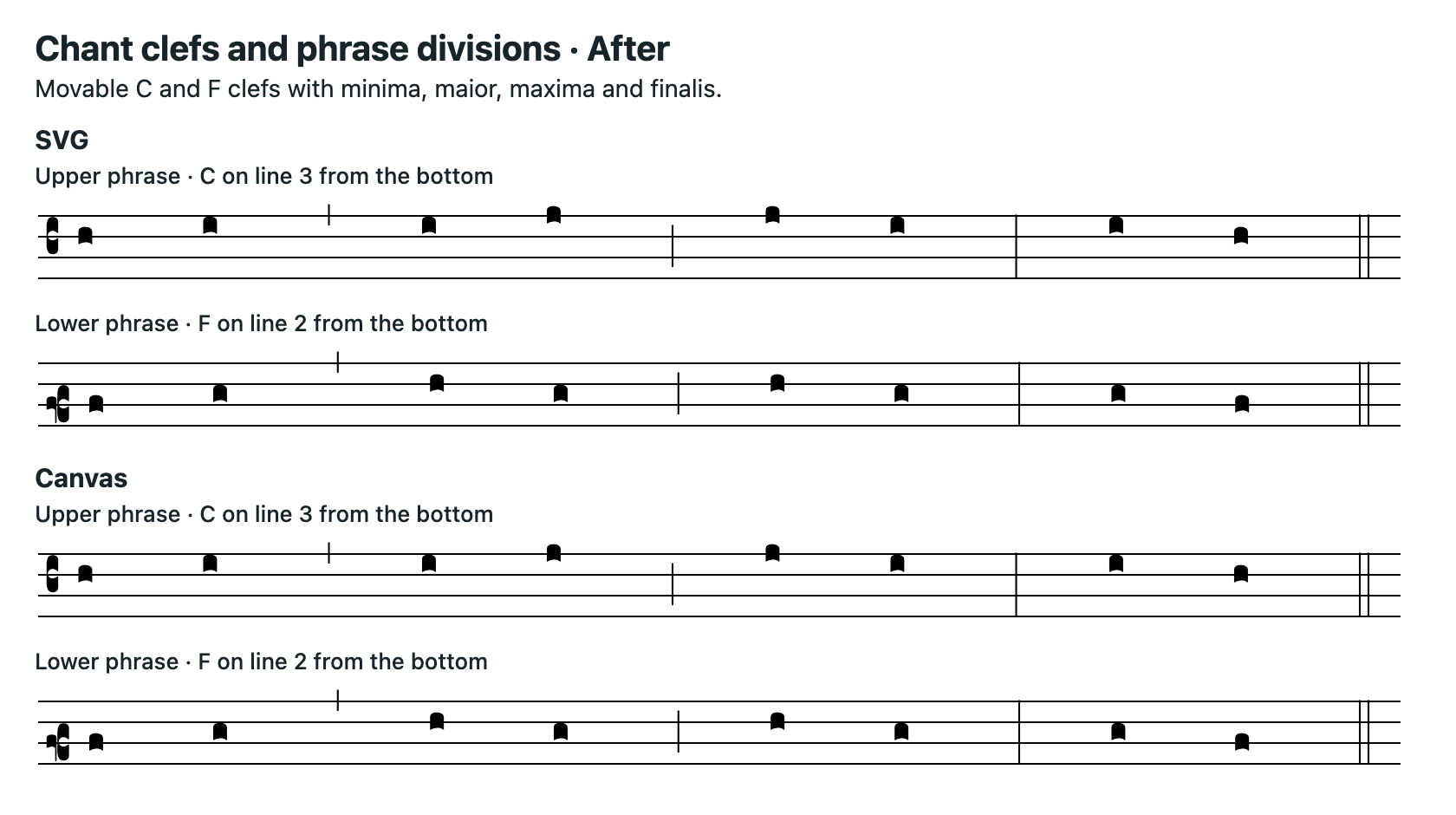
Longa and maxima join the long-duration vocabulary. At the other end, notes can carry 256th, 512th and 1024th values with matching flags and tick counts.
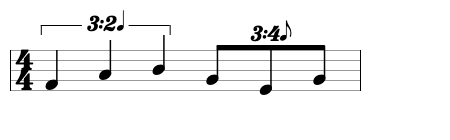
A suffix glyph can show a reference note alongside a tuplet number or ratio. Nested groups retain their own identity and placement, including brackets below the staff.
EasyScore builds automatic groups from the meter and explicit groupings. Tuplets, ties and beams can refer to the same managed notes and preserve strict voice timing.
Two chords can share an alternating tremolo with explicit stroke count, occupied time and written values. The M6 study combines it with literal keyboard, wind and string instructions.
Sheet groups formatted systems into rows and exposes their bounds and overflow. Retained drawing lets a host change the available width and lay out the same notes again.
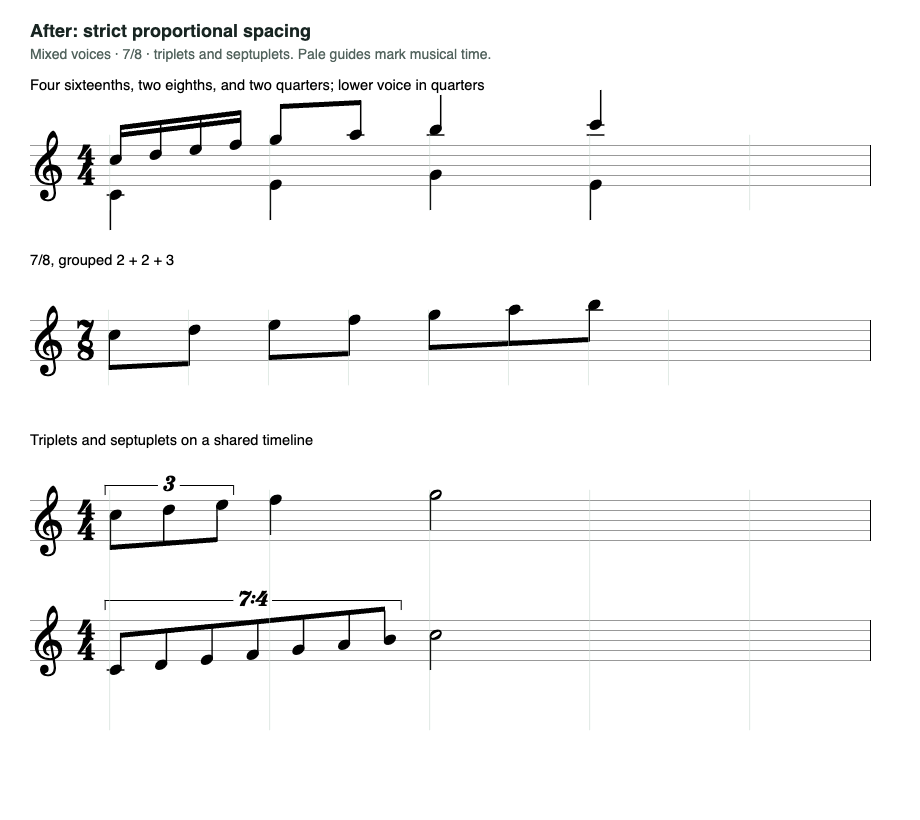
Strict proportional spacing aligns events against a common rhythmic timeline. Optical spacing reserves measured ink and reports a minimum width when an inline prefix or short ending needs room.
Callers can inspect qualified note, stem and beam regions before drawing. Engraving policy can use staff-space units and a score-specific profile with font metadata and fallback.
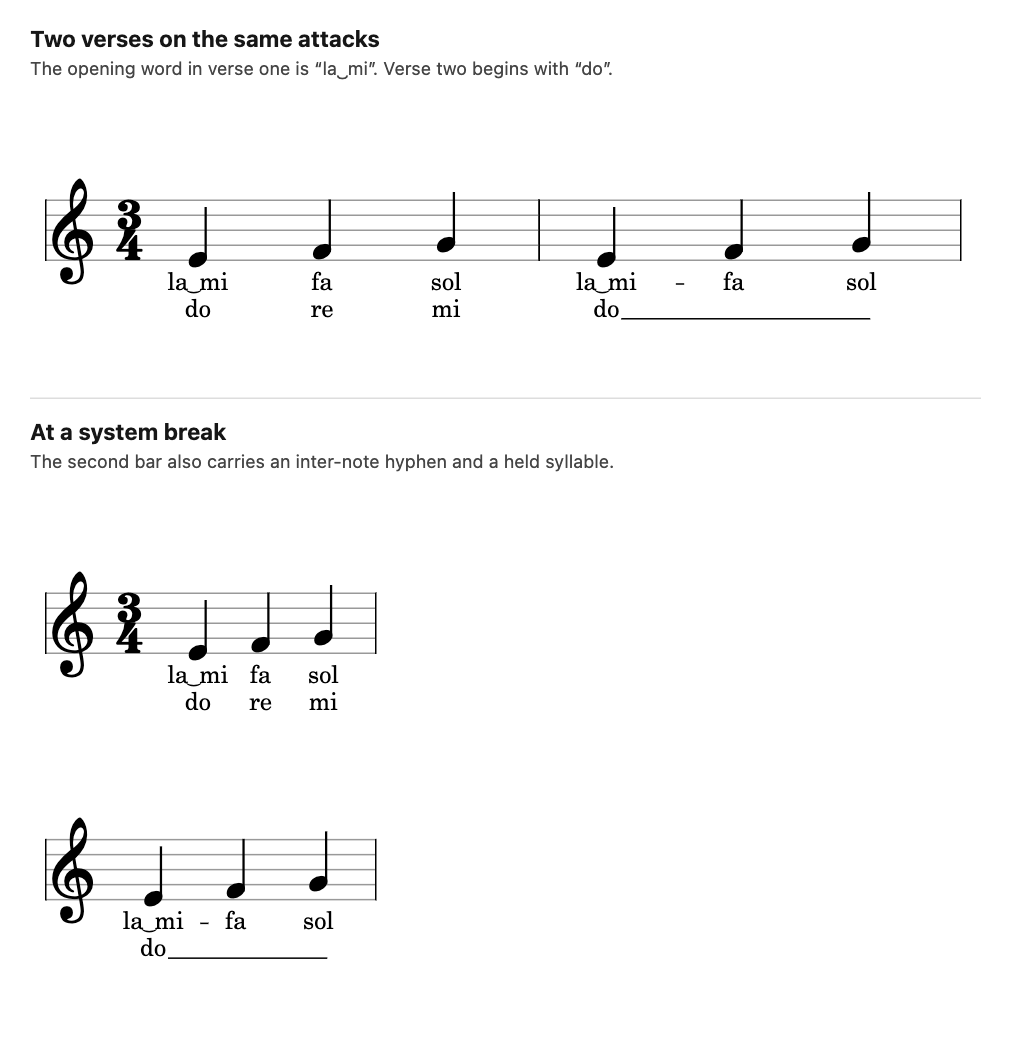
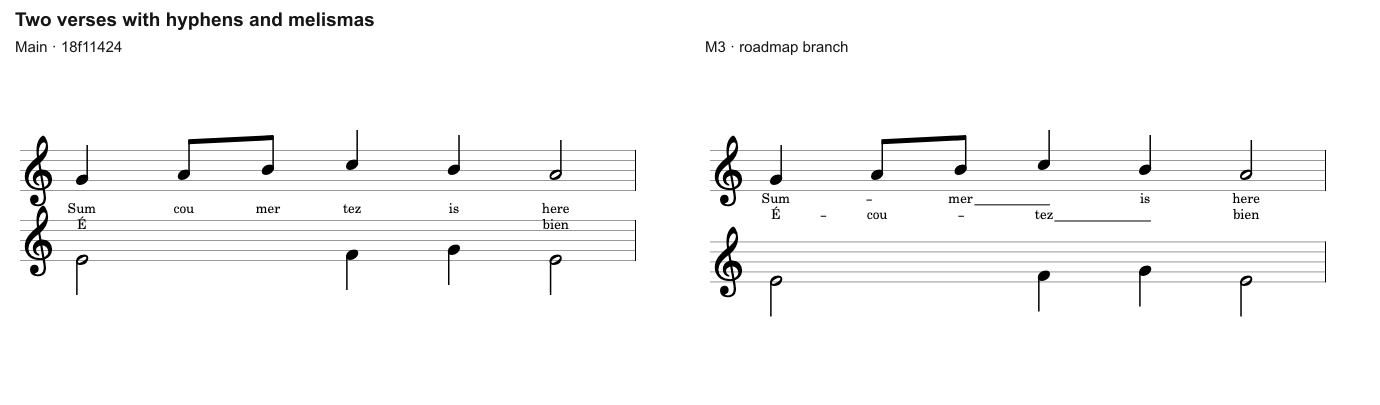
Phrase layout assigns verses to shared baselines and draws hyphens and melisma extenders. Skipped attacks preserve the syllable sequence and alignment with the music.
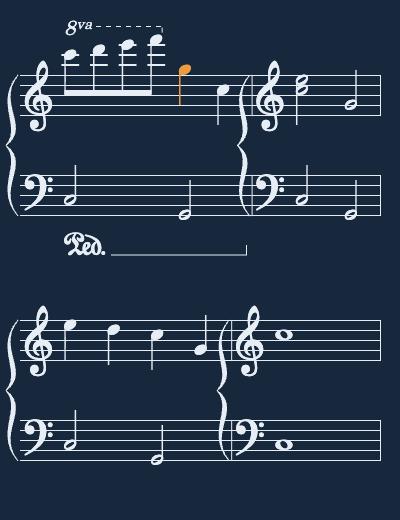
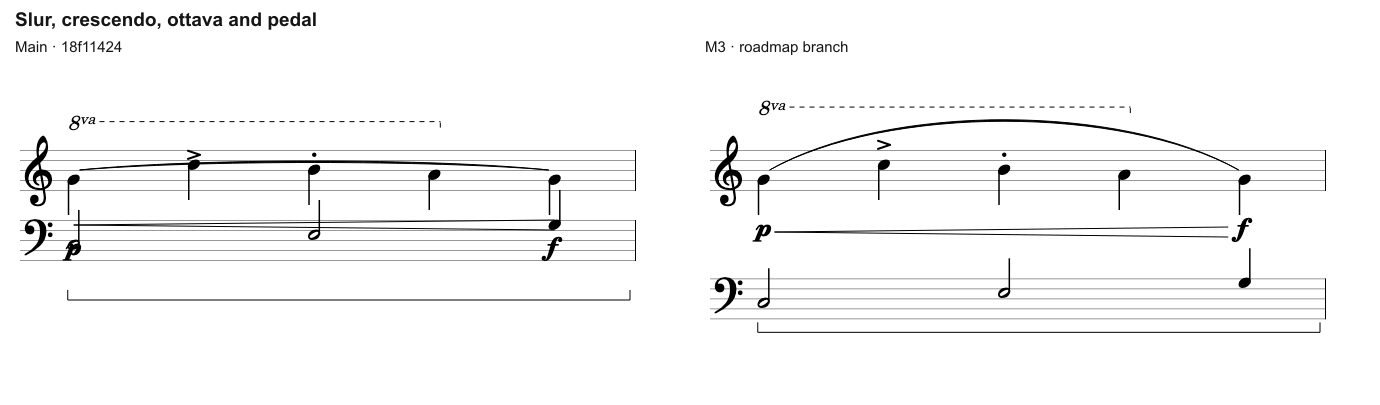
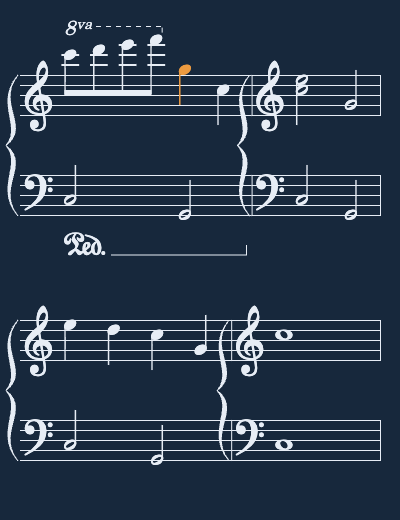
A phrase can fit a slur past intervening ink and reserve lanes for dynamics, hairpins, pedal and octave lines. Infeasible pinned positions produce a diagnostic.
Greedy and balanced break selection use measured row costs, authored keeps and mandatory breaks. Changing width can move a complete group to another system.
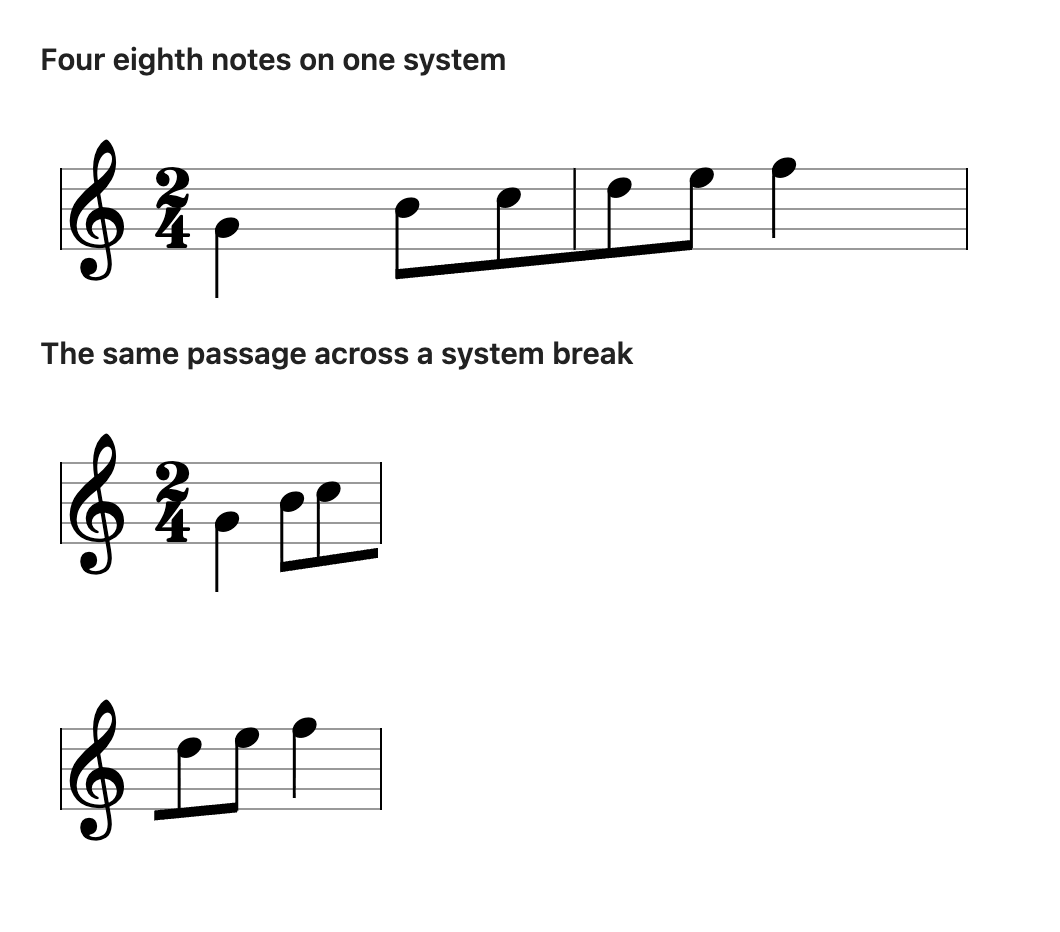
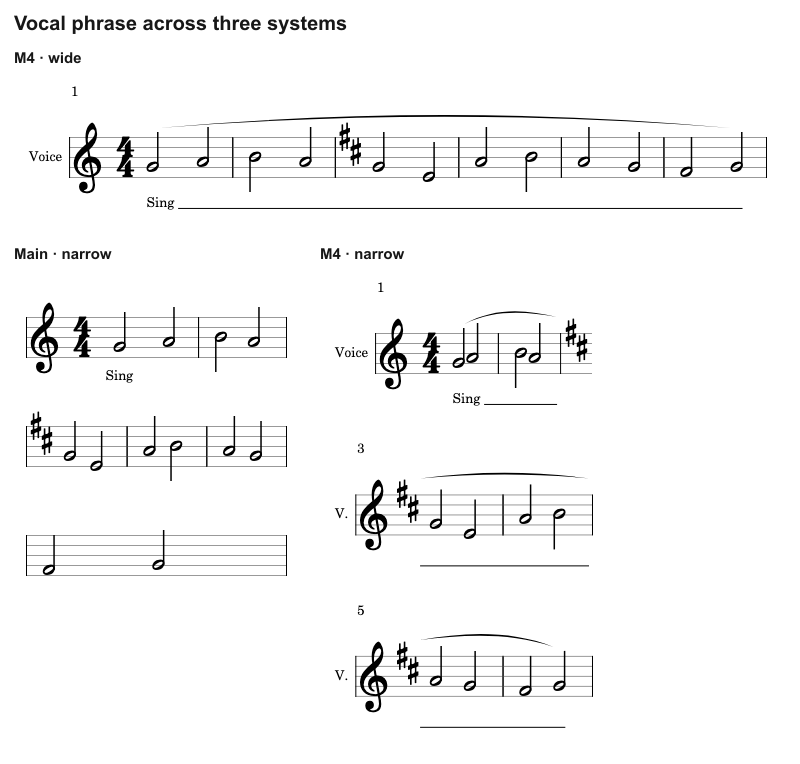
Ties, slurs, wedges, pedals, lyrics, tuplets, endings, octave and trill lines split into indexed fragments. Labels, continuation pitch and wedge aperture follow the logical span across the break.
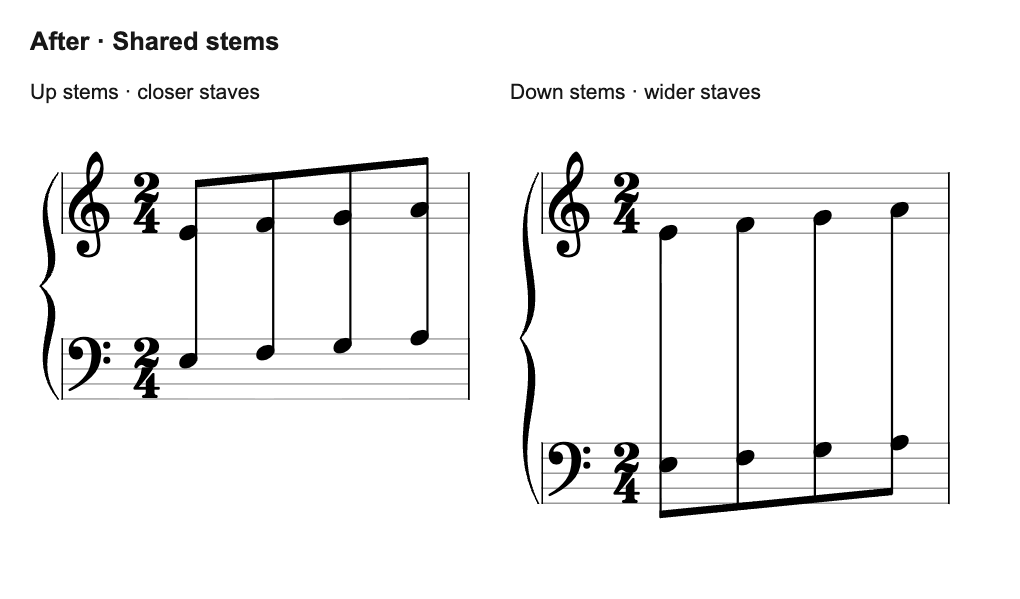
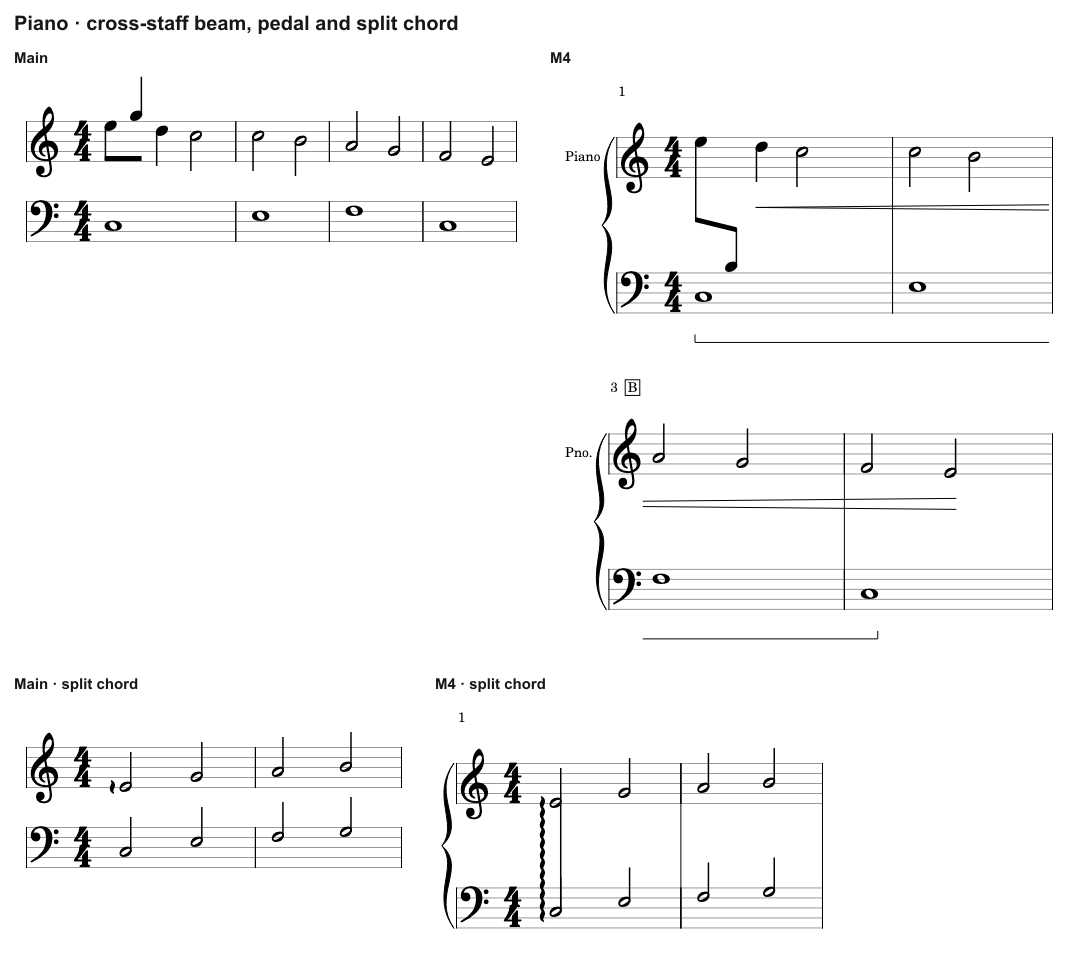
Cross-staff beams and split-chord stems follow displayed staves, while empty-staff hiding and multimeasure rests preserve the original measures. Returning players retain their identity.
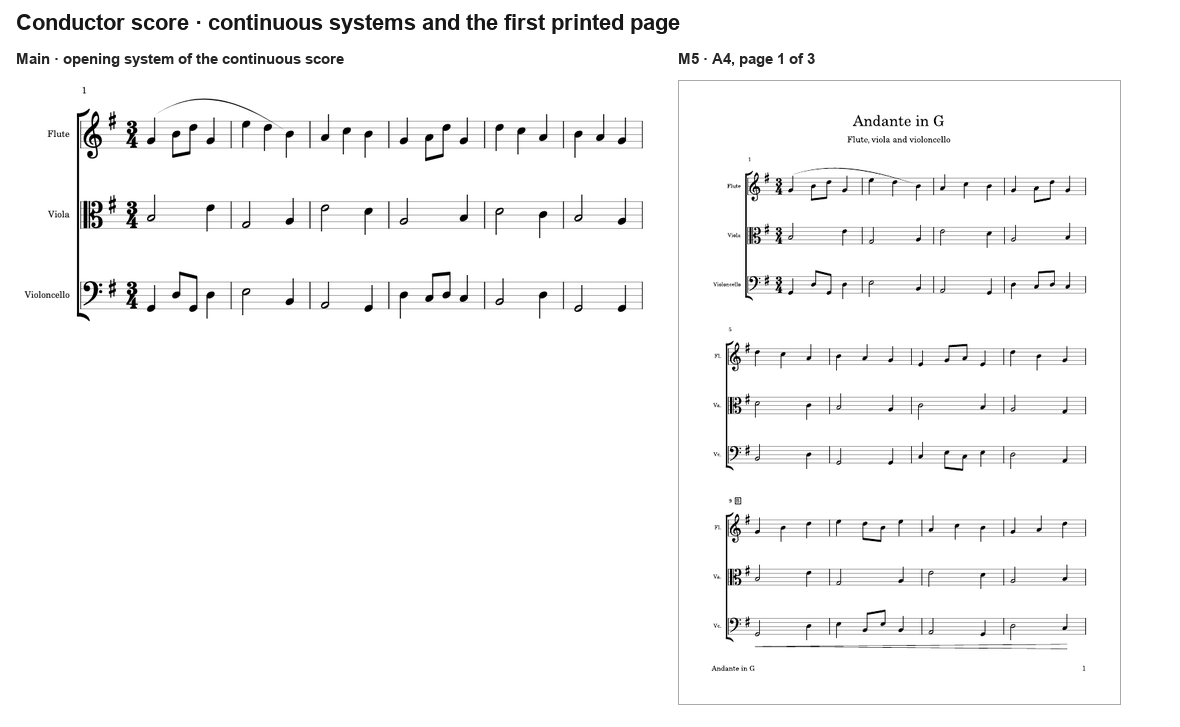
Publication lays out physical paper sizes, page furniture, margins, turn constraints and independent part views. SVG pages retain source IDs; cues and ossias remain distinguishable from the performing voice.
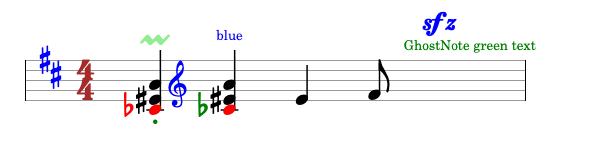
Factory styles propagate through staves, notes, stems, ledger lines and separately queued marks. Element-specific colors can still highlight an individual note.
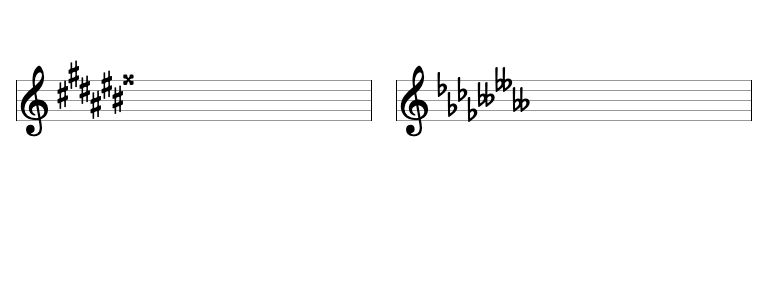
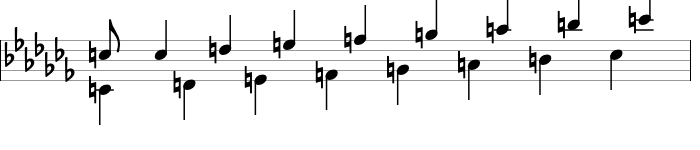
The numbered sharps and flats syntax supports signatures beyond seven signs and explicit zero-sign keys. The key parser validates the range and preserves the requested sign family.
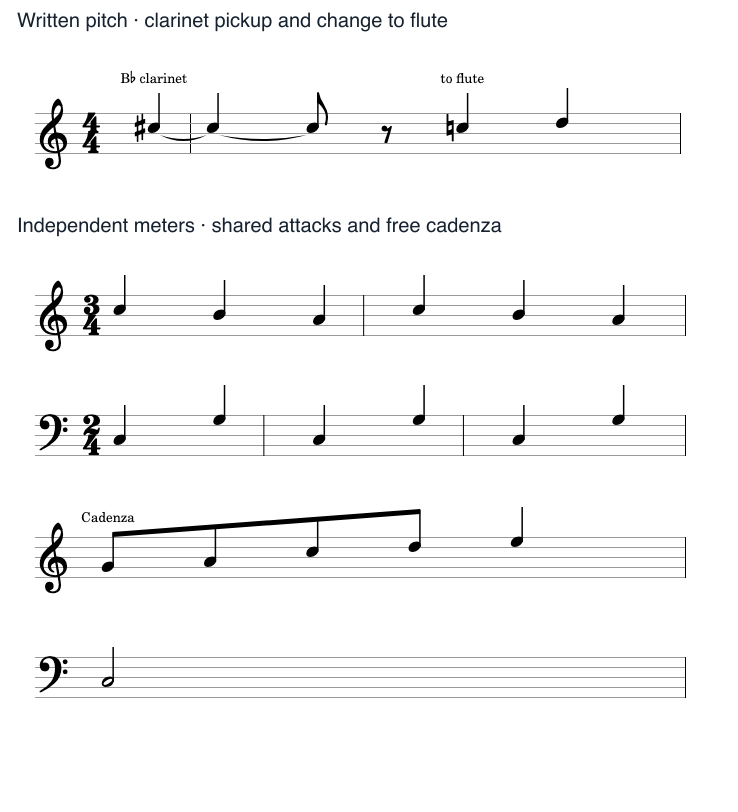
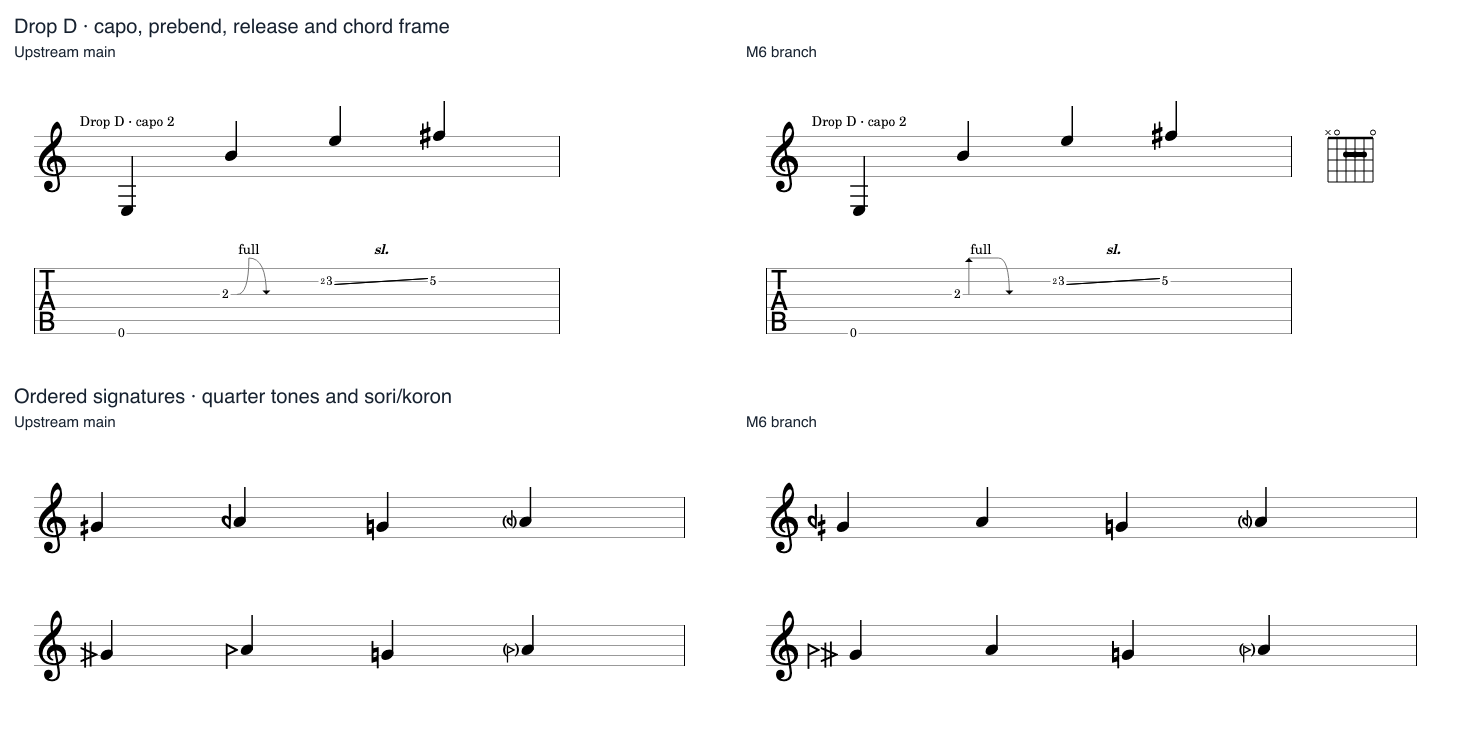
Explicit pitch spelling, ordered microtonal signatures, courtesy signs and cancellation survive construction. The clarinet study exercises a pickup and a tied spelling through an instrument change.
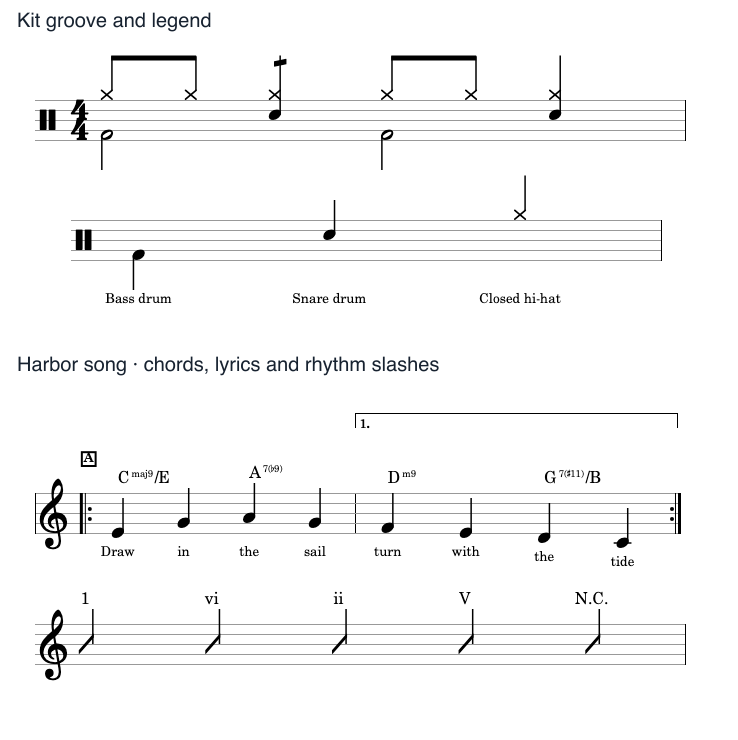
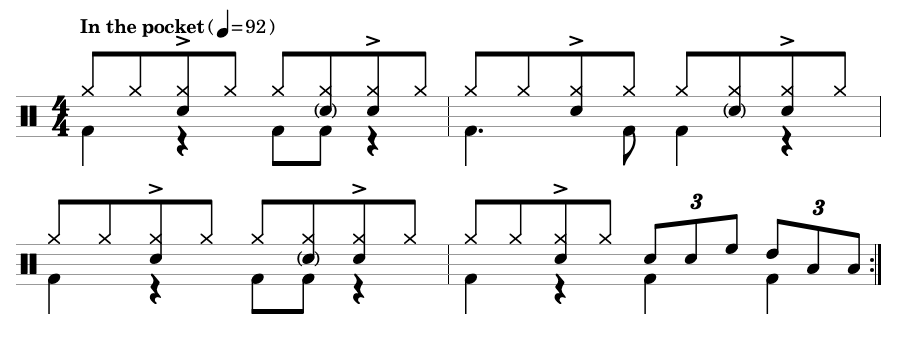
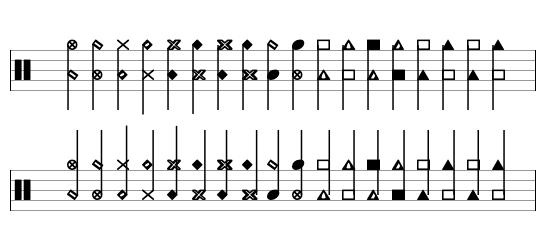
A kit maps instrument names to staff positions and head shapes. The drum-set study includes a legend, mixed heads and independent voices; a second study uses a single visible staff line.
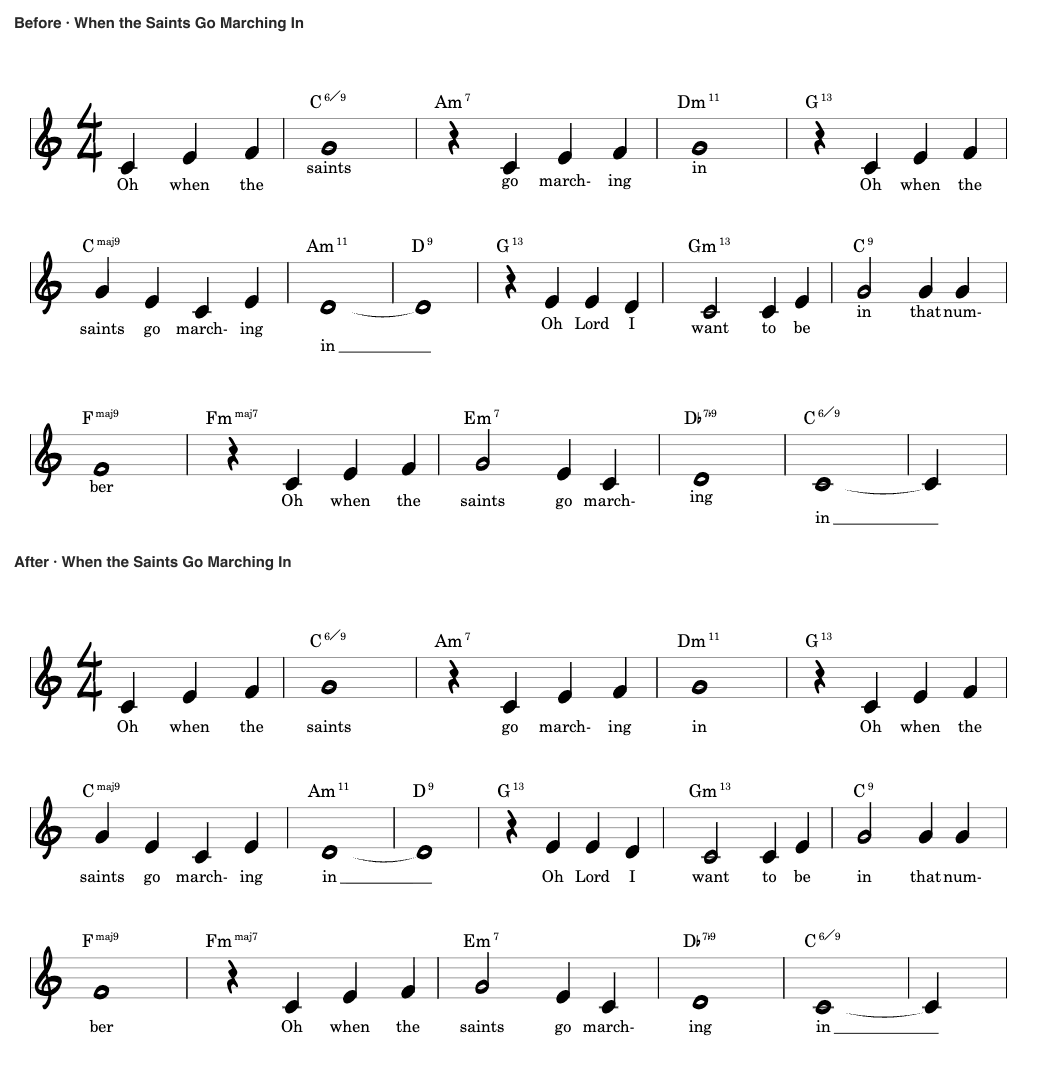
Optional font-specific kerning tightens selected chord-symbol combinations for supported font pairs. The Harbor Song study combines literal chord names, slash bass, lyrics, rhythmic slashes and a repeat.
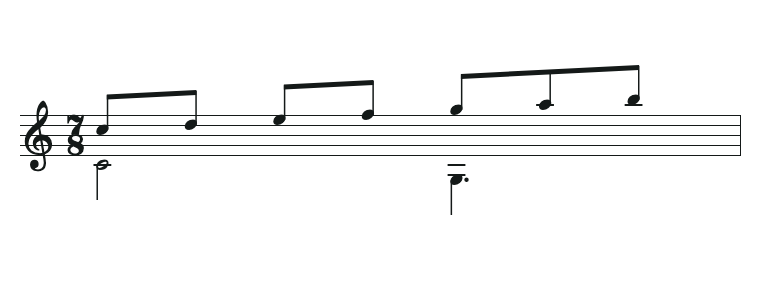
A fixed six-quarter window aligns two bars of 3/4 with three bars of 2/4. The later ensemble control prints separate parts with a common rehearsal entrance. General independent-meter pagination remains a future requirement.
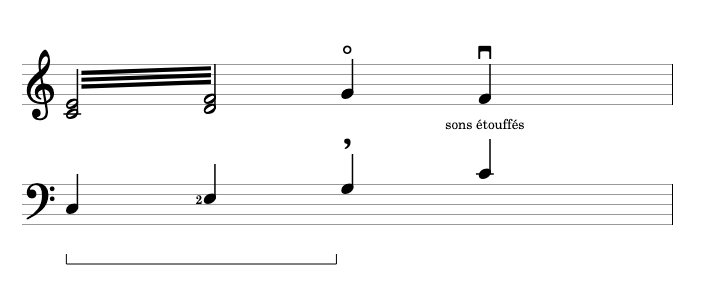
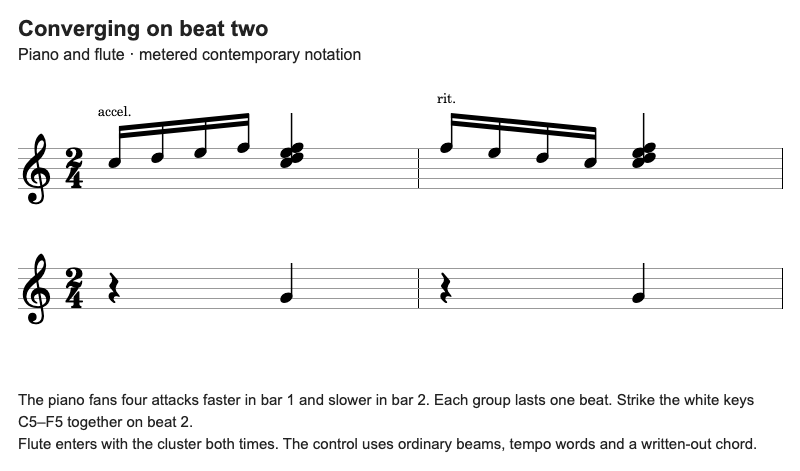
An original piano-and-flute study tests the meeting point after a measured group and the limits of a white-key cluster. Conventional notation establishes a reading target for future feathered and spatial notation.
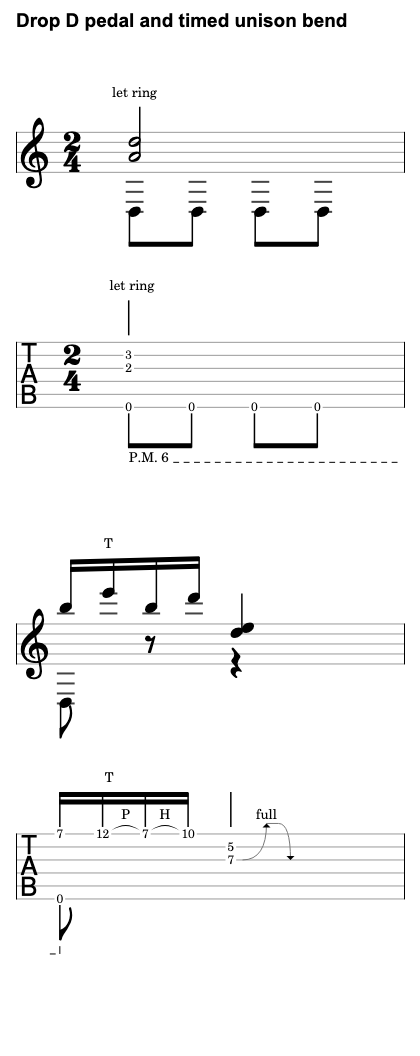
A fretted instrument derives staff and TAB descriptions from tuning, string positions and capo. The Drop D study combines a fret frame, grace slide, prebend, hold and release.
Each measured stroke records its finger and physical direction. Reversing the printed arrow convention preserves the performed order, and a simultaneous golpe consumes no extra time.
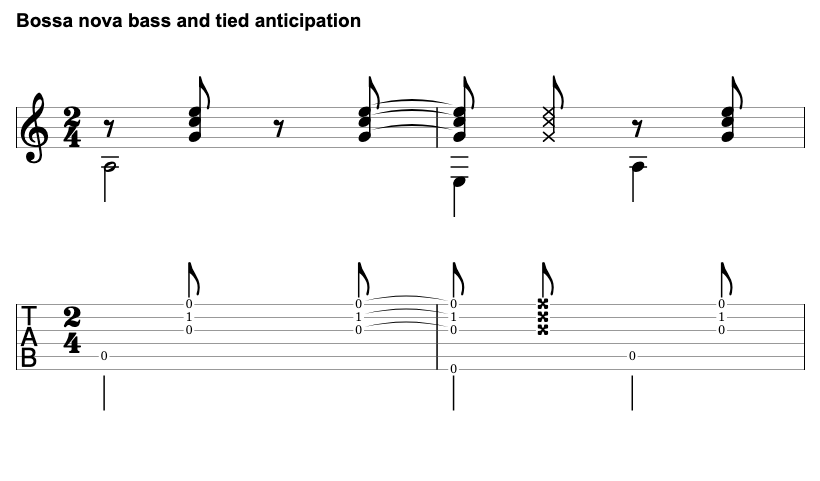
Independent bass and chord voices preserve offbeat attacks and a three-head tie across the bar. A struck muted string has a timed X on TAB and a crosshead at its written display position.
A mute targets named strings between inclusive attacks and continues over a system break. A bend on one member of a dyad retains its semitone change and exact rise, hold and release fractions.
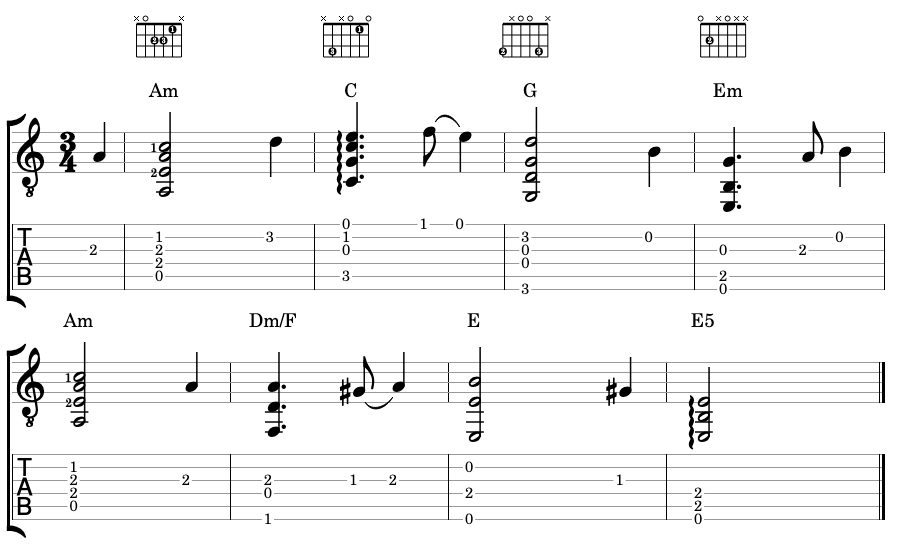
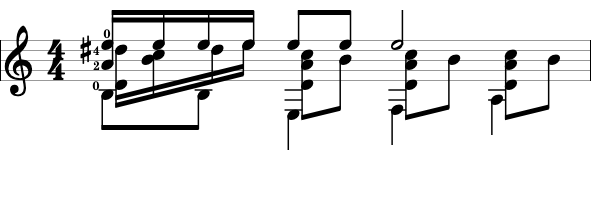
Compare the guitar chord melody with an electric lead part. The two examples use paired notation and tab to show harmony, legato and technique markings.
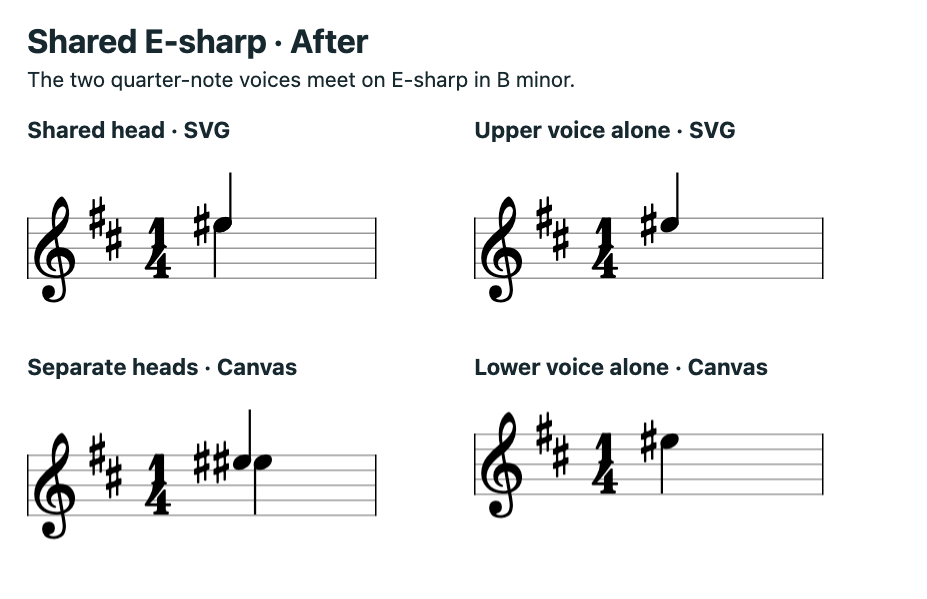
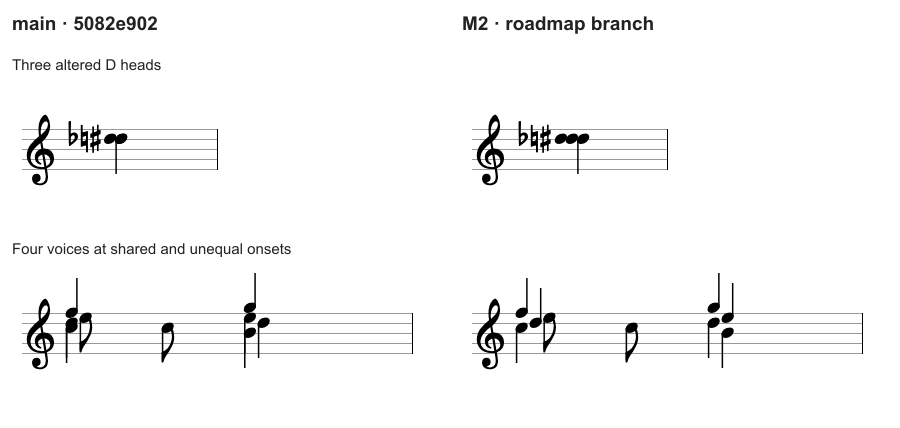
Three enharmonically distinct heads on one line now remain visible. Shared positions and accidental columns are ordered consistently across voices, and four close voices reserve separate columns where needed.
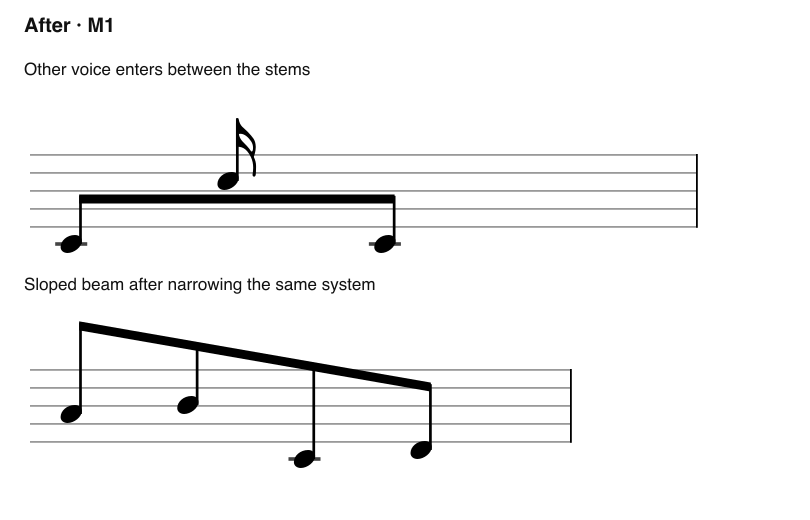
A beamed middle voice now clears a lower head at the shared attack. Later clearance checks include intervening heads between beamed attacks and preserve stem joins after reflow.
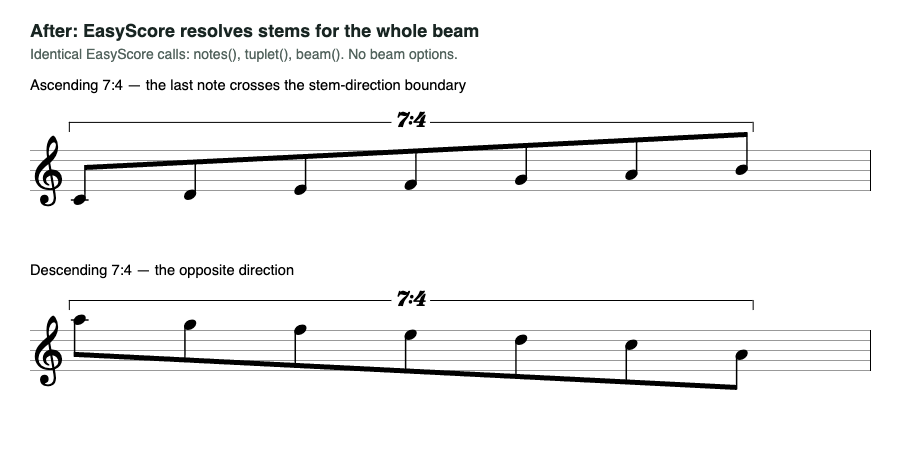
EasyScore resolves automatic stem direction for the complete group before drawing. The regression includes a group passing through the middle staff line.
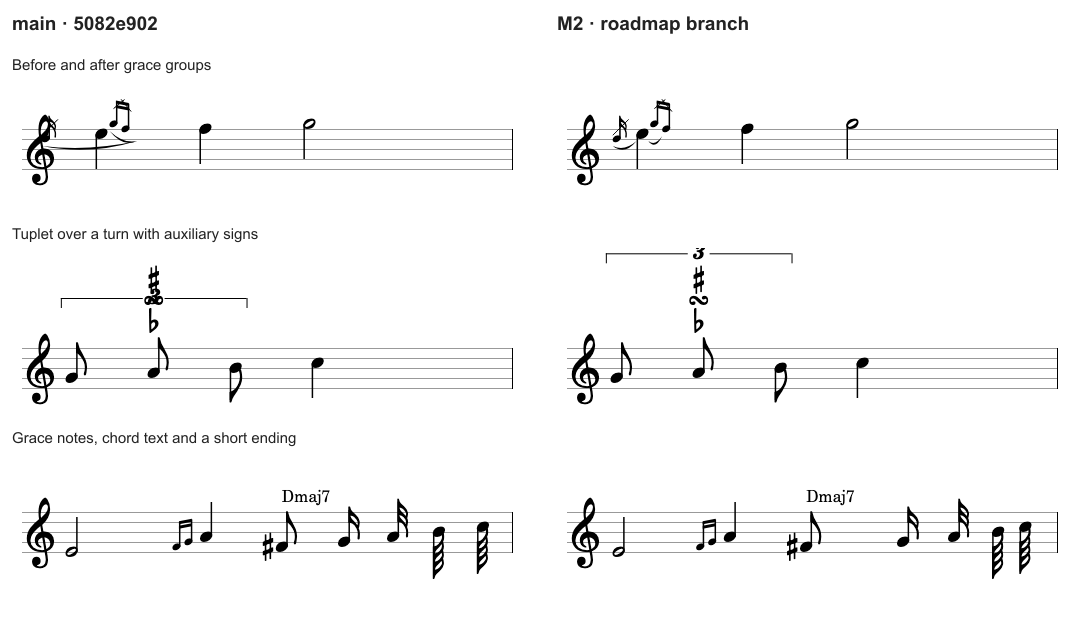
Brackets now reserve space above mixed marks and beneath the reference triplet. Nested groups and auxiliary ornament signs contribute to the measured clearance.
Upward and downward slurs now follow the requested opening and clear the intervening group in both reference passages. Endpoints remain attached to the intended notes.
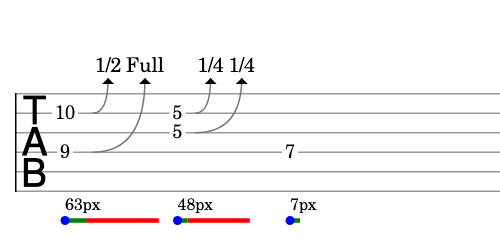
Multiple bends on one chord are ordered and nested by string. The half bend sits inside the full bend and two quarter bends remain traceable to their own arrows.
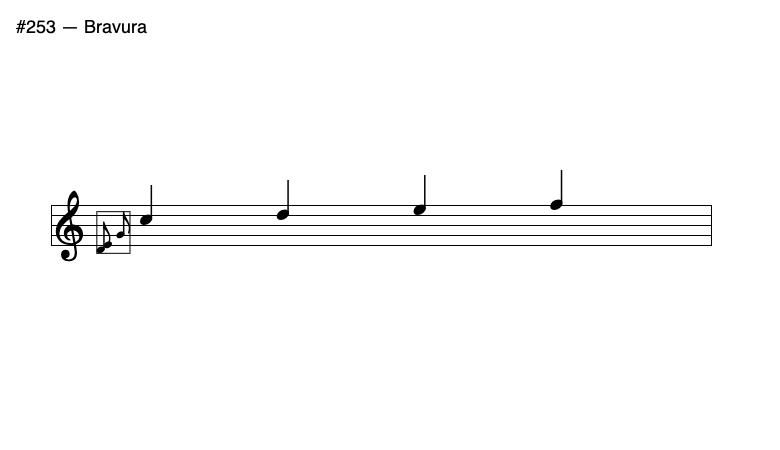
Ordered grace accidental policy resolves before-groups, hosts and after-groups in sequence. Groups attached to opposite sides reserve separate space and their slurs meet the appropriate head edges.
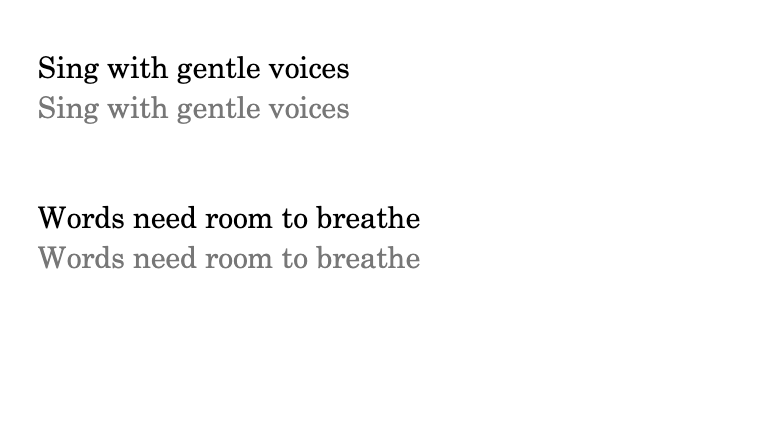
Annotations prefer the text face while notation glyphs retain the music face. Lyric syllables can share an explicit baseline across notes with different stems and pitches.
Drawing an articulation twice preserves its position. Curves, strokes, clefs, signatures and tuplets gained or corrected bounds used by pointer targeting and measurement.
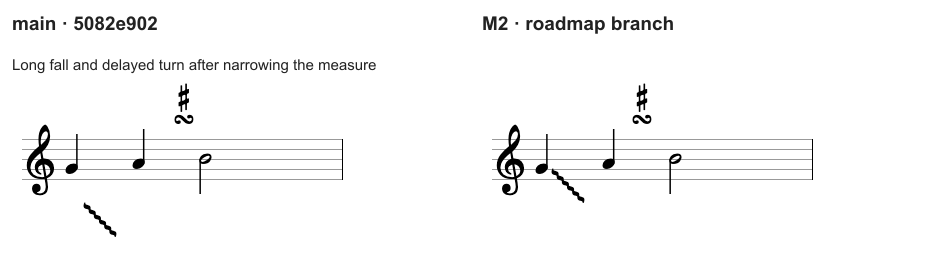
Delayed turns and long falls recompute their offset from the current neighboring note. Retained draws avoid accumulating offsets from an earlier width.
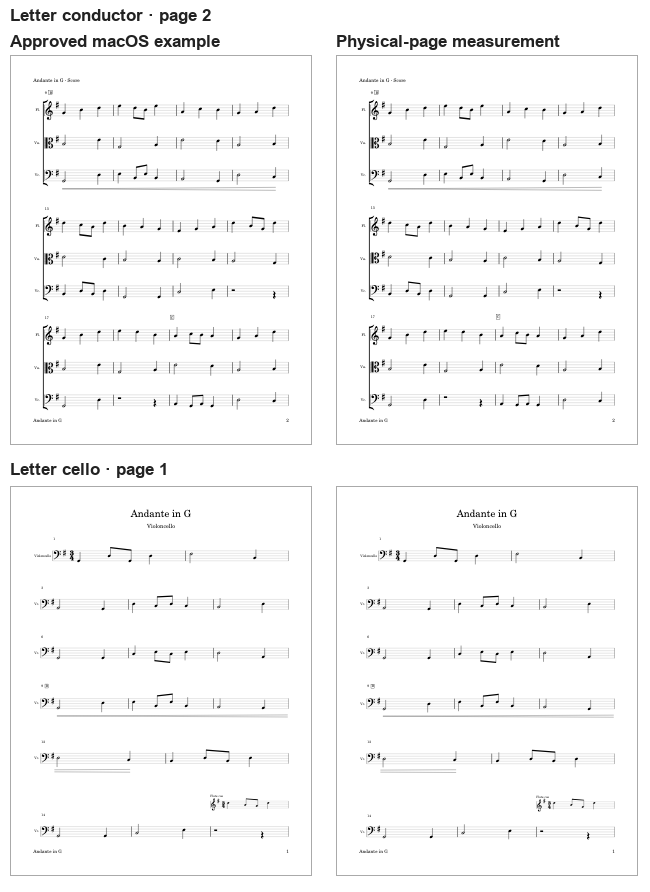
Pagination measures headings and footers in the physical print viewport. The Letter turn uses the available space after accounting for the actual footer and system height.
Automatic accidentals process onsets in numeric order and consider notes at a shared onset together. Reordering the input voices leaves the printed accidentals in place.
Repeated attachment is idempotent. Voices refresh total ticks, shortest duration and spacing weights after tuplet changes, including nesting and detachment.
Composed key changes preserve the active clef and numbered sharp signatures keep their sharps. Both changes prevent the printed sign or position from contradicting the source.
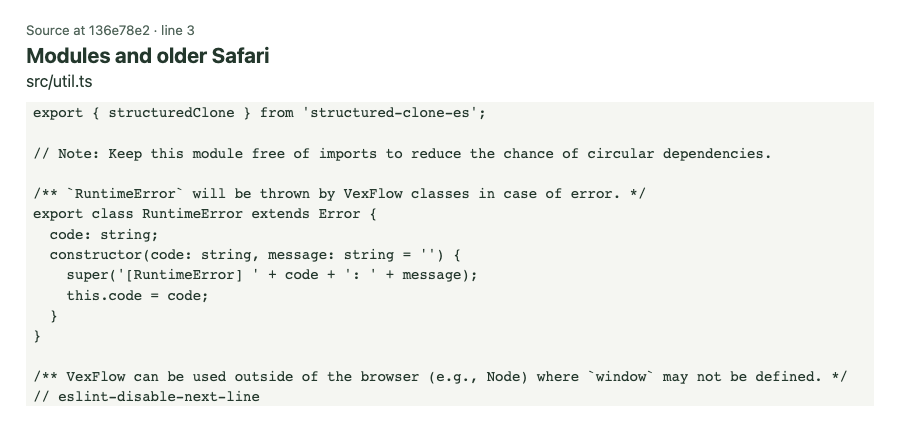
Published ESM imports resolve under Node, and the package verifies ESM, CommonJS and declarations with an external consumer. A structured-clone ponyfill covers older Safari runtimes.
The guide reuses a warm runtime across edits and navigation. Async failures keep their error details, reset isolates prior execution, and scaled pointer coordinates resolve the intended target.
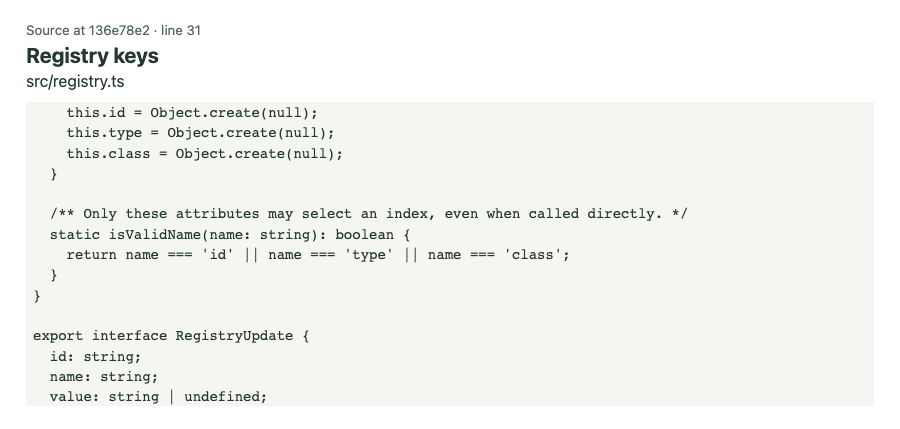
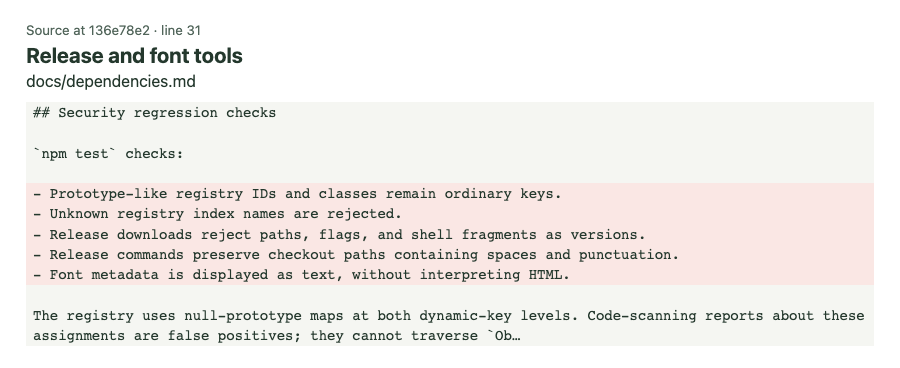
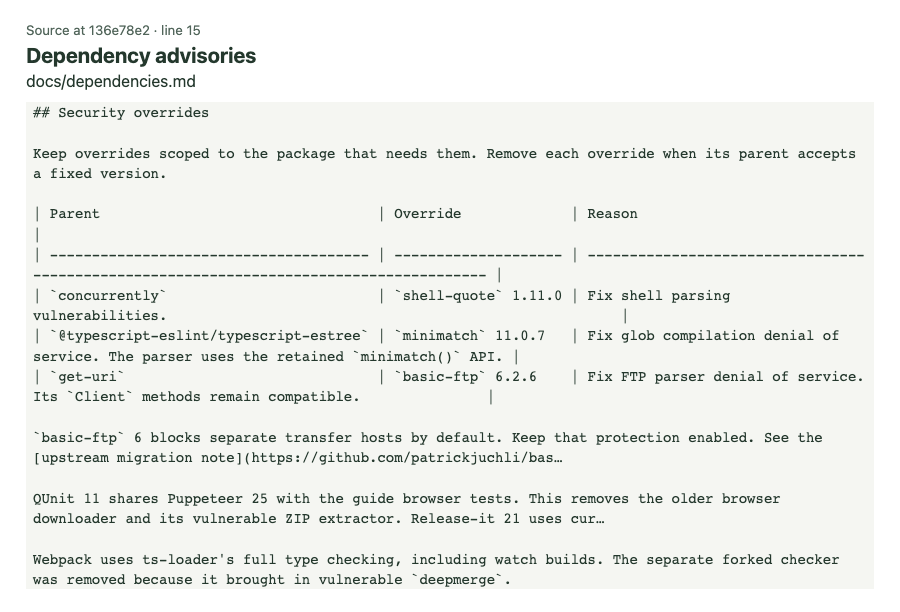
The project updated DOMPurify, shell-quote, fast-uri, zod and ip-address, plus browser download and build dependencies. Scoped overrides cover specified minimatch, basic-ftp and shell-quote paths.
The host runs editable code inside a sandboxed preview iframe and handles its messages and errors. Standalone downloads and resets have regression checks for isolation.
Construct and attach an owned grace group, or mix pitched and shaped percussion heads in a typed sequence. Both studies render through the public EasyScore API.
Typed constructors cover staff and TAB notes, rests, modifiers, grace groups and stave markings. Batch construction, validation and scoped defaults support editing without leaking temporary settings.
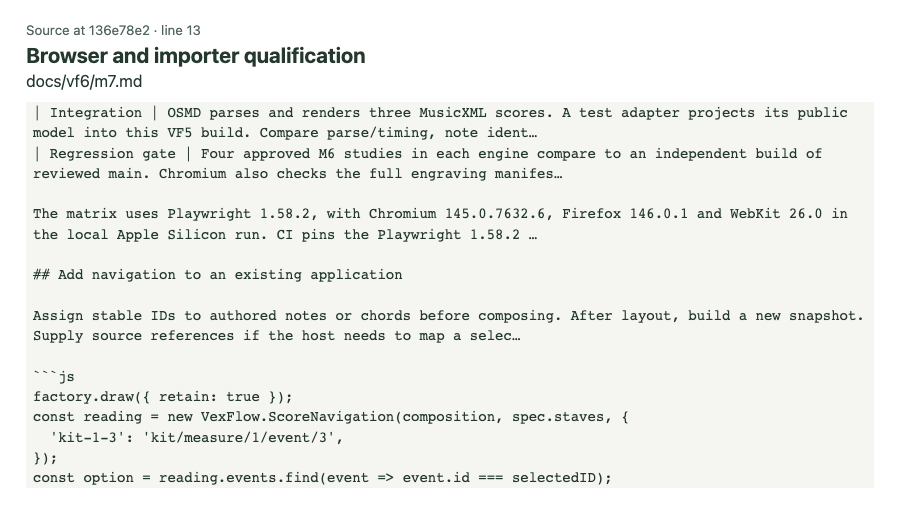
Authored IDs, source spans and validated native adoption let a host map a drawn note back to its input. Relationships validate endpoints and Factory ownership.
Declarative staves and measures support pickups, inherited clef and key, signature repetition, explicit accidental policy and responsive systems. Existing native objects can participate through their owning factory.
Retained drawing, optical spacing, exact spacing, ordered grace accidentals and font-specific chord kerning have explicit entry points. Applications depending on old collision positions may see different geometry after updating.
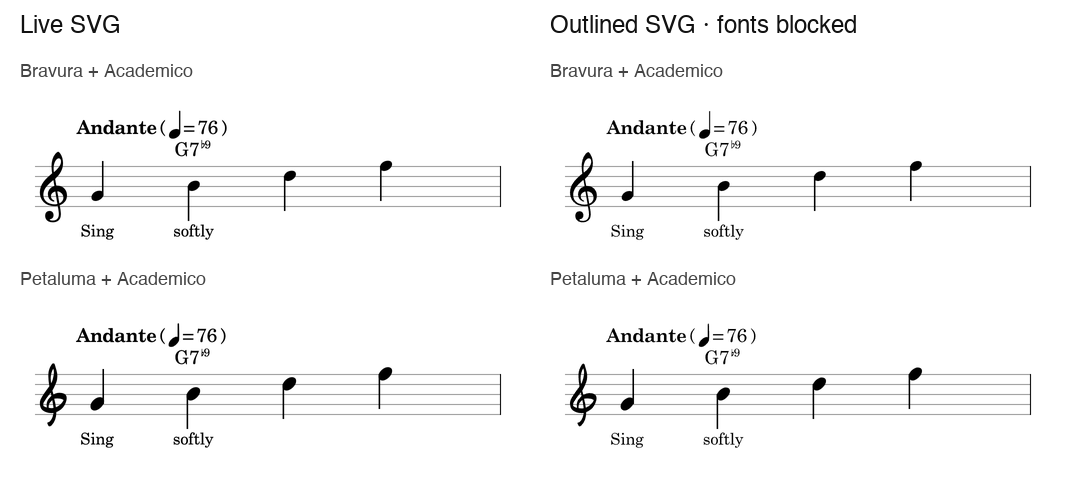
Callers can supply matching fonts to convert music and text to paths for standalone SVG. Missing glyphs or unsupported text produce diagnostics during the export.
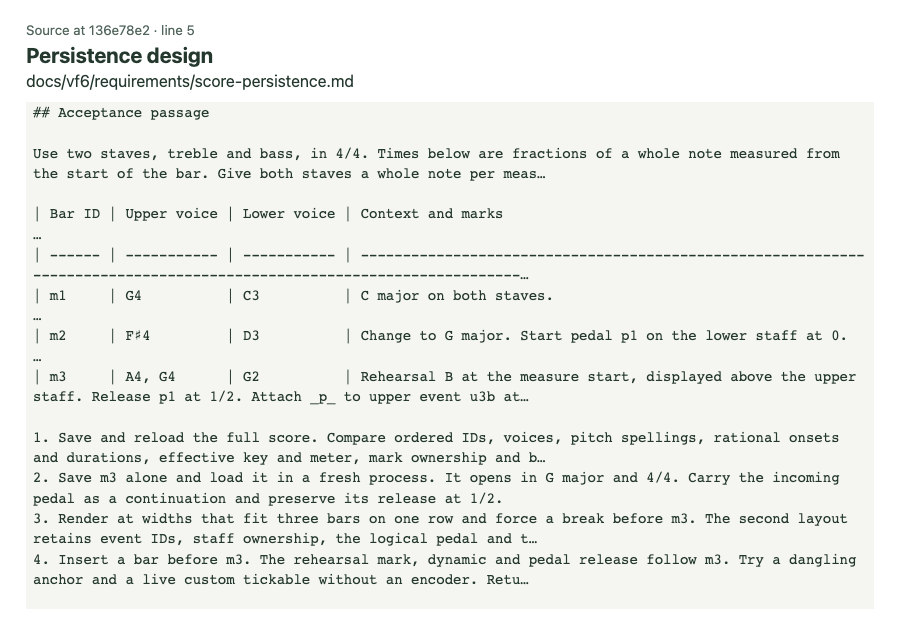
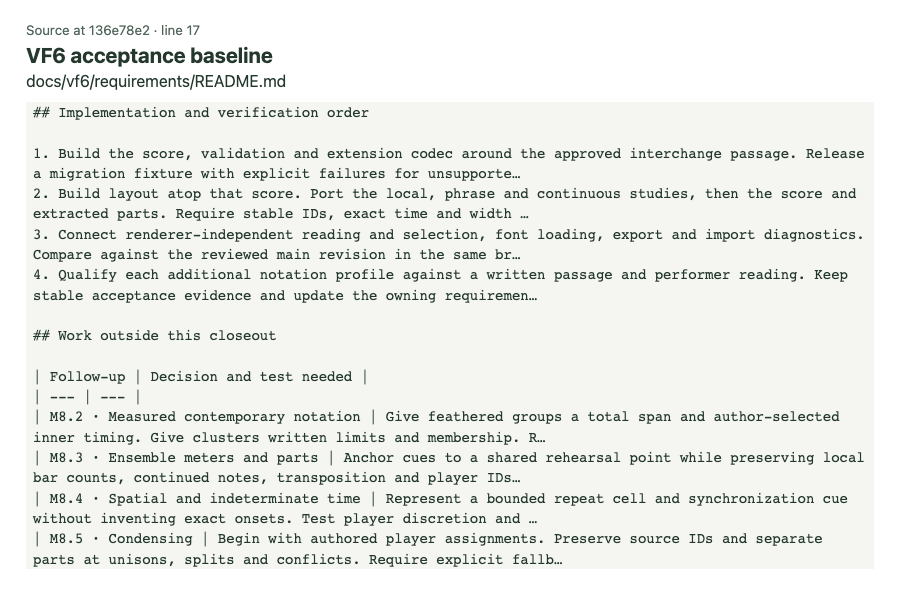
The approved VF6 direction stores versioned measures, rational time, stable IDs, portable excerpts and authored overrides. The executable adapter study documents boundaries of the proposed format.
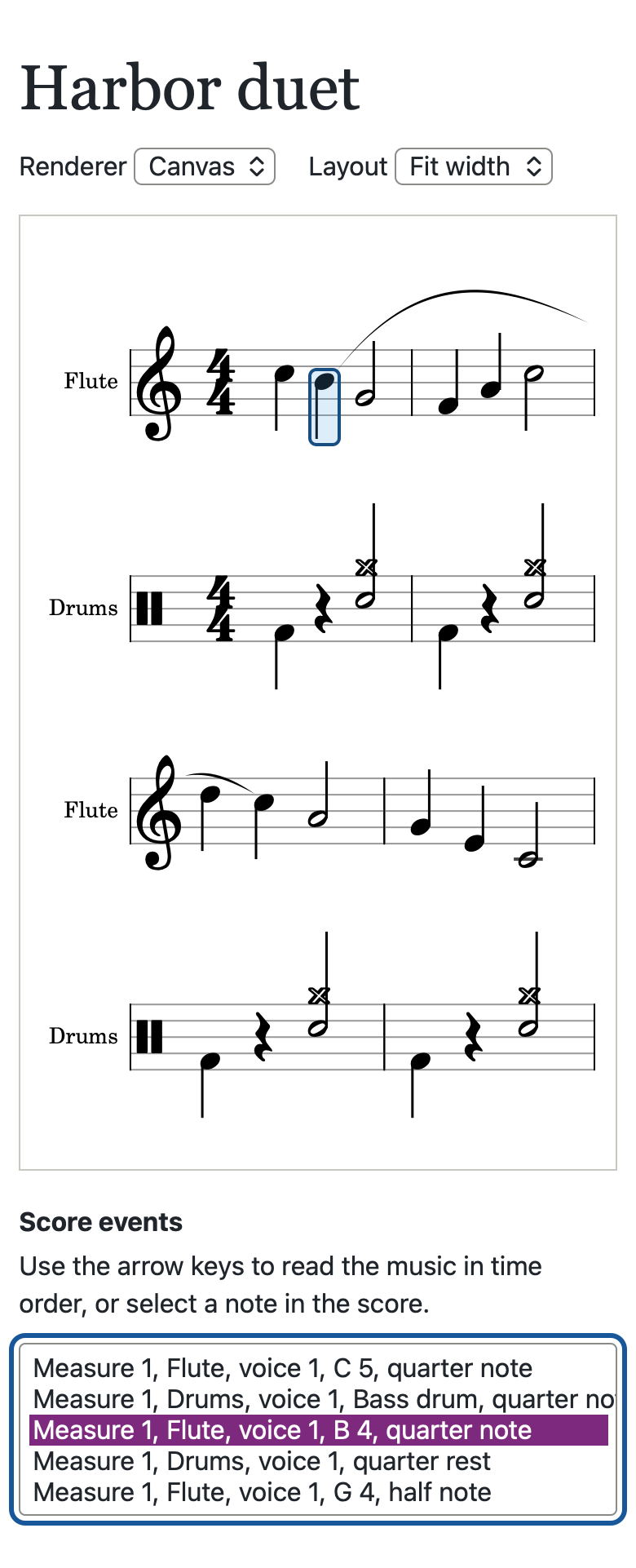
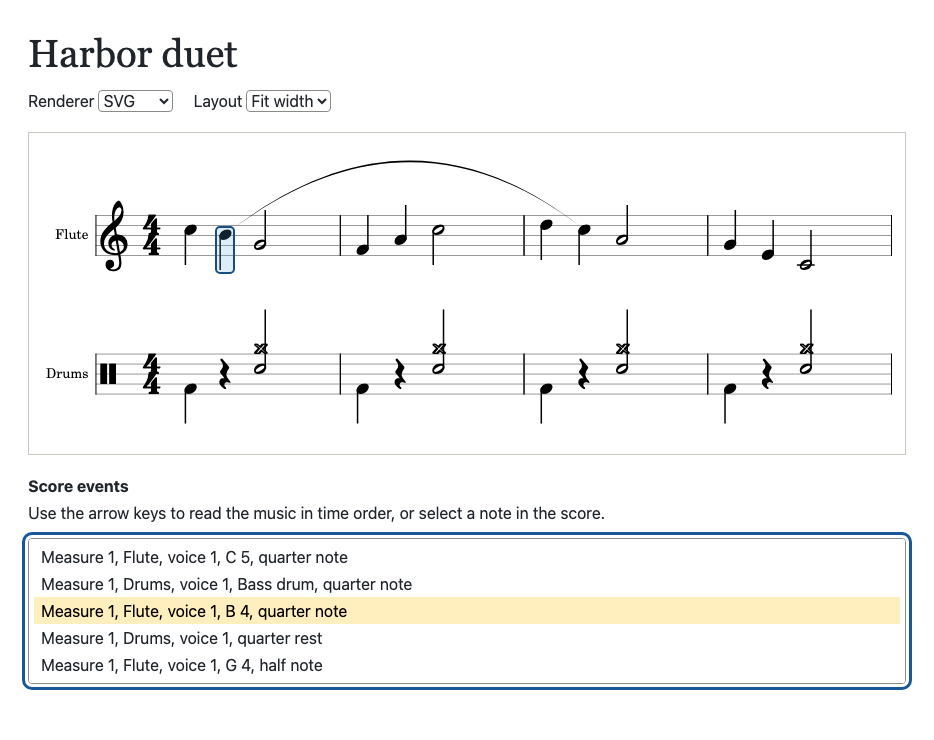
A host-owned list provides the same reading order as SVG. A tap or keyboard move selects the corresponding event even after resizing a high-density Canvas surface.
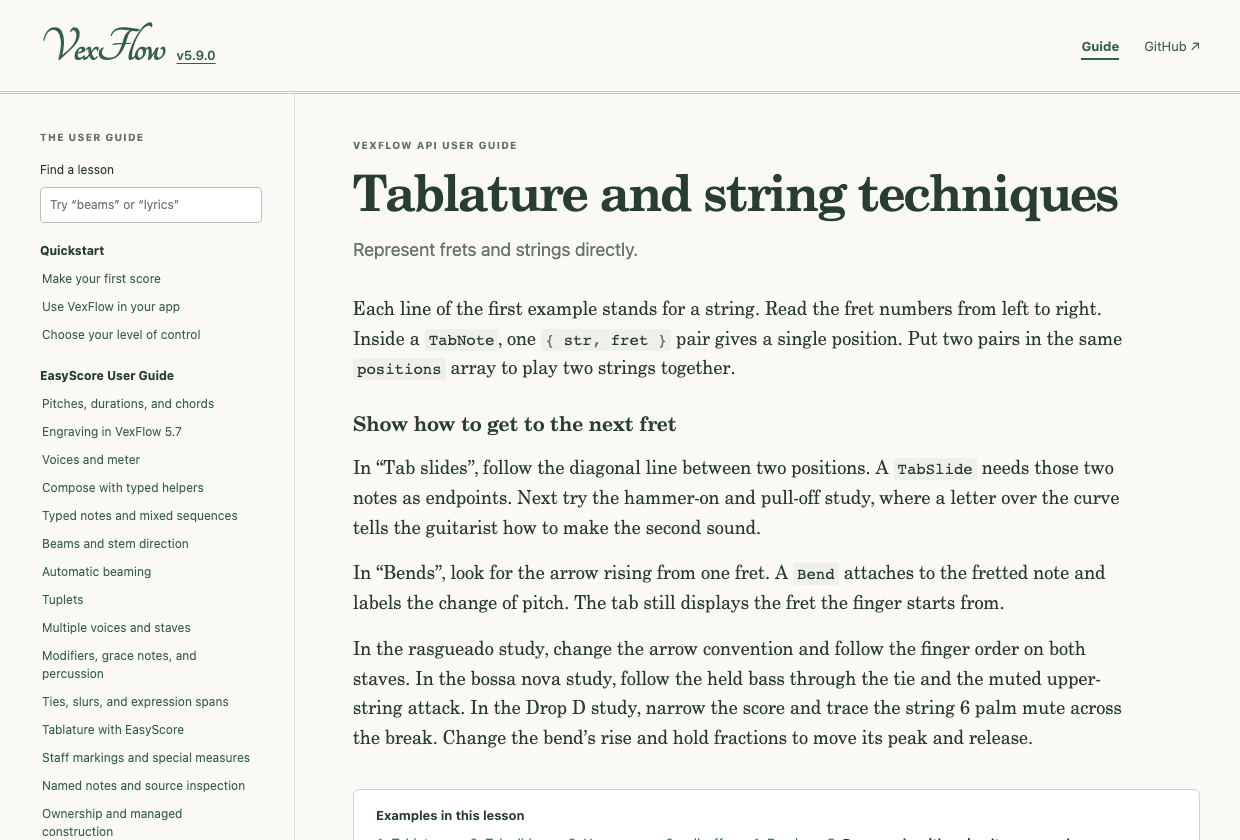
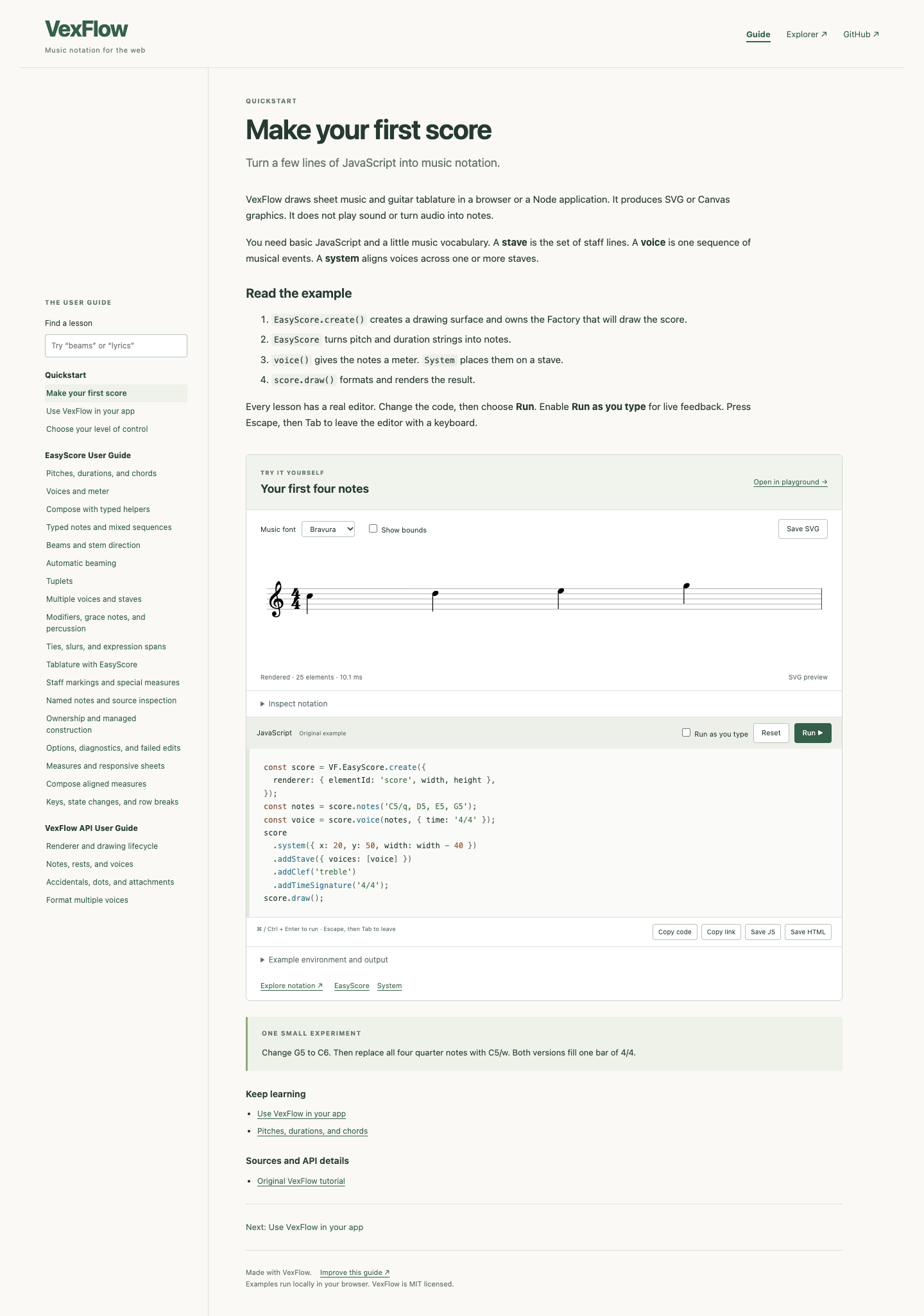
Progressive lessons take a reader from four notes to composition and layout. Lesson deep links, keyboard navigation, local drafts and a shared playground keep examples editable and runnable.
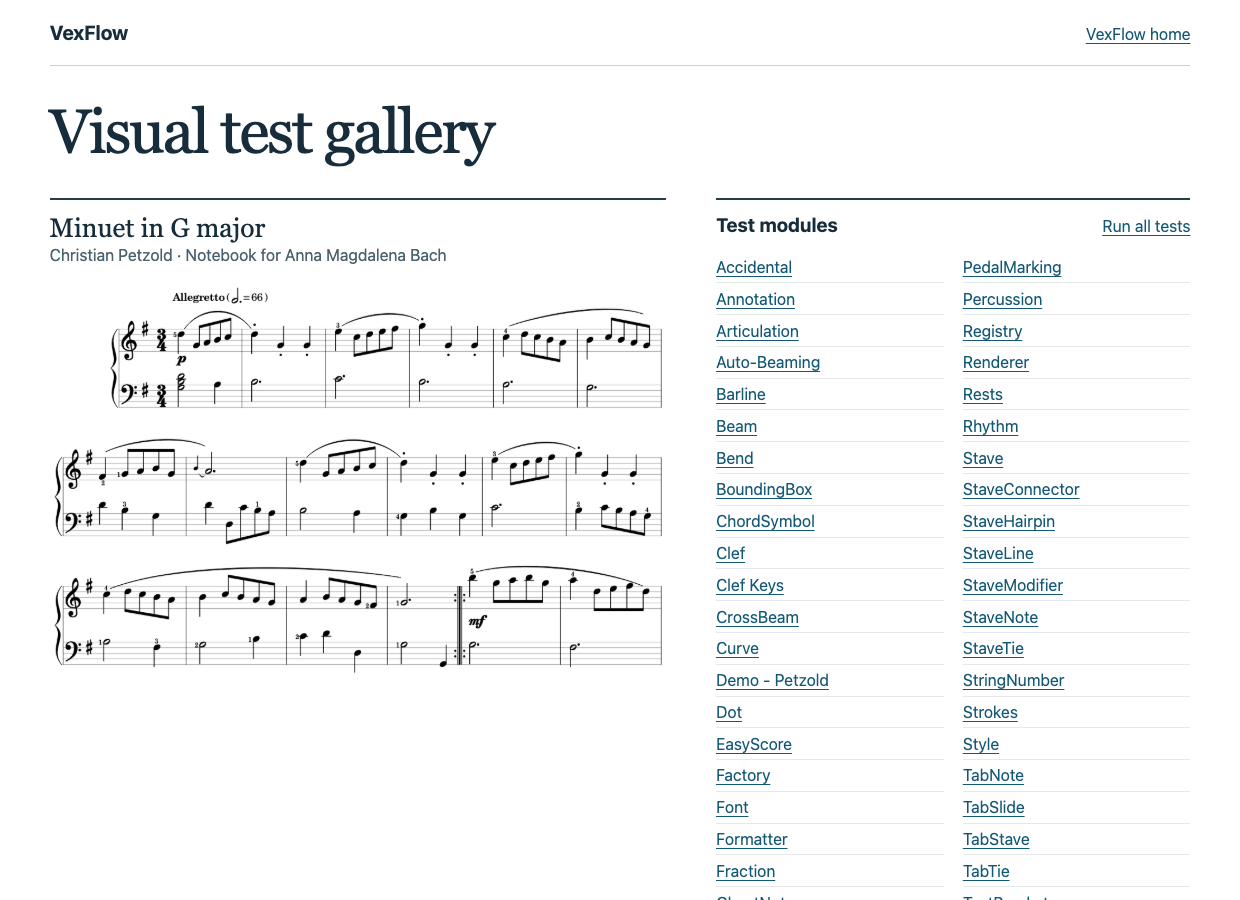
The public module index leads to individual QUnit examples and playable score studies. Bundled fonts, local source and a versioned asset manifest make the site portable.
ScoreNavigation orders logical events by measure, onset, staff and voice. A native list and renderer-independent hit regions preserve selection across SVG, Canvas, zoom and reflow. The roadmap records a human assistive-technology walkthrough.
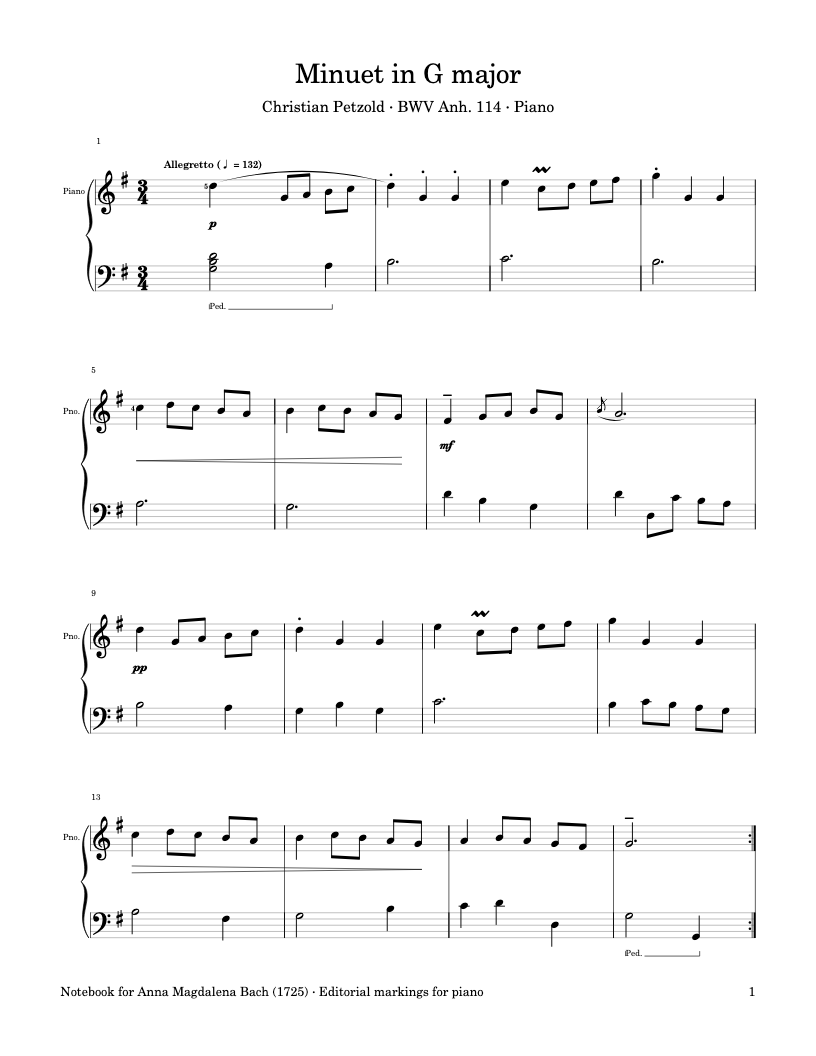
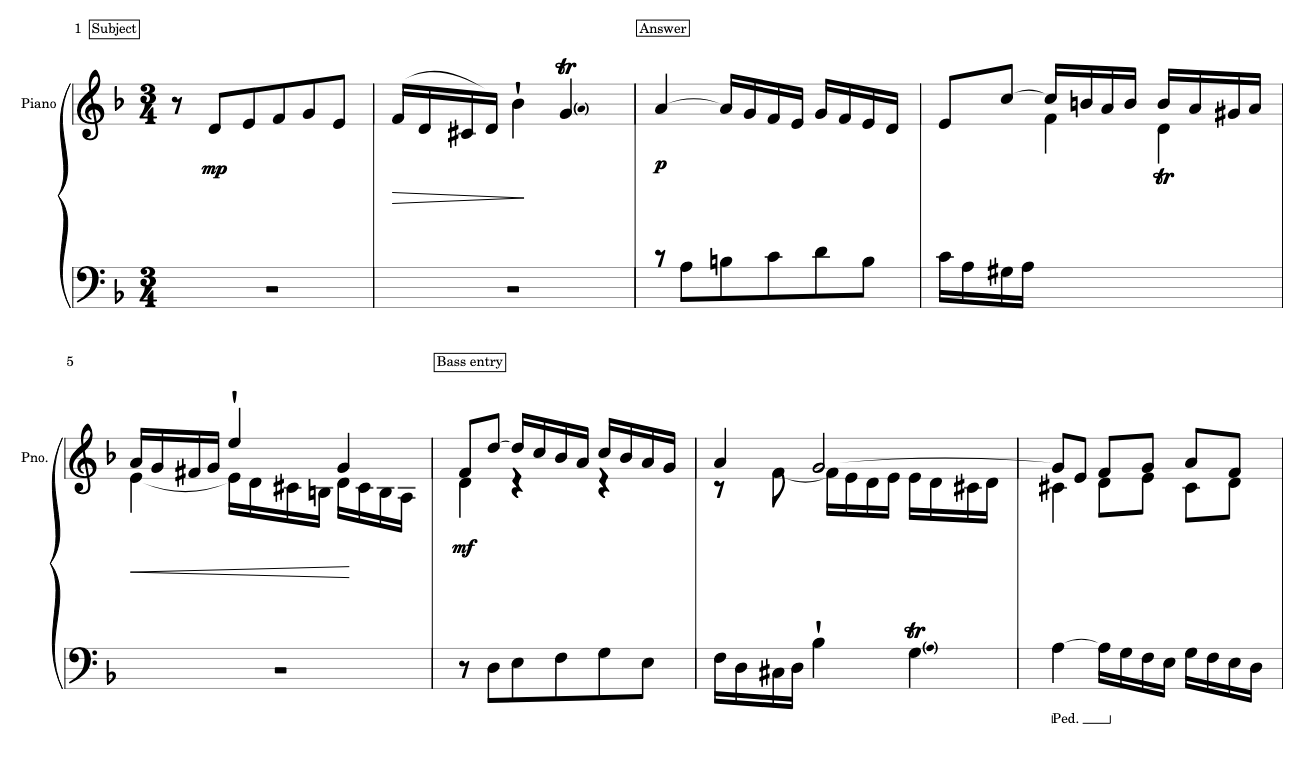
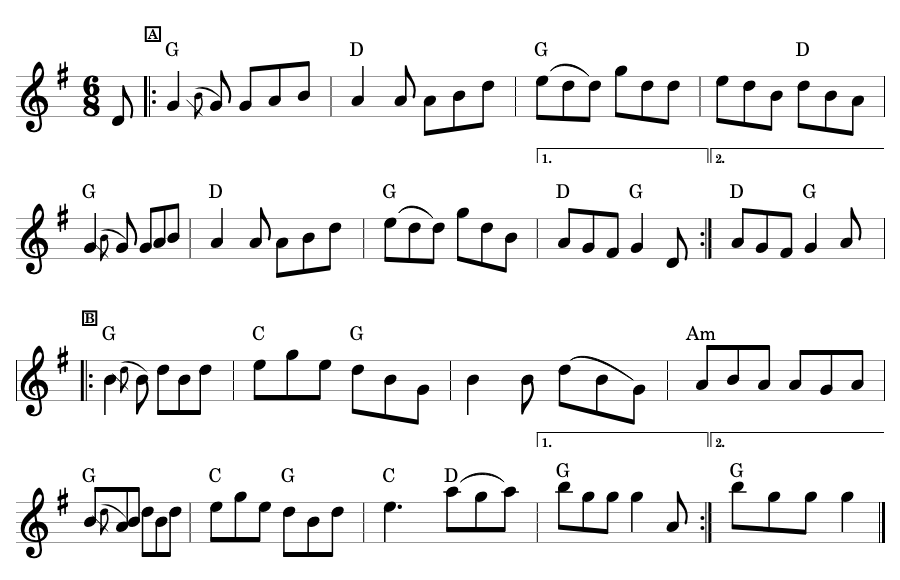
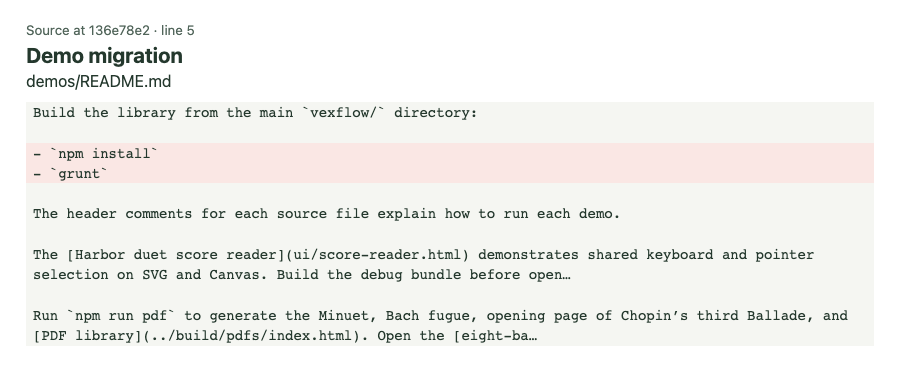
Eight additional musical examples exercise complete passages, including a jig, a chorale melody and original studies. Their module index links the rendered music to editable source.
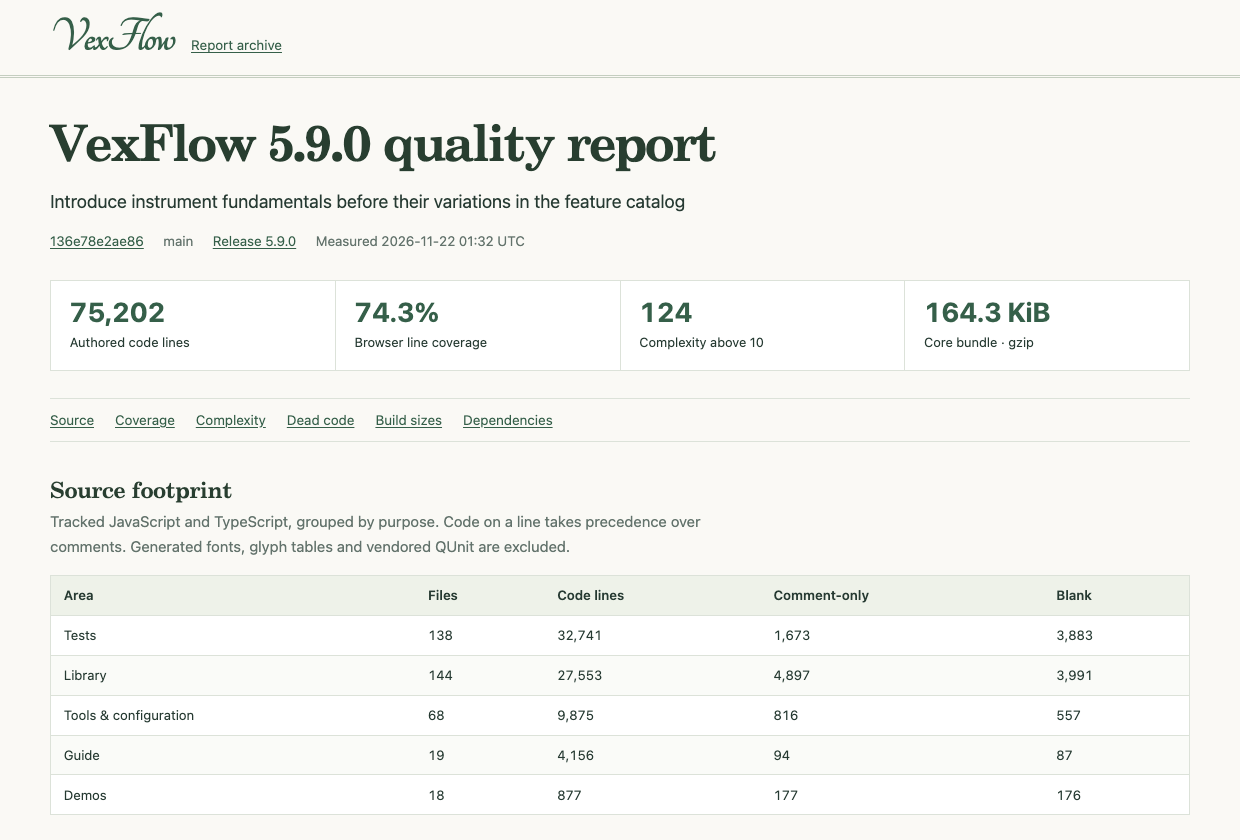
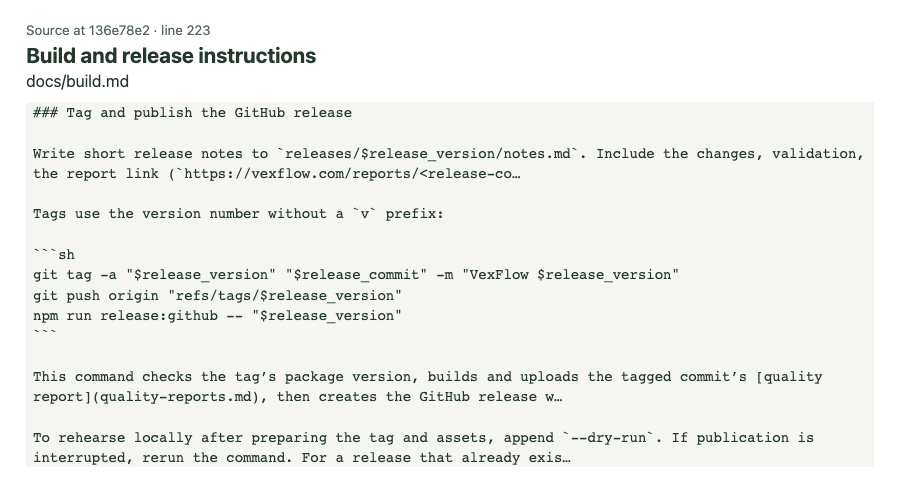
Each commit report measures source, coverage, complexity, unused declarations, compressed bundles and locked dependencies. Release publishing links measurements to a tag and records them in a versioned archive.
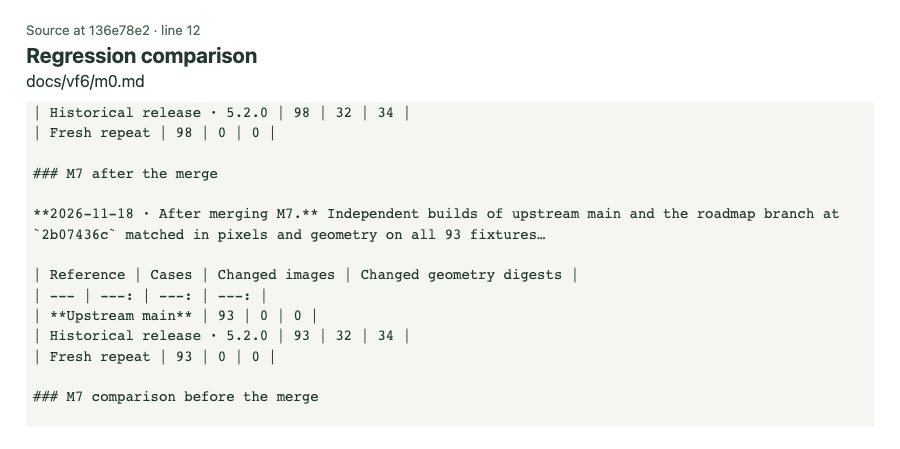
The 98-case roadmap gallery compares candidate and reviewed main pixels and geometry in the same browser, retains the 5.2.0 historical pass and checks a fresh repeat. Reviewed exceptions and source IDs are recorded per case.
A pinned Playwright matrix exercises Chromium, Firefox and WebKit, mobile scaling, font readiness, keyboard selection and export. The MusicXML adapter pilot compares parse results, note identity, timing and layout through OSMD.
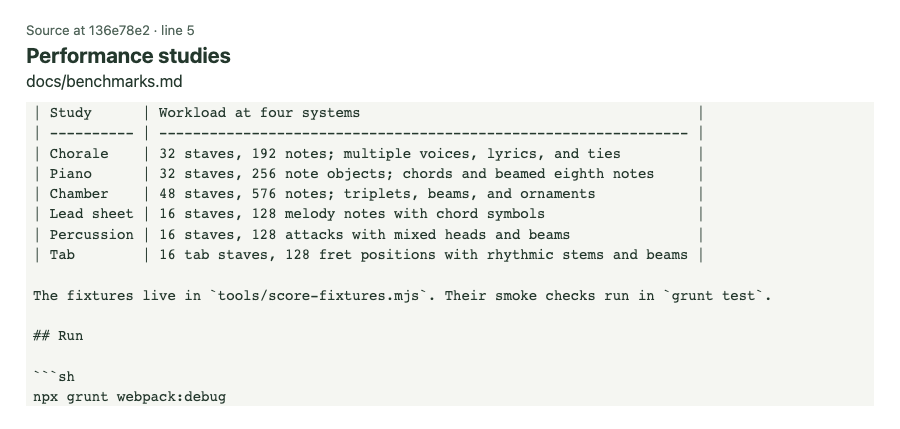
Six original score workloads separate construction, layout and drawing times. Later experiments measure retained and local updates against a clean layout and record host and browser metadata.
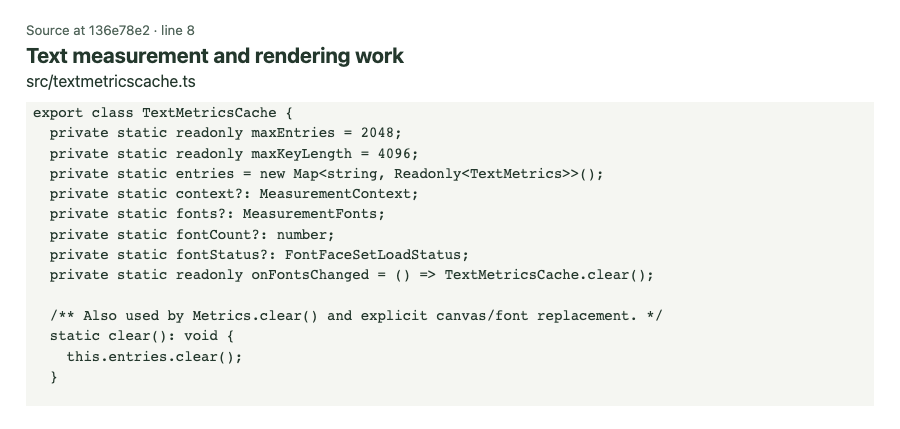
A shared measurement cache reduces repeated work for identical text and font settings. Engraving probes distinguish measured geometry from rasterized ink.
StaveNote avoids duplicating noteheads during construction. Rebuilding a chord removes obsolete child heads, and changing the stem direction reuses the note’s flag.
Failed font requests now identify the requested face. Tests cover delayed loads, failed glyph lookup, fallback behavior and agreement between live text and exported outlines.
Browser, worker, ESM and CommonJS examples were updated for the 5.x package entry points and font loading. The local sandbox can test a debug build inside an iframe.
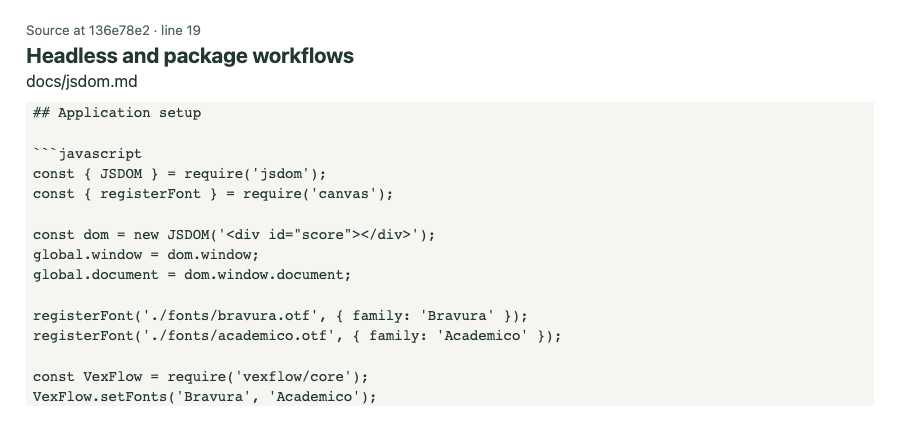
The jsdom path supports headless notation rendering. An external package consumer checks declarations and each published module entry point, complementing in-repository tests.
Build, testing, package verification and deployment procedures are consolidated. The guide and gallery use versioned local assets; uploads validate files and publish assets before the HTML.
The README adds UTF-8 setup and links to worked examples. API contracts, score-layout policies, portable export, security guidance and the roadmap have dedicated reference documents.
The requirements connect each design decision to a score or test, record screenshot and assistive-technology approval, and identify future contemporary notation and ensemble work.
Open an exhibit to see it at full size. Use Previous and Next or the arrow keys to browse your results. Issue comparisons identify the original and corrected scores.
API inventory
Public TypeScript declarations compared by exported name and member. Expand a row for the exact signatures. An added overload or a spelling change can appear here alongside a behavioral change.
Documentation
Open a guide from the revision that contains it. The inventory includes added, modified, moved and removed Markdown files between the two endpoints.
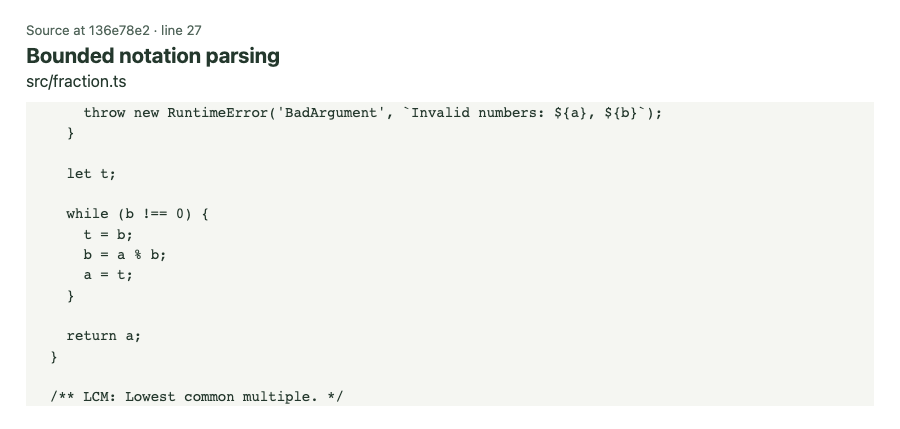
Every commit reachable from the endpoint after the 5.0.0 tag, including merges, release preparation, dependency updates and follow-up corrections. Expand a commit to inspect a source excerpt, read its description, or open the full diff.
Method and limits
The release images come from the browser bundle stored in the 5.0.0 Git tag. The current bundle was built from 136e78e2ae86. Both ran in Chromium 145.0.7632.6 on a white background at device scale 1. The native suites produced 463 and 537 score captures respectively. The current examples include 98 guide examples and supplementary studies.
Native comparisons match module, test name and font at both revisions. Test source can also evolve. Shared roadmap studies use the same authored score and the release’s native soft-voice equivalent where needed. When the 5.0.0 input is unavailable, a changed intermediate roadmap control is explicitly labeled 5.2.0. A current-only image means the old test or drawing was unavailable. Some studies exercise familiar notation through a new API. Issue screenshots link to the original review comment; paired images retain their before and after captions. Source excerpts document changes without a visible score. Each commit also has a first-parent diff excerpt or file inventory and a link to its full Git record. Reference controls that render identically are identified in the index.
The declaration inventory includes exported types and public members, excludes private and protected members, and compares emitted TypeScript. Compiler changes can affect a printed declaration. The complete Git comparison also covers internal implementations, configuration, generated files and assets. The proposed VF6 requirements and future specialist work are documented in their own section.
 Before and after ↗
 Before and after ↗
 Before and after ↗
 Before and after ↗
 Before and after ↗
 Before and after ↗
 Before and after ↗
 Before and after ↗
 Before and after ↗
 Before and after ↗
 Before and after ↗
 Before and after ↗
 Before and after ↗
 Before and after ↗
 Before and after ↗
 Before and after ↗
 Before and after ↗
 Before and after ↗
 Before and after ↗
 Before and after ↗
 Before and after ↗